studio / on-this-day / Dec 27
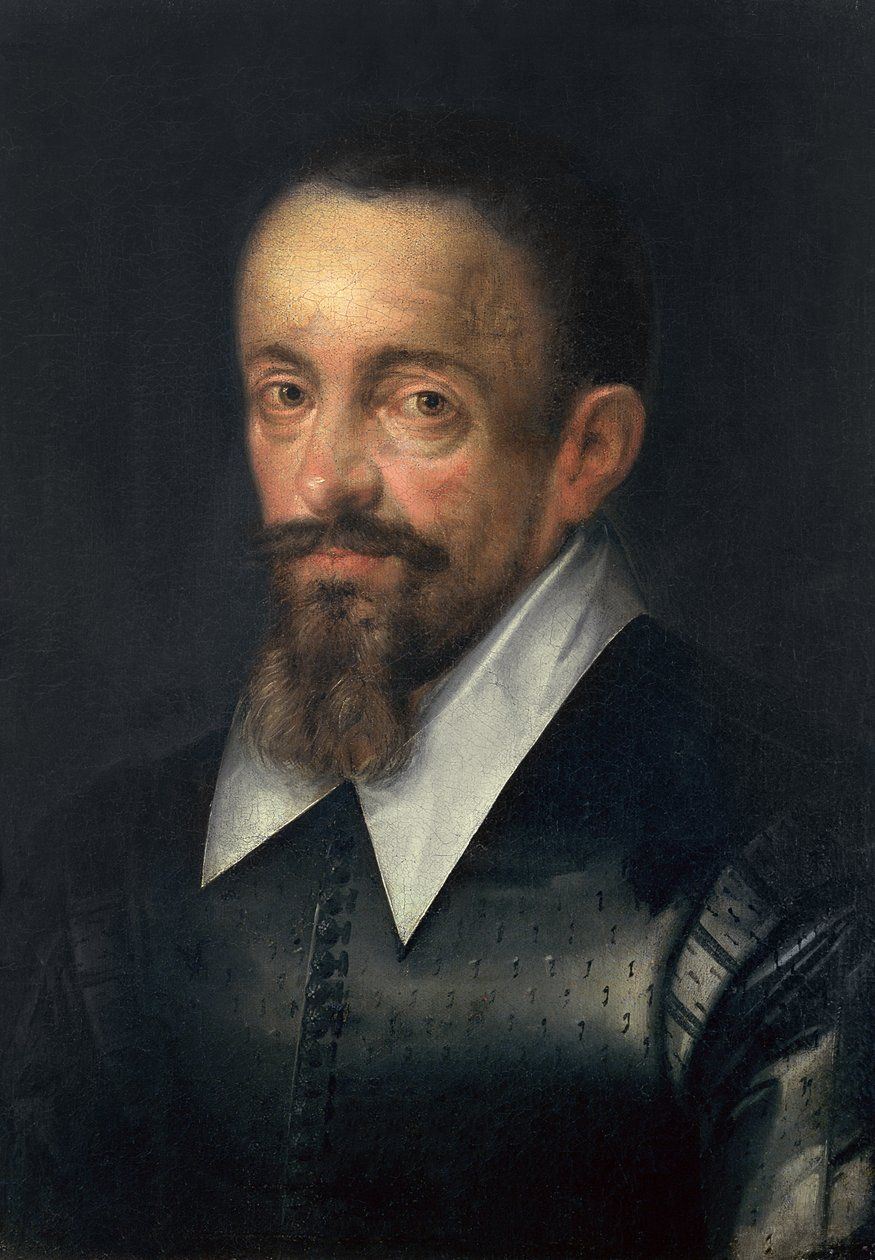
Johannes Kepler, 1610. Attributed to Hans von Aachen, Public domain, via Wikimedia Commons
The Operating System of the Solar System
On this day in 1571 — Johannes Kepler was born, whose laws of planetary motion still run quietly beneath every orbit we calculate.
3 min read
Johannes Kepler was born on December 27, 1571, in Weil der Stadt, in what is now Germany. His father was a mercenary who disappeared when Kepler was five. His mother was later tried for witchcraft. Kepler survived smallpox as a child, which left his hands crippled and his vision permanently damaged. None of this suggested he would become one of the greatest astronomers in history. But Kepler had a mind for patterns, and the universe is full of them.
Kepler studied theology and mathematics, intending to become a Lutheran minister. Instead, he became a mathematics teacher in Graz, Austria. It was there, in 1595, that he had a vision of geometric harmony in the heavens. He believed the orbits of the planets were arranged according to the five Platonic solids, nested spheres corresponding to divine geometry. The idea was beautiful. It was also wrong. But it set him on the path to discovering the real laws governing planetary motion.
In 1600, Kepler joined Tycho Brahe, the greatest observational astronomer of the age, in Prague. Tycho had spent decades recording the positions of planets with unprecedented precision, but he lacked the mathematical skill to interpret his data. Kepler had the mathematics but needed the observations. Tycho assigned him the problem of Mars, whose orbit resisted all attempts at prediction. Tycho died a year later. Kepler inherited his data and spent the next decade wrestling with it.
The breakthrough came when Kepler abandoned the assumption that planetary orbits must be circular. Circles were perfect, divine, the shape the heavens were supposed to follow. But the data did not fit circles. Kepler tried ovals, then finally ellipses. Mars orbited the sun in an ellipse, with the sun at one focus. This was Kepler's first law: planets move in elliptical orbits. It was a radical departure from centuries of astronomical tradition, but it worked.
Kepler's second law described how planets move along their orbits: a line connecting a planet to the sun sweeps out equal areas in equal times. This meant planets move faster when closer to the sun and slower when farther away. The third law, published years later, showed a precise mathematical relationship between a planet's orbital period and its distance from the sun. These three laws allowed astronomers to predict planetary positions with extraordinary accuracy. They are still used today to navigate spacecraft.
Kepler did not stop at planetary motion. He made fundamental contributions to optics, explaining how lenses work and laying the groundwork for the telescope. He published the first science fiction novel, "Somnium," imagining a journey to the moon and speculating about what lunar inhabitants might observe. He developed a method for calculating the volumes of wine barrels, inventing early integral calculus in the process. He was endlessly curious, working on problems that ranged from snowflakes to the motion of comets.
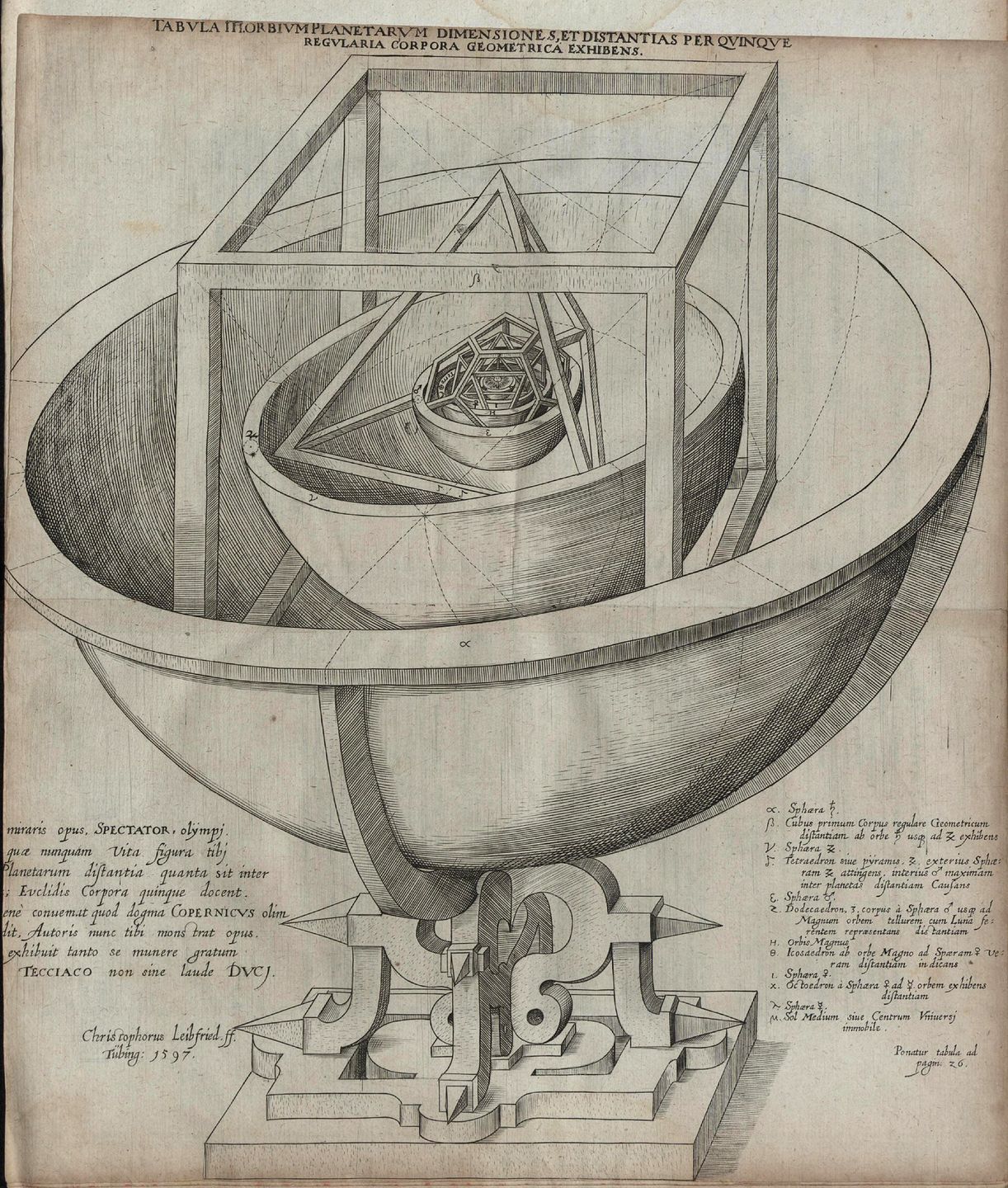
Kepler's nested Platonic solids model of planetary orbits, from Mysterium Cosmographicum (1596) — the beautiful idea that turned out to be wrong. Johannes Kepler, Public domain, via Wikimedia Commons
Kepler's life was difficult. His first wife and two of his children died. He spent years defending his mother in her witchcraft trial, which she eventually survived. His work was poorly paid and often interrupted by war and religious persecution. He moved frequently, struggling to find stable employment. He published his findings at his own expense, often going into debt to do so. Yet he kept working, driven by the conviction that the universe operated according to mathematical laws, and that those laws could be discovered. As Copernicus had shown, challenging ancient assumptions required both courage and evidence.
Kepler died in 1630. His grave was destroyed during the Thirty Years' War. But his laws endured. Isaac Newton used them to develop his theory of gravitation. Einstein's relativity refined them but did not replace them. Every satellite, every space probe, every mission to another planet relies on Kepler's mathematics. His laws are the operating system of the solar system, the code that describes how everything moves. He found the pattern in the chaos, the simplicity hidden in complexity. The orbits are not divine geometry. They are ellipses. But in their mathematical precision, they have a beauty Kepler would have recognized.
studio / on-this-day / Dec 27