studio / on-this-day / Dec 26
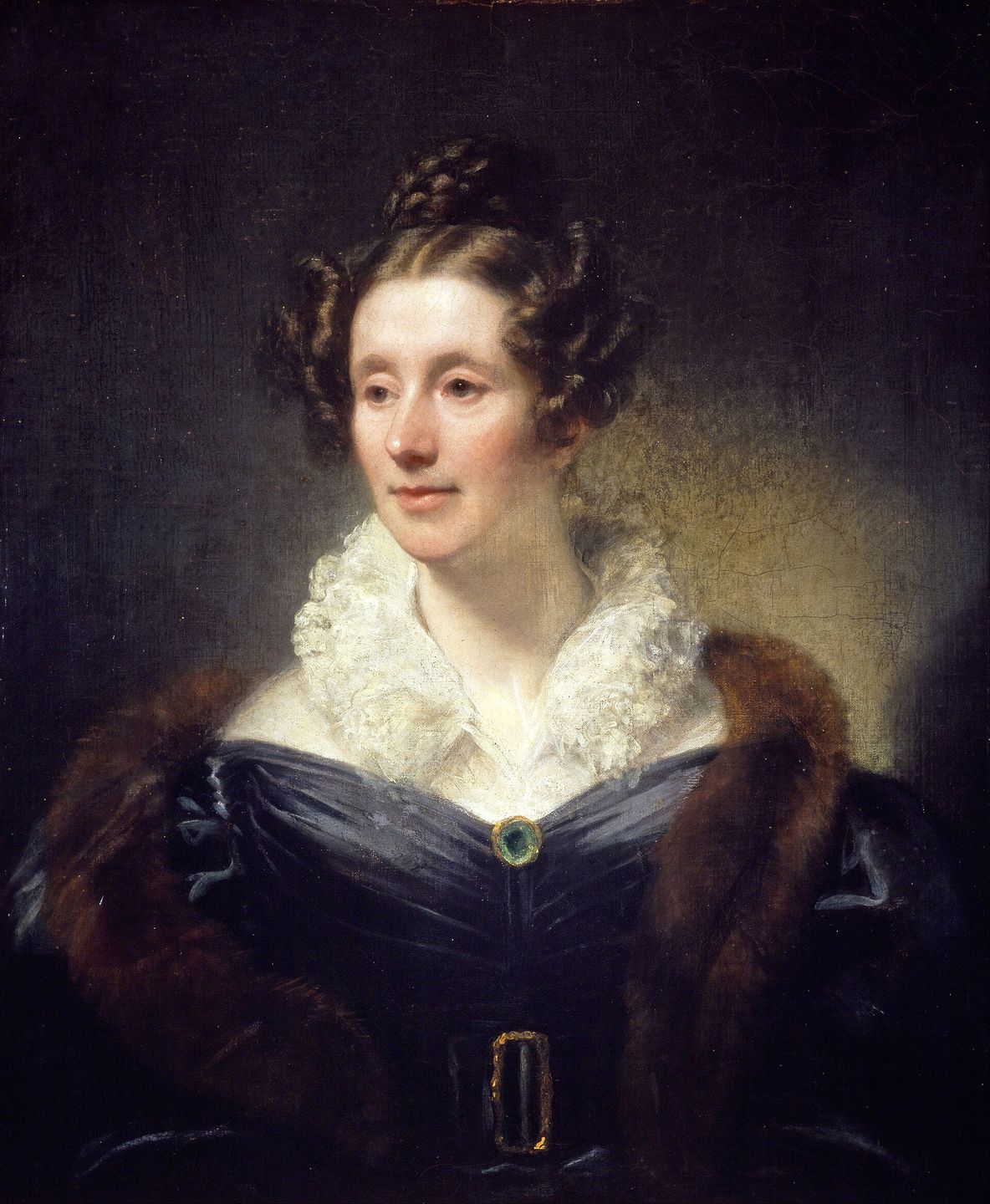
Mary Somerville, the self-taught mathematician and science writer, painted by Thomas Phillips. Public domain, via Wikimedia Commons
The Woman They Coined the Word For
On this day in 1780 — Mary Somerville was born. She taught herself mathematics in secret, explained the universe so clearly that the word "scientist" was coined to describe her, and introduced Ada Lovelace to Charles Babbage.
4 min read
Mary Somerville was born on December 26, 1780, in Scotland, into a world that had no intention of teaching her anything difficult. Girls of her class were schooled in needlework and manners; a single year of formal education was considered plenty. She met algebra by accident, as strange symbols in a puzzle in a women's magazine, was warned the subject was unsuitable and possibly harmful to a young woman's mind, and taught it to herself at night, in secret, after the household had gone to sleep.
She never stopped. Over a long life she mastered the mathematics and physics of her era at the highest level, not as a hobby but as a genuine contributor and, above all, as an explainer. Her gift was for synthesis: taking the scattered, technical work of the Continent's greatest mathematicians and turning it into clear, connected, readable accounts that other scientists actually used to understand their own field.
Her 1834 book On the Connexion of the Physical Sciences did something new. It argued, and showed, that the sciences were not separate cabinets but one connected structure, that astronomy and heat and light and magnetism were facets of a single physical order. Reviewing it, the scholar William Whewell wanted a word for a person who worked across all of these, someone the old phrase "man of science" did not fit, in part because the person he was describing was a woman. He coined the word scientist. The term we now use for everyone in the field was minted, in effect, to describe her.

The title page of Somerville's 1831 "Mechanism of the Heavens," her acclaimed account of celestial mechanics. Public domain, via Wikimedia Commons
She was rigorous as well as clear. Her account of the planets' motions discussed how an unexplained wobble in one orbit might betray the pull of an undiscovered world, a line of reasoning that helped point others toward the search that found Neptune. Clarity, in her hands, was not a softening of the science. It was a sharpening of it.
And she reached forward. It was Mary Somerville who saw the brilliance in a young Ada Lovelace, tutored her, and introduced her to Charles Babbage and his calculating engines, the meeting that set Lovelace on the path to writing what is often called the first computer program. The woman denied an education became the hinge connecting the mathematics of her century to the first glimmer of the computing age.
There is a particular kind of contribution that history tends to undervalue: not the lone discovery, but the work of making a whole field legible, teachable, and connected, so that others can build on it. Somerville's synthesis was that kind of work, and it was foundational. She did not just add facts to a pile. She organized understanding, which is harder and lasts longer.
She published her last major work in her late eighties and kept studying mathematics until she died at ninety-one. An Oxford college is named for her, and more than a century after her death her portrait was chosen for a national banknote. Her deepest monument, though, is an ordinary word: the term for her whole profession was written to fit her. On December 26, 1780, a girl was born who would be told that serious thinking was not for her, and who answered by helping to define what serious thinking, at the highest level, is even called.
studio / on-this-day / Dec 26