studio / on-this-day / Jan 4
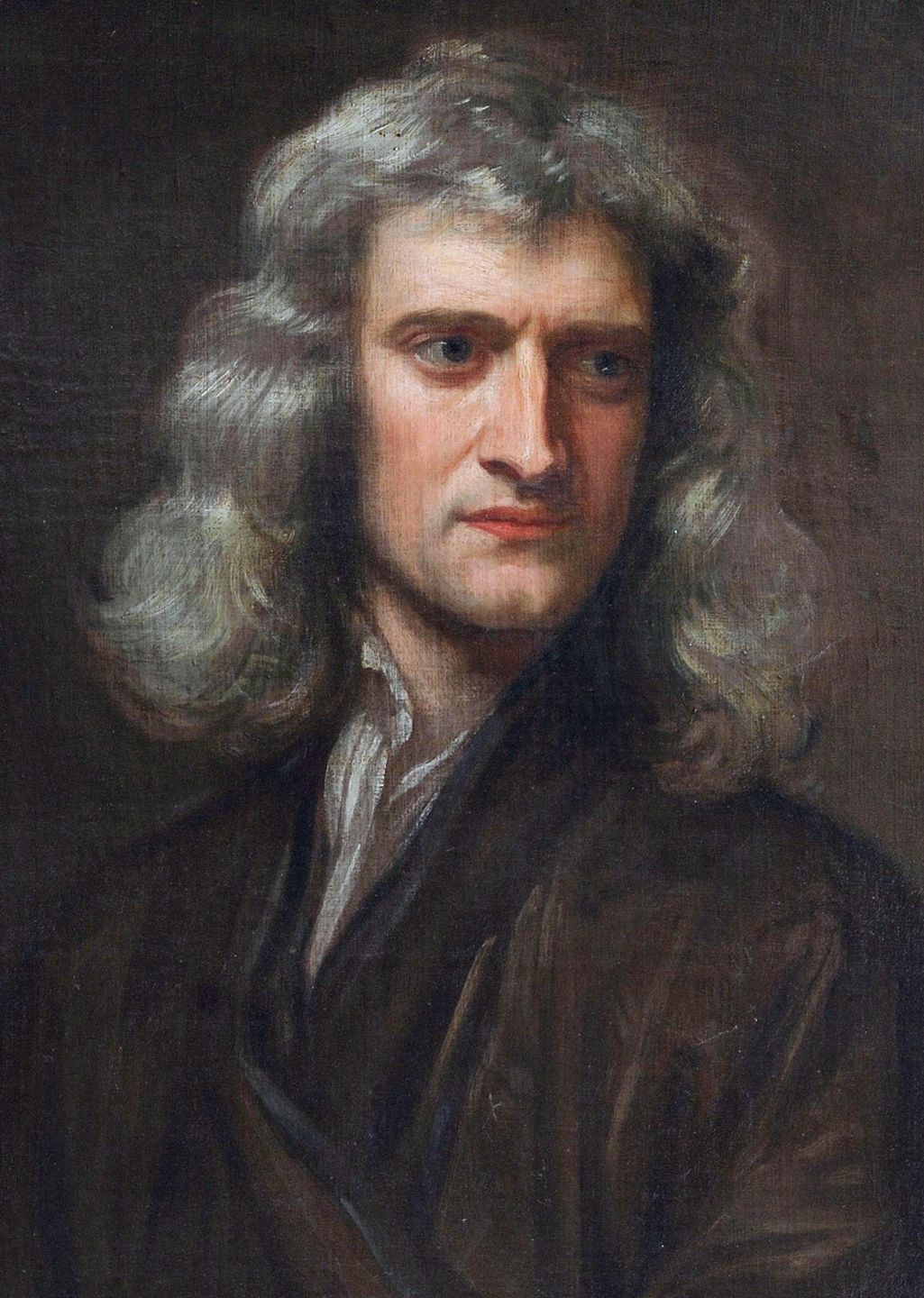
Portrait of sir isaac Newton painted by godfrey kneller in 1689, age 46. James Thronill after Sir Godfrey Kneller, Public domain, via Wikimedia Commons
The Man Who Saw Through Everything
On this day in 1643 — Isaac Newton was born, and would spend a plague year alone assembling much of modern physics and mathematics.
3 min read
Isaac Newton was born on Christmas Day, 1642, according to the Julian calendar England still used. By the Gregorian calendar, which most of Europe had adopted, the date was January 4, 1643. He was born prematurely in a stone farmhouse in Woolsthorpe, Lincolnshire. His father had died three months earlier. He was so small they didn't expect him to survive the day.
He lived to be 84 and spent most of that time thinking harder than almost anyone before or since. He invented calculus to solve problems in physics that couldn't be solved any other way. He worked out the laws of motion and universal gravitation. He built the first practical reflecting telescope. He demonstrated that white light is made of all the colors of the spectrum. And he did most of this work before he turned 30.
The mythology says an apple fell and he understood gravity. The truth is more interesting. In 1665, plague closed Cambridge University, and Newton went home to Woolsthorpe for two years. He was 23. With no students to teach and no lectures to attend, he had nothing but time to think. He later called these his anni mirabiles, his miraculous years. He developed the foundations of calculus, the theory of color, and the beginnings of gravitational theory, all in isolation, with no collaborators, no lab, no equipment except paper and ink.
What Newton saw was pattern. Things fall at the same rate regardless of their weight. The moon orbits the Earth. Planets orbit the Sun. These weren't separate phenomena. They were examples of the same force acting at different scales. The apple and the moon were both falling. The only difference was that the moon was moving fast enough sideways that it kept missing the Earth. Gravity wasn't just about objects on the ground. It was universal.
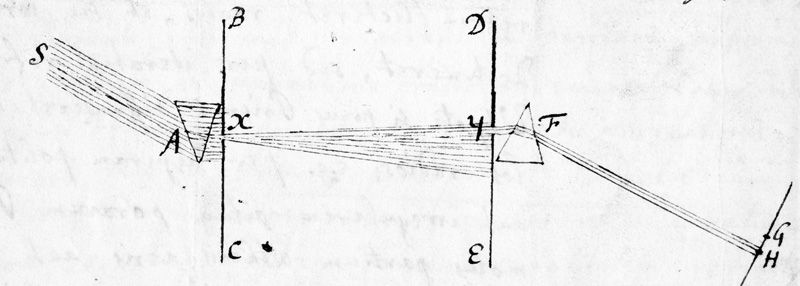
Newton's dual prism experiment demonstrating that white light is composed of all colors of the spectrum. Isaac Newton, Public domain, via Wikimedia Commons
He published his findings in 1687 in a book called Philosophiae Naturalis Principia Mathematica, usually just called the Principia. It was written in Latin and dense with mathematics. It described a clockwork universe governed by laws you could write down and test. It was, in a very real sense, the user manual for physical reality.
Newton was difficult. He fought bitter priority disputes with other scientists, most famously with Leibniz over who invented calculus first. He was secretive, paranoid, and obsessive. He spent years on alchemy and biblical prophecy, trying to decode hidden meanings in scripture. He never married, had few friends, and was known for holding grudges. When Robert Hooke criticized his work on optics, Newton refused to publish anything else on the subject until after Hooke died.
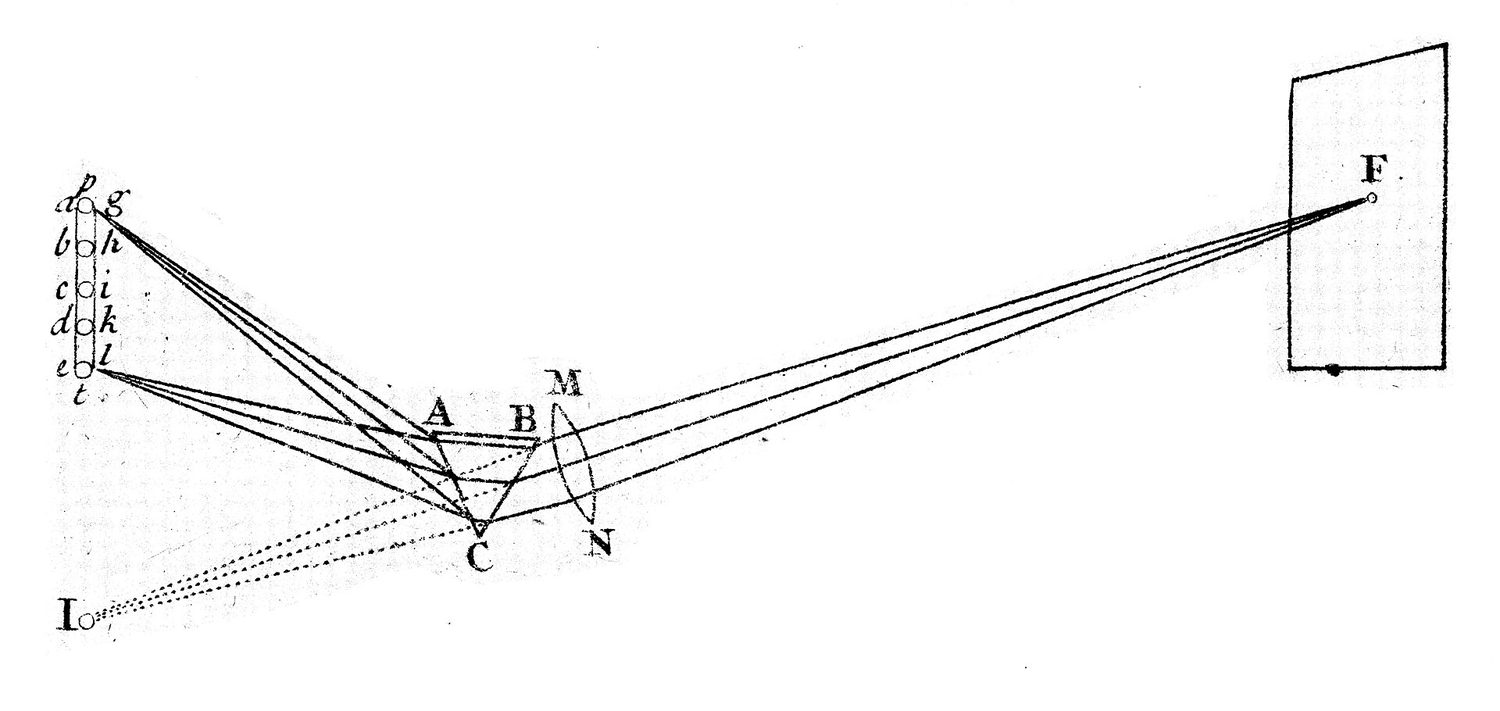
A prism splitting white light, the effect Newton explained in his optics. Unknown, CC BY 4.0, via Wikimedia Commons
But he was also strangely humble about what he had accomplished. Near the end of his life, he wrote that he felt like a boy playing on the seashore, finding a smoother pebble or prettier shell than usual, while the great ocean of truth lay undiscovered before him. This from the man who had rewritten the rules of the universe.
Today, we live in a world Newton made comprehensible. Every spacecraft trajectory, every bridge calculation, every prediction about how objects move through space and time relies on the laws he discovered. Just as TCP/IP became invisible infrastructure for the Internet, Newton's laws became invisible infrastructure for engineering. You don't think about them. You just use them. They work because he was right, and he was right because he looked at the universe and saw not mystery, but structure.
studio / on-this-day / Jan 4