studio / on-this-day / Sep 30
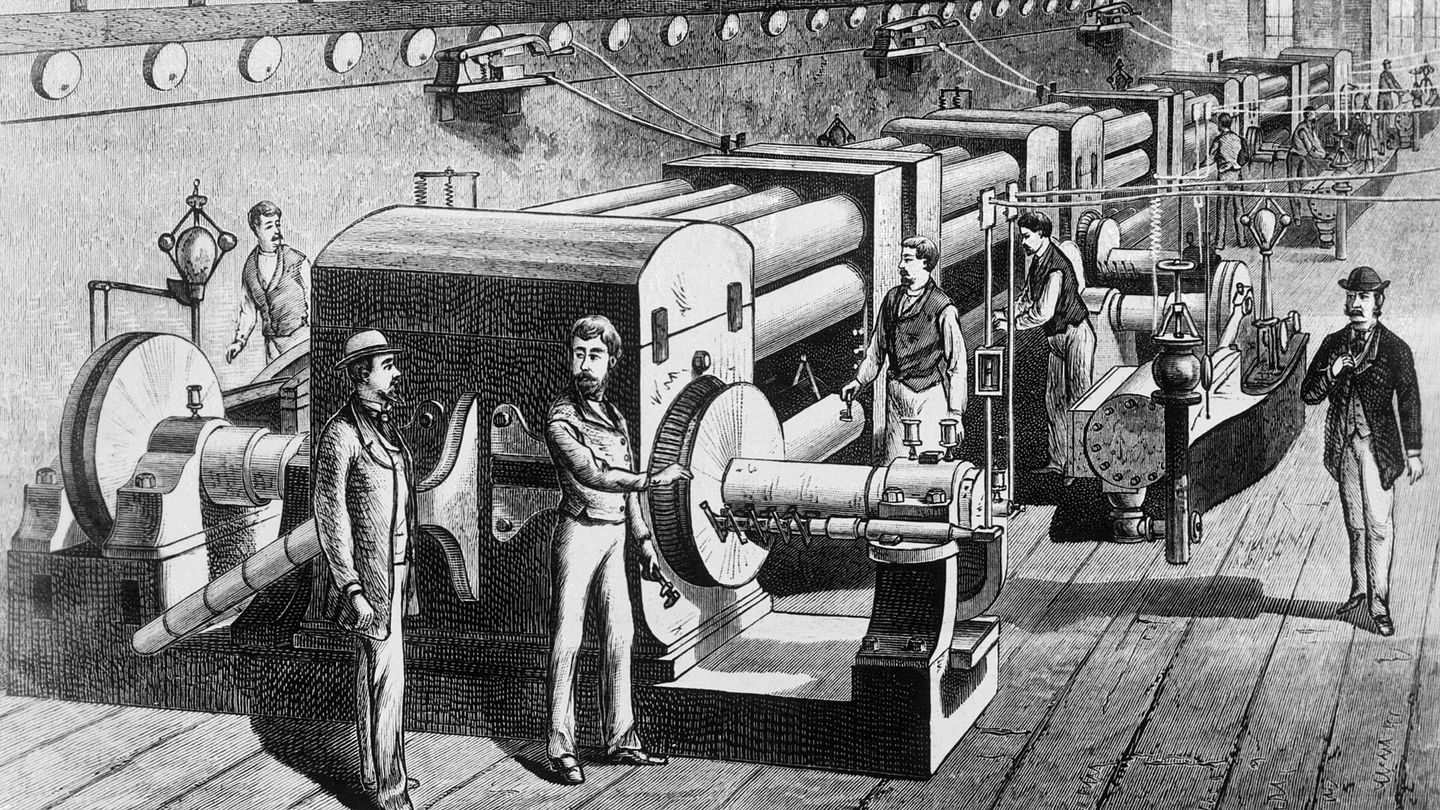
Replica of the Vulcan Street Plant, the first hydroelectric central station, Appleton, Wisconsin. Public domain, via Wikimedia Commons
The River That Learned to Power a City
On this day in 1882 — the first hydroelectric plant opened in Appleton, Wisconsin, and a flowing river was turned directly into electricity.
3 min read
On September 30, 1882, the Vulcan Street Plant on the Fox River in Appleton, Wisconsin, began generating electricity. It was the first hydroelectric central station in the United States and one of the first in the world, predating the famous Niagara Falls installation by more than a decade. The plant powered lights and machinery for the Appleton Paper and Pulp Company and a handful of private customers, delivering direct current to about two dozen buildings. The Fox River had been milling paper for years. Now it was doing something entirely new: turning falling water into electrons and sending them down wires into rooms and workshops that had never before been lit by anything but fire or gas.
The plant was built on principles developed by Thomas Edison, whose Pearl Street steam-powered generating station in lower Manhattan had opened just twenty-six days earlier. A local entrepreneur, H.J. Rogers, persuaded Edison's organization to design a water-powered version using a direct current generator. The physics were the same as Pearl Street: electricity generated centrally, distributed through wires, consumed at the point of use. The energy source was different. Instead of burning coal to make steam to drive a turbine, the Fox River's current drove a waterwheel that turned the generator directly. The water did the work that fuel would otherwise do, and it kept doing it as long as the river flowed.
The implications of this substitution are still unfolding. Burning fossil fuels for electricity is a one-way transaction: you extract a resource, combust it, and the stored solar energy of millions of years is released as heat and, with appropriate machinery, converted to electricity. The resource is consumed. Water flowing downhill is a renewable transaction: gravity does the work, the water continues downstream, the river replenishes from rain and snowmelt. The same drop of water, in principle, passes through a hydroelectric turbine and then eventually evaporates, falls as rain, and passes through again. The energy comes not from a stored deposit but from the ongoing solar-driven water cycle.
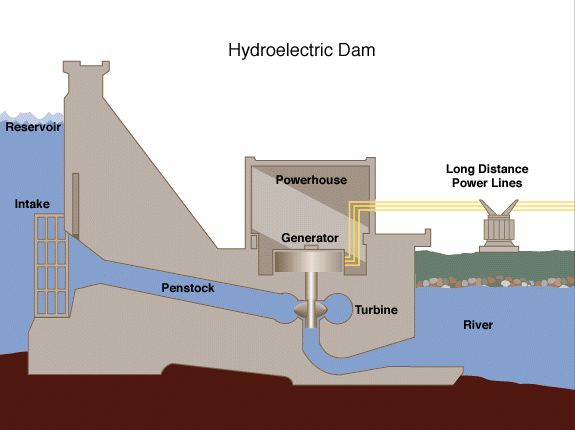
Cross-section diagram showing how a hydroelectric Dam converts water flow to electricity. Public domain, via Wikimedia Commons
This wasn't obvious to everyone in 1882. The competing visions for how electricity would be generated and distributed were still unsettled. Edison's direct current system required generating stations every mile or so because DC loses voltage over distance. George Westinghouse and Nikola Tesla were developing alternating current, which could be transformed to high voltages for long-distance transmission and then stepped back down for use, allowing a single generating station to serve a much larger area. The Vulcan Street Plant used DC, which limited its reach. The AC system that eventually prevailed was better suited to exploiting large-scale hydroelectric resources far from population centers.
The settlement of that debate, the "War of Currents" that ran through the late 1880s, is one of the defining design competitions in the history of technology. Niagara Falls became the proving ground: if AC could transmit power from Niagara to Buffalo, twenty miles away, the large-scale hydroelectric future was viable. It could, and it was. By the early twentieth century, rivers across the country were being dammed and harnessed. The Columbia, the Colorado, the Tennessee: each became infrastructure. The Hoover Dam, completed in 1936, was the largest structure ever built by human hands at the time of its completion and generated enough power to supply Los Angeles.
Hydropower now accounts for roughly sixteen percent of global electricity generation, a share that has remained roughly stable for decades. It is the largest single source of renewable electricity on earth. The physics haven't changed since the Fox River turned that first generator in 1882: water falls, a turbine spins, a generator produces current, electrons flow through wires. The scale has grown by orders of magnitude. The machines are more efficient. The grids are more complex. But the essential transaction, gravity converted to light, is the same one H.J. Rogers and the Appleton Paper and Pulp Company made on a September afternoon in Wisconsin, one month after Edison lit up lower Manhattan with steam.
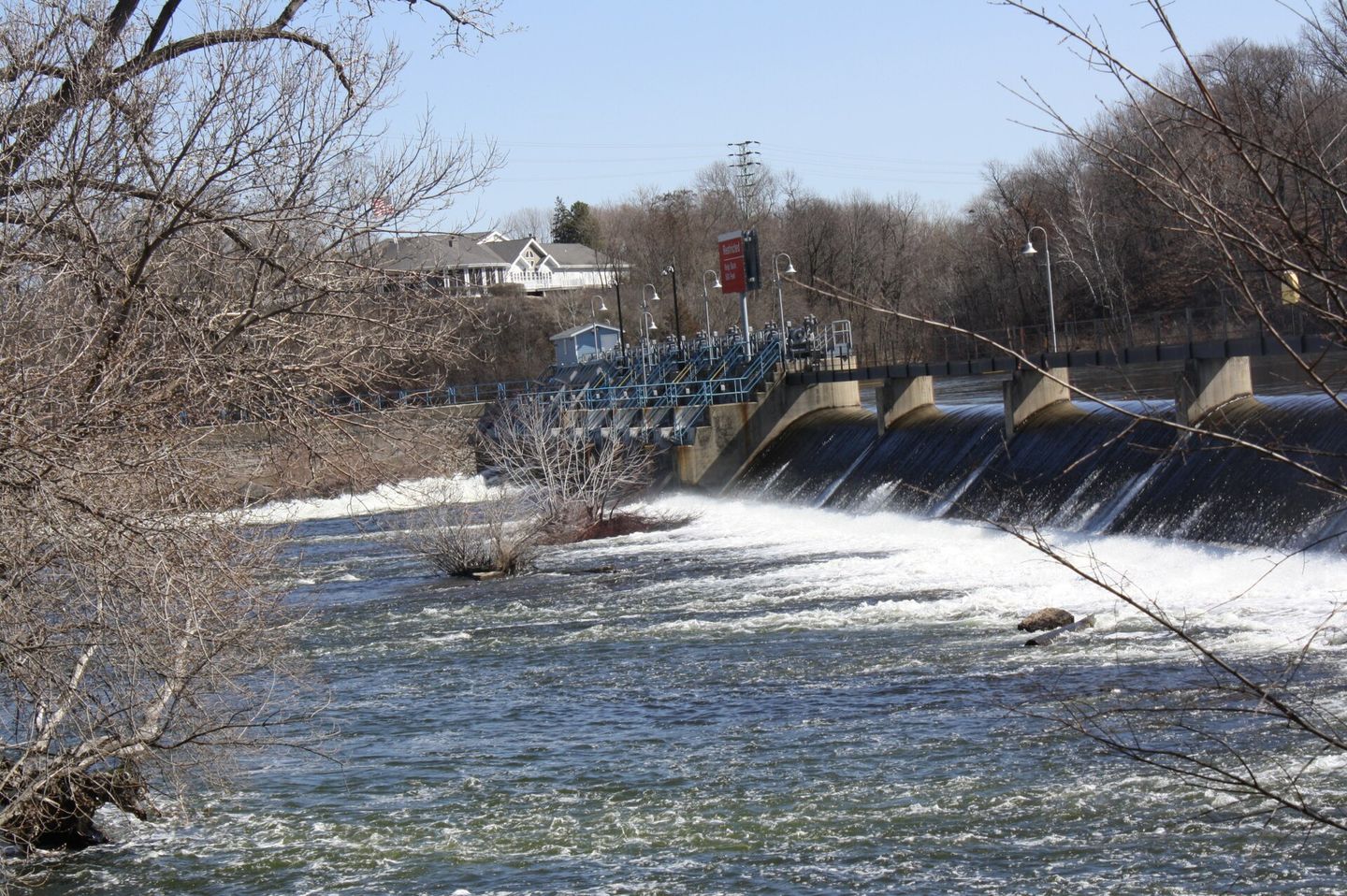
A lock and Dam on the Fox River at Appleton, Wisconsin, the River that drove the first hydroelectric station. Royalbroil, CC BY-SA 3.0, via Wikimedia Commons
What the Vulcan Street Plant really demonstrated was that energy infrastructure could be local and renewable at the same time. The Fox River wasn't imported. It didn't need to be extracted or refined or shipped. It was already there, already moving. The design problem was simply to build the right machine at the right point in the river and let the river do what rivers do. That insight, that the energy system could be built around what the landscape already provides, rather than what can be dug up and burned, is the one we are slowly returning to now.
studio / on-this-day / Sep 30