studio / on-this-day / Sep 23
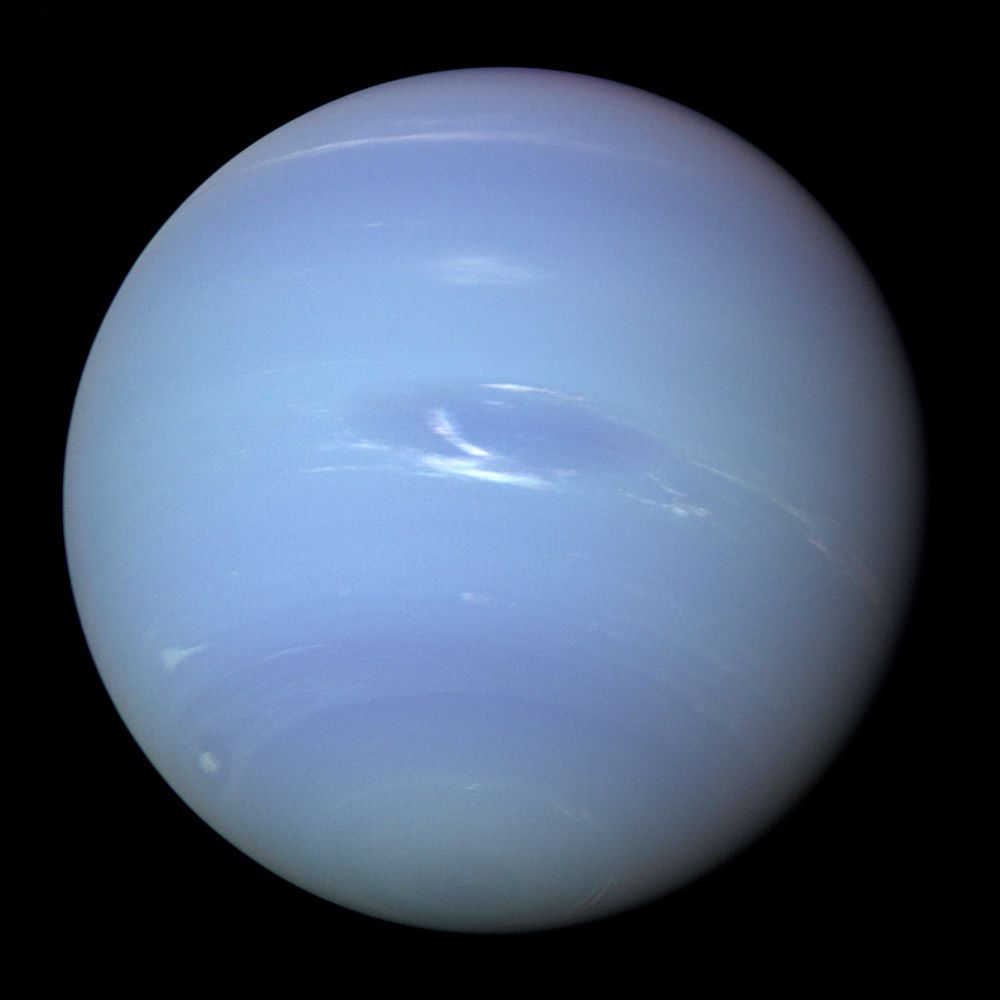
Neptune, photographed by Voyager 2. NASA / JPL / Voyager-ISS / Aster Cowart, Public domain, via Wikimedia Commons
The Planet Found With Mathematics
On this day in 1846 — Neptune was found almost exactly where the mathematics said it should be, a planet located by calculation first.
3 min read
On the evening of September 23, 1846, German astronomer Johann Gottfried Galle pointed his telescope at a specific patch of sky near the constellation Aquarius. He was looking for a planet that had never been seen but had been mathematically predicted to exist. Within an hour, he found it. Neptune was exactly where the calculations said it would be, within one degree of the predicted position. It was the first planet discovered not by observation but by inference, located by tracking the gravitational disturbances it caused in the orbit of Uranus.
The story begins decades earlier. In 1781, William Herschel discovered Uranus, the first planet found with a telescope. Astronomers calculated its orbit and began making predictions about where it would appear in the sky over the coming years. But Uranus did not behave. It drifted off course, deviating from the path Newtonian mechanics said it should follow. The discrepancies were small but persistent. Something was pulling on Uranus, causing it to speed up and slow down in ways that could not be explained by the gravitational influence of the known planets.
Two mathematicians, working independently, proposed the same solution: there must be another planet, farther out, exerting gravitational force on Uranus. Urbain Le Verrier in France and John Couch Adams in England both calculated where this hypothetical planet should be, based solely on the perturbations in Uranus' orbit. They did not observe anything. They simply solved the inverse problem: given the disturbances, where must the disturbing object be located?
Adams finished his calculations first, in 1845, but struggled to get British astronomers to take him seriously. He was young, unknown, and his predictions were not precise enough to convince anyone to spend valuable telescope time searching. Le Verrier completed his work in 1846 and sent his predictions to Galle at the Berlin Observatory, which had recently completed a detailed star chart of the region where Le Verrier predicted the planet would be. Galle received the letter on September 23, pointed his telescope at the coordinates, and found Neptune the same night. The planet looked like a faint blue star, but it moved against the background stars in a way that confirmed it was not a star at all.
The discovery triggered a nationalistic dispute over credit. The French claimed Le Verrier had found it. The British insisted Adams deserved recognition. In reality, neither man observed Neptune. Galle did that. What Le Verrier and Adams did was more remarkable: they used mathematics to predict the existence and location of an unseen object based entirely on its gravitational signature. They treated the solar system as a system with rules, and when the system behaved unexpectedly, they inferred that a missing component must exist.
This was a philosophical shift as much as a scientific one. Before Neptune, planets were things you saw. After Neptune, planets were things you could infer. The discovery proved that mathematical models of the universe were not just descriptive; they were predictive. You could use equations to find objects that had never been observed. The method became a blueprint for later discoveries. Pluto was found in 1930 using similar techniques, searching for an object that might explain remaining discrepancies in the orbits of Uranus and Neptune. Exoplanets are now discovered by detecting tiny wobbles in the motion of distant stars, using the same principle: infer the unseen from its effects on the seen.
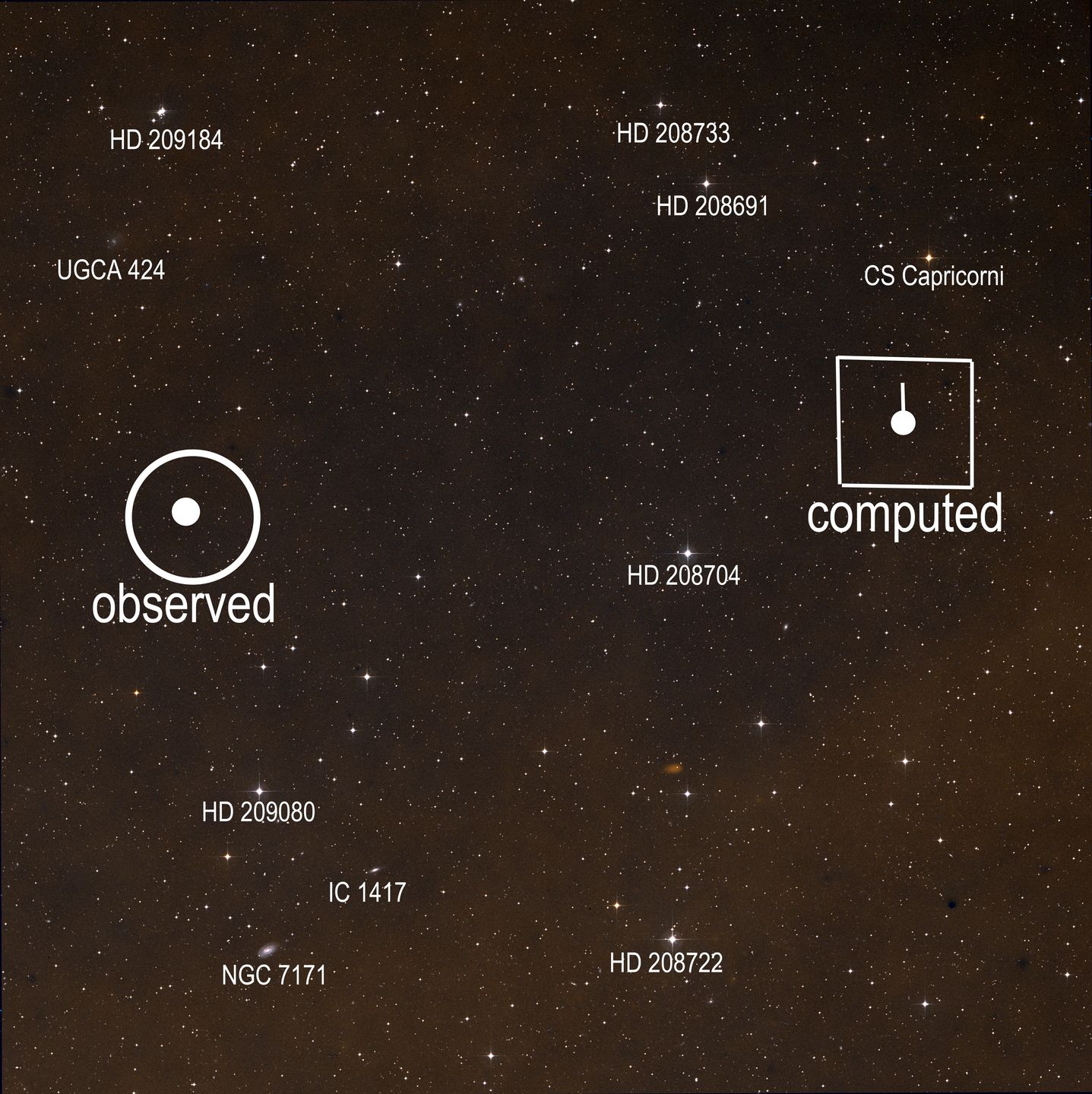
The patch of sky, near Aquarius, where Galle found Neptune on the night of September 23, 1846 — within one degree of Le Verrier's predicted position. Meli thev, CC BY-SA 4.0, via Wikimedia Commons
Neptune itself turned out to be an ice giant, roughly four times the diameter of Earth, with winds that reach over 1,200 miles per hour. It takes 165 Earth years to complete one orbit around the Sun. Voyager 2 is still the only spacecraft to have visited it, flying past in 1989 and sending back images of a blue world with dark storm systems and faint rings. But the planet itself is less important than what its discovery represented. It was proof that the universe operates according to principles we can model, and that those models can reveal things we have never seen.
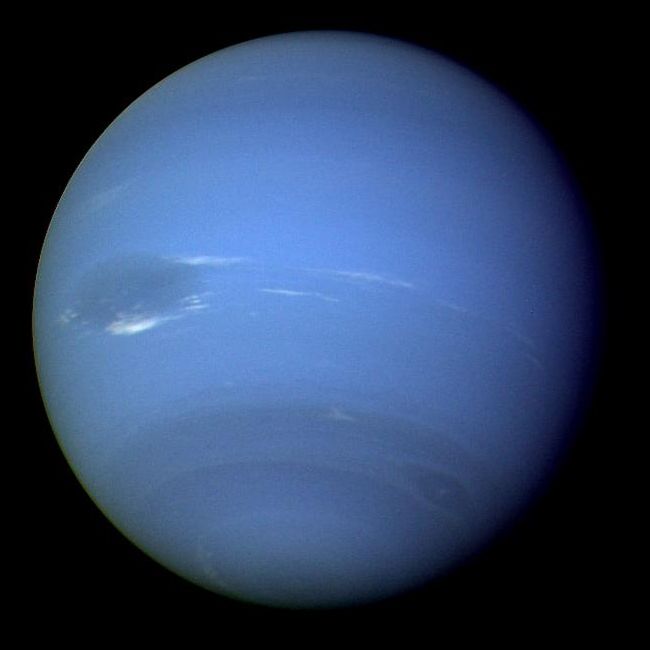
Neptune photographed by Voyager 2 in 1989 — the planet whose existence was predicted by mathematics in 1846 before it was ever seen through a telescope. NASA/JPL, Public domain, via Wikimedia Commons
The discovery of Neptune in 1846 was not an accident. It was a designed outcome. Two people, working with pencil and paper, constructed a mathematical description of the solar system precise enough to predict the location of a planet 2.8 billion miles from Earth. They did not search randomly. They calculated where to look, and when someone looked, the planet was there. That is design. Not of the planet, but of the method. The system revealed itself because the tools for understanding it had been refined to the point where prediction became possible. The universe is complex, but it is not arbitrary. Neptune proved that if you build the right model, you can find things you did not know you were looking for.
studio / on-this-day / Sep 23