studio / on-this-day / Jul 7
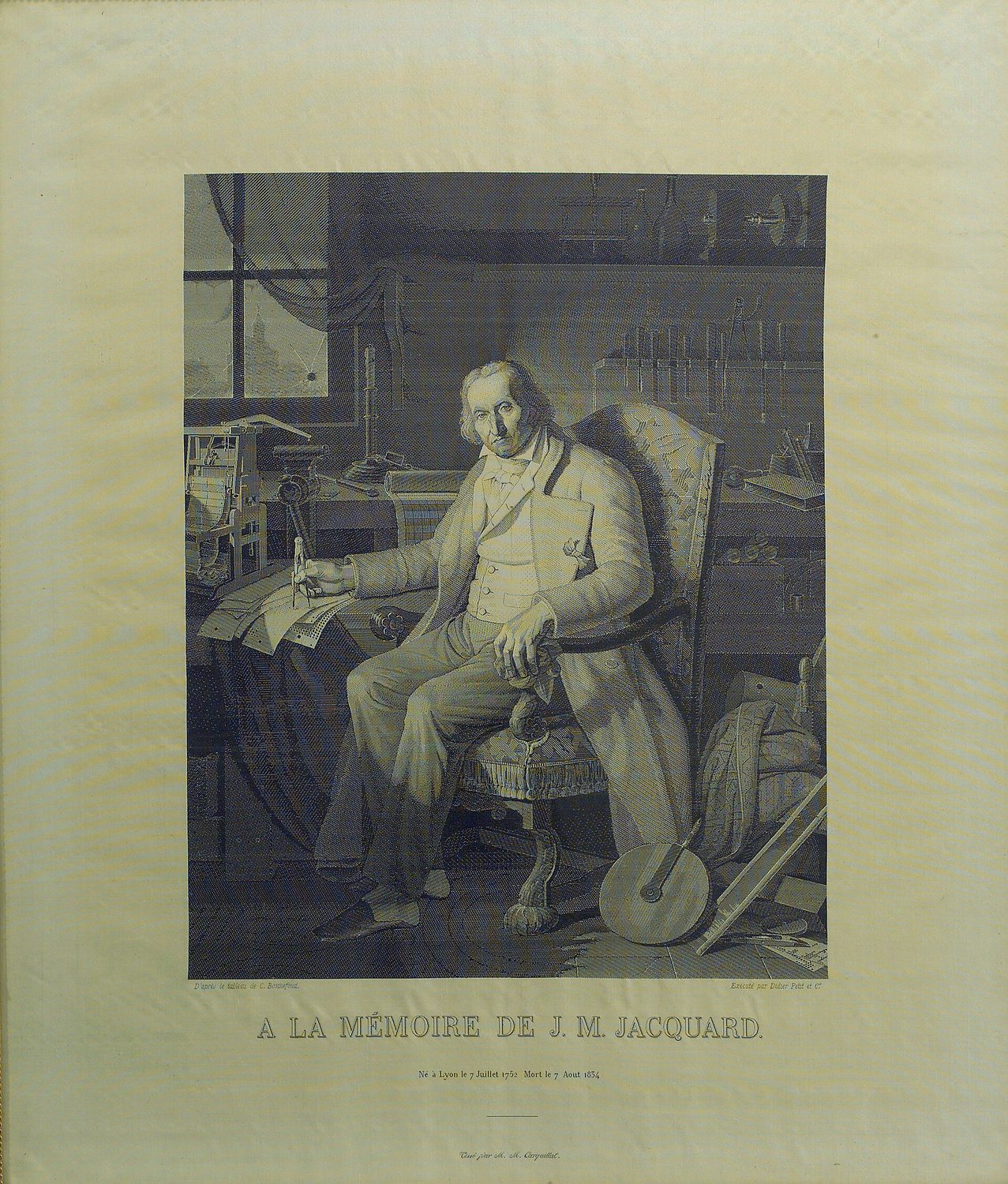
Joseph Marie Jacquard, whose punch-card loom made weaving programmable. Public domain, via Wikimedia Commons
Weaving Code
On this day in 1752 — Joseph Jacquard was born, whose punch-card loom made cloth programmable and pointed the way toward the computer.
3 min read
Joseph Marie Jacquard was born on July 7, 1752, in Lyon, France, the son of a weaver. He grew up around looms, and he understood their limitations. Complex patterns required a team of workers, one operating the loom and others sitting above it, manually lifting specific threads in sequence according to the pattern. It was slow, expensive, and error-prone. A single mistake could ruin hours of work. Jacquard spent years trying to solve the problem. What he eventually invented was not just a better loom, but one of the first programmable machines in history.
The Jacquard loom, demonstrated in 1801 and refined over the following years, used a chain of punched cards to control which threads were lifted during weaving. Each card represented one row of the pattern. Holes in the card allowed certain hooks to pass through, lifting specific warp threads. Where there was no hole, the thread stayed down. The machine read the cards sequentially, translating holes into motion. The pattern was encoded in the cards, not in the skill of the operator. One person could now produce complex brocades and damasks that previously required a team.
The punch card system was not entirely new. Earlier inventors had experimented with similar ideas, but Jacquard's design was the first to be practical and reliable enough for industrial use. The cards could be swapped out, allowing the same loom to produce different patterns simply by changing the program. This was a conceptual breakthrough. The loom became a general-purpose machine, and the cards became software. The separation of hardware and software, the idea that a machine's function could be changed by feeding it new instructions, began here.
Weavers hated it. When Jacquard looms were introduced in Lyon, workers rioted. They saw the machines as a threat to their livelihoods, which they were. A task that once required multiple skilled workers could now be done by one person with a machine. Jacquard himself was attacked. His looms were smashed. But the technology was too useful to suppress. By the 1820s, there were thousands of Jacquard looms operating across Europe. Textile production became faster and cheaper. Intricate patterns that were once luxury goods became accessible to a broader market.
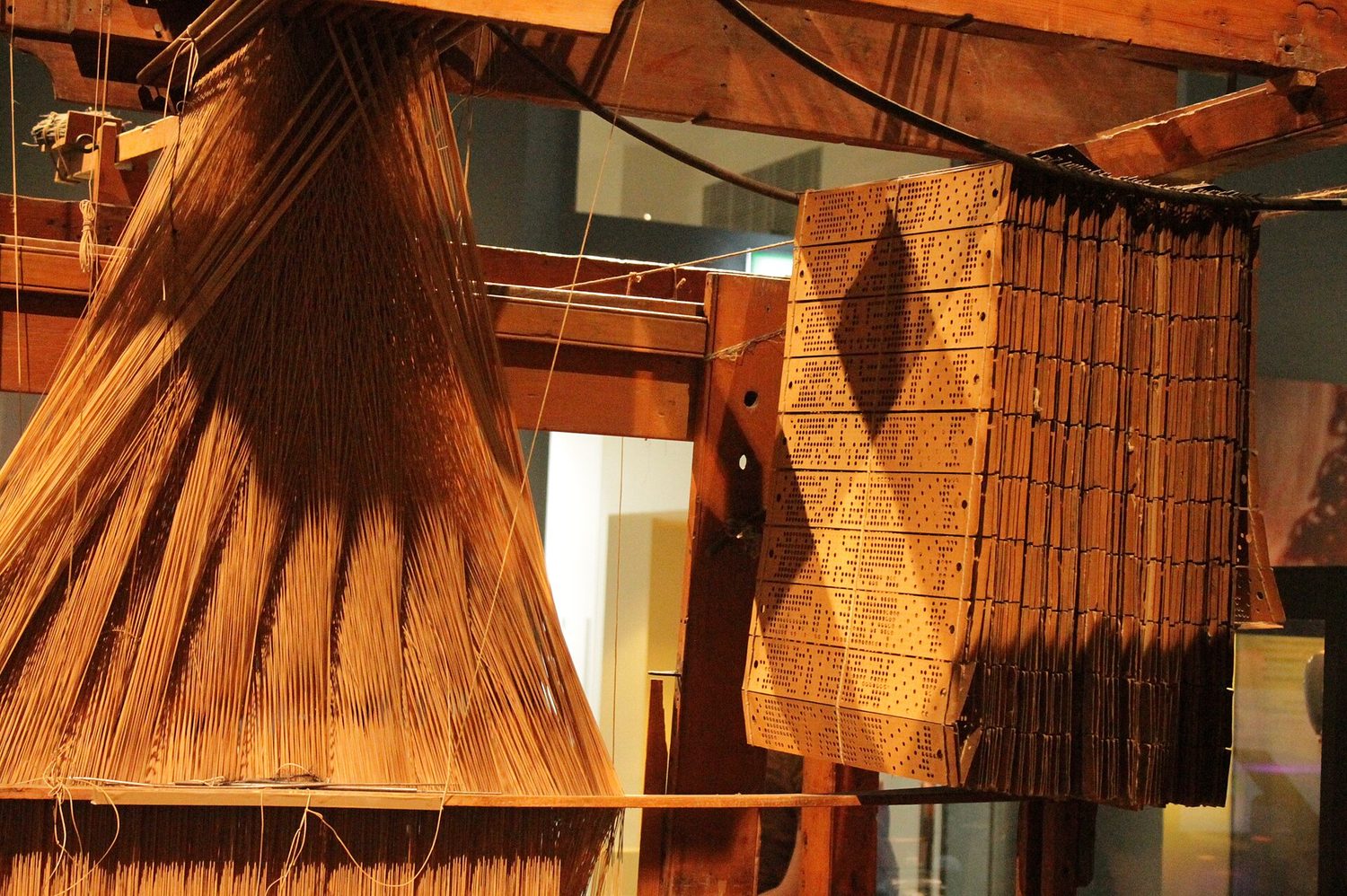
The punched cards that programmed a Jacquard loom, chaining together to encode a woven pattern. Stephencdickson, CC BY-SA 4.0, via Wikimedia Commons
The real significance of the Jacquard loom was not economic but conceptual. In the 1830s, Charles Babbage visited a textile factory and saw a Jacquard loom in operation. He realized that the same principle could be applied to calculation. If punch cards could control a loom, they could control a calculating machine. He designed his Analytical Engine, a mechanical computer, to use punched cards for input and programming. Ada Lovelace, working with Babbage, recognized that such a machine could do more than arithmetic. It could manipulate symbols of any kind. She is often credited with writing the first computer algorithm, a set of instructions for the Analytical Engine to calculate Bernoulli numbers.
Babbage's machine was never built, but the idea persisted. Punch cards became the standard method for programming and data storage in early computers. Herman Hollerith used them to tabulate the 1890 U.S. Census, cutting processing time from eight years to one. IBM built its empire on punch card systems. Programmers in the mid-twentieth century wrote code by punching holes in cards and feeding them into machines. The connection between weaving and computing, between Jacquard's loom and modern software, is direct and unbroken.
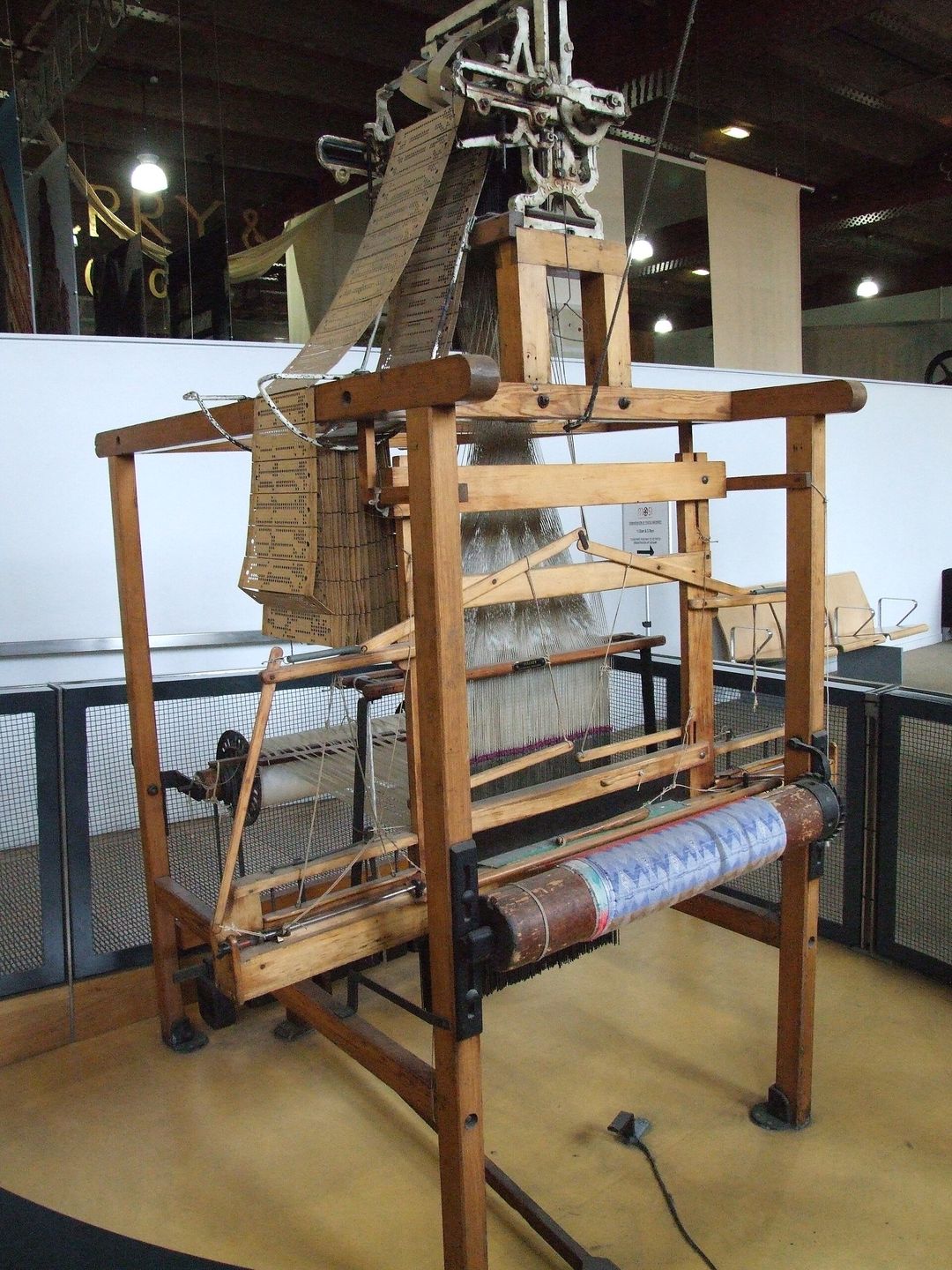
A wooden Jacquard loom, its chain of punch cards hanging from the reading head above the warp. Clem Rutter, Rochester, Kent., CC BY 3.0, via Wikimedia Commons
There is something elegant about the parallel. Both weaving and programming are about pattern and repetition, about encoding complexity in a form a machine can execute. A textile is information made tangible, threads arranged according to a design. A program is the same thing, instructions arranged to produce a result. Jacquard did not set out to invent the foundation of computer science. He just wanted to make better fabric. But the tool he designed to automate looms turned out to automate thought itself.
studio / on-this-day / Jul 7