studio / on-this-day / Jul 29

NASA logo. National Aeronautics and Space Administration, Public domain, via Wikimedia Commons
The Institution of Space
On this day in 1958 — NASA was created, and American spaceflight turned from a scramble of programs into a permanent institution.
2 min read
On July 29, 1958, President Dwight D. Eisenhower signed the National Aeronautics and Space Act into law, creating NASA. The agency officially began operations on October 1 of that year, absorbing the existing National Advisory Committee for Aeronautics along with its laboratories, personnel, and research programs. NASA was not built from nothing. It was assembled from parts that already existed, reorganized under a new mandate: explore space for peaceful purposes and assert American capability in an arena where the Soviet Union had taken the lead.

Sputnik 1 model at the tellus science museum — the launch that prompted the creation of NASA. JJonahJackalope, CC BY-SA 4.0, via Wikimedia Commons
The Soviets had launched Sputnik 1 on October 4, 1957. It was a metal sphere, 23 inches in diameter, carrying a radio transmitter that sent beeps back to Earth as it orbited every 96 minutes. The beeps were not data. They were proof. The Soviet Union had placed an object in space, and the world could hear it passing overhead. A month later, they launched Sputnik 2 with a dog named Laika onboard. She died in orbit, but the message was clear: the Soviets could put living things into space. If they could do that, they could put weapons there too.
The U.S. military had space programs, but they were fragmented across branches. The Army, Navy, and Air Force each had rocket projects with different goals and overlapping efforts. Eisenhower wanted a civilian agency to centralize space exploration, separate it from military operations, and make it a public endeavor. NASA became that agency. Its mission was scientific research, technological development, and demonstrating what America could build when it decided to compete.
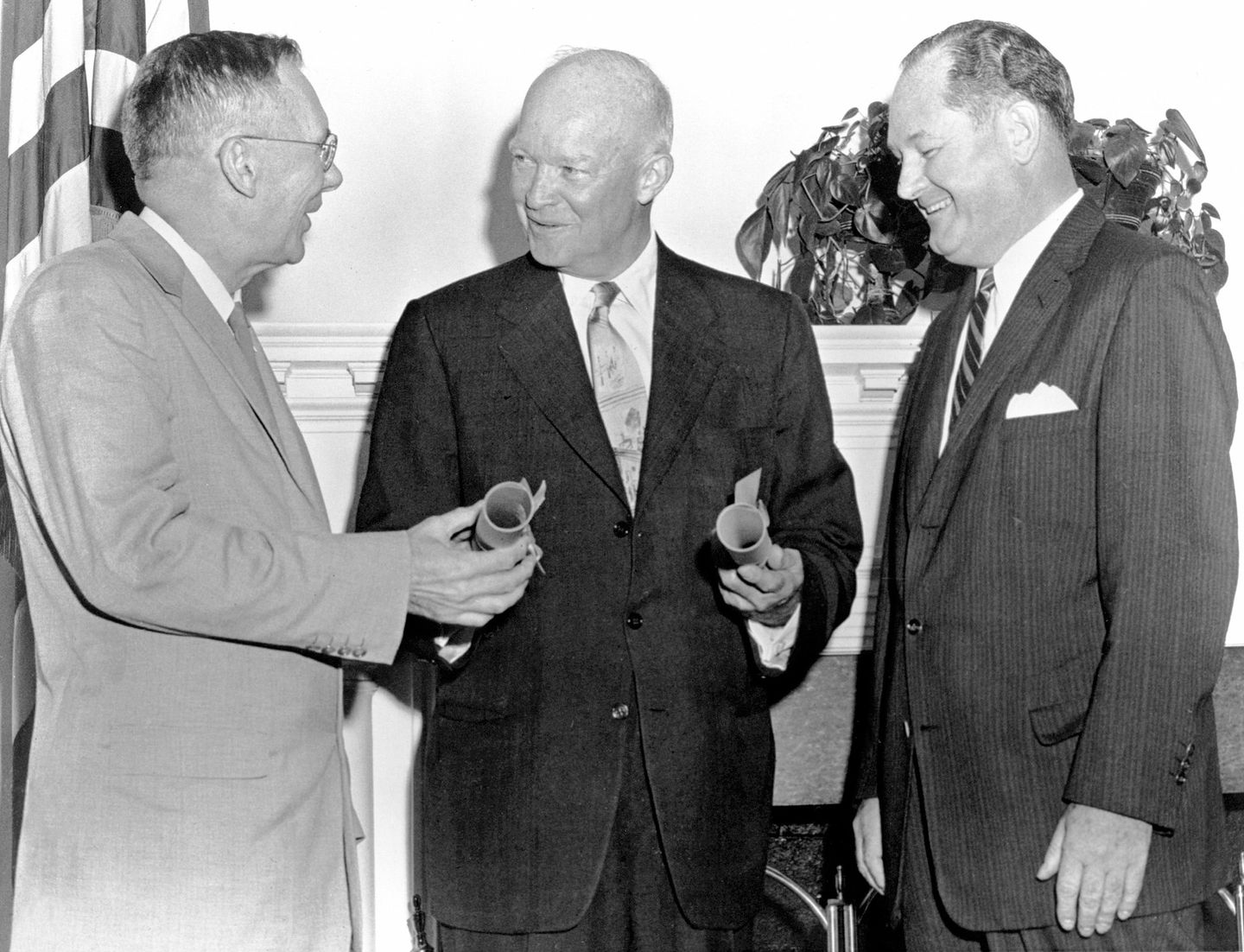
President eisenhower with hugh dryden and t. keith glennan, NASA's first deputy and administrator. NASA on The Commons, No restrictions, via Wikimedia Commons
NASA inherited talent and infrastructure. Wernher von Braun, who had designed the V-2 rocket for Nazi Germany and was brought to the U.S. after the war, became the director of the Marshall Space Flight Center. His team developed the Saturn V rocket that would eventually carry astronauts to the Moon. The Jet Propulsion Laboratory in California, already conducting rocket research, was transferred to NASA. Facilities in Virginia, Ohio, and Florida became NASA centers. The agency was designed to coordinate what had been scattered.
Within a year, NASA launched its first spacecraft. Within three years, it put Alan Shepard into space. Within eleven years, Neil Armstrong stepped onto the Moon. The pace was extraordinary because the mandate was urgent. Space was not just science. It was geopolitics. Every launch was a signal to the world about capability, ambition, and the future. NASA was the institution designed to send that signal.
The agency outlasted the Cold War. After the Soviet Union collapsed, NASA shifted focus from competition to cooperation. The International Space Station became a joint project involving Russia, Europe, Japan, and Canada. Mars rovers explored a planet no human has touched. Telescopes like Hubble and James Webb revealed galaxies billions of light-years away. The mission expanded from beating rivals to understanding the universe.
NASA also became infrastructure for private industry. Companies like SpaceX and Blue Origin build rockets, but they rely on NASA contracts, launch facilities, and decades of accumulated research. The agency designed the system that made commercial spaceflight possible. It proved that space was accessible, developed the tools to get there, and then handed those tools to others. This is what institutions do. They build capacity that outlives the original purpose.
The agency's creation was a response to fear, but it became something more durable. NASA exists because a nation decided that exploring space mattered enough to fund it continuously, through administrations and shifting priorities. It persists because the infrastructure, once built, becomes hard to dismantle. Rockets need engineers. Engineers need training. Training needs institutions. Institutions need funding. Funding requires justification. Justification comes from missions. Missions require rockets. The loop sustains itself.
On July 29, 1958, space exploration stopped being a scattered collection of military projects and became a permanent government function. NASA turned ambition into organization, competition into process, and the desire to leave Earth into a system capable of doing it repeatedly. The dream of reaching space is old. The agency that made it routine is not.
studio / on-this-day / Jul 29