studio / on-this-day / Jul 20
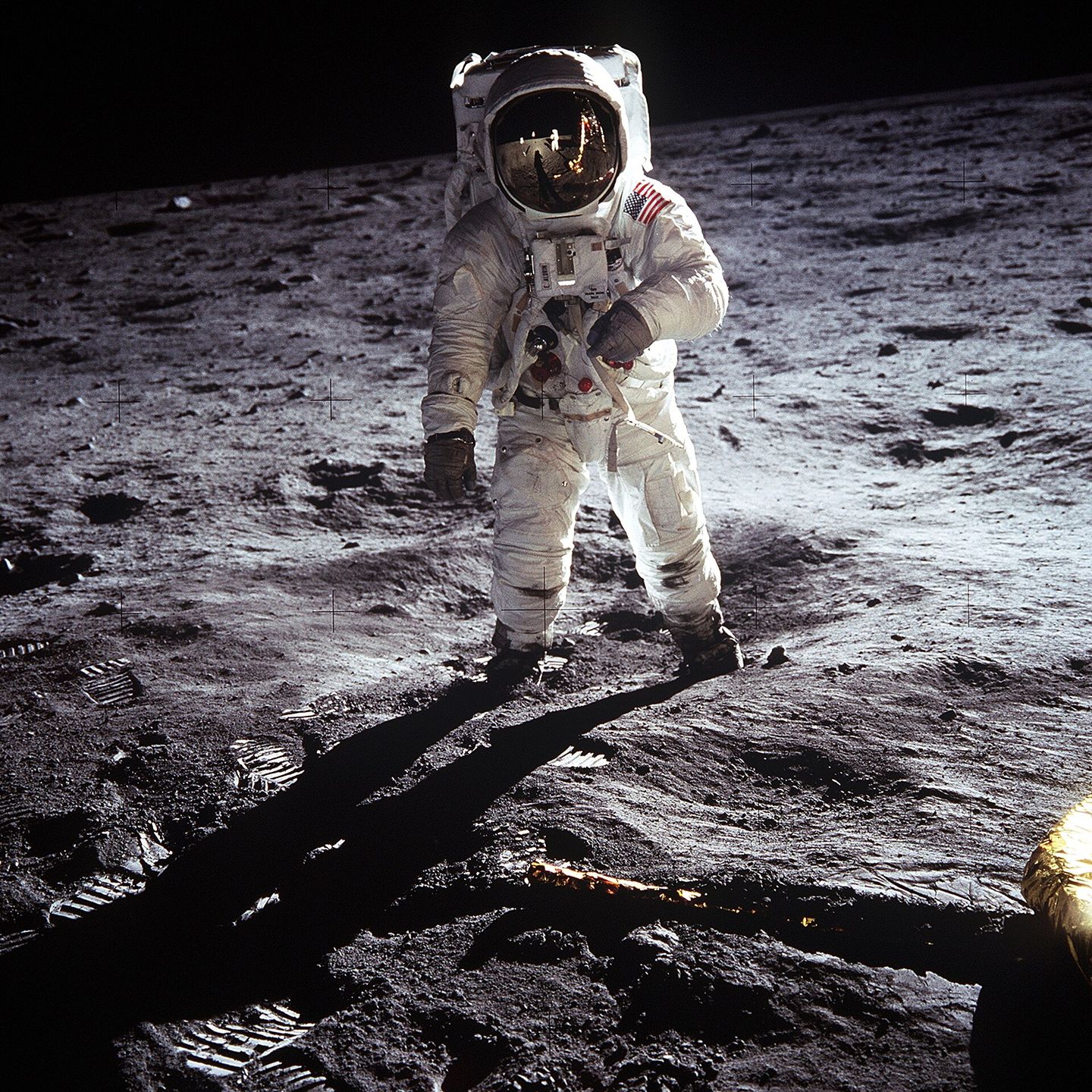
Buzz Aldrin on the Moon, July 20, 1969. photograph by Neil Armstrong. Neil A. Armstrong, Public domain, via Wikimedia Commons
One Small Step
On this day in 1969 — Neil Armstrong stepped onto the Moon, his line rehearsed in advance, the footprint left behind entirely his own.
3 min read
At 10:56 PM Eastern time on July 20, 1969, Neil Armstrong placed his left boot onto the surface of the Moon. The print it left in the lunar dust is still there, preserved in a place with no wind, no rain, and no erosion. It will remain for millions of years unless something disturbs it. That footprint is the most permanent thing any human has ever made.
Four days earlier, Apollo 11 had launched from Cape Kennedy atop a Saturn V rocket. Armstrong, Buzz Aldrin, and Michael Collins rode the shockwave of controlled combustion into orbit, then fired the engines again to escape Earth's gravity and coast toward the Moon. The trip took three days. On the fourth day, Armstrong and Aldrin transferred into the lunar module, a fragile metal structure that looked like it had been assembled from spare parts. Collins stayed in the command module, orbiting alone.
The descent did not go smoothly. The lunar module's guidance computer aimed for a landing site covered in boulders. Alarms sounded. Armstrong took manual control, flying the craft sideways, searching for flat ground. Fuel ran low. Mission control watched the telemetry and stayed quiet. With less than 30 seconds of fuel remaining, Armstrong found a clear patch and set the module down. The engine shut off. Dust settled. Aldrin radioed Houston with five words that became history: "The Eagle has landed."
They were supposed to rest before leaving the module, but neither man could sleep. After checking the systems and suiting up, Armstrong opened the hatch and backed down the ladder. A camera mounted on the module's exterior transmitted grainy black-and-white images to Earth. Six hundred million people watched on television, the largest audience in history at that point. Armstrong paused on the bottom rung, then stepped off.
The words he spoke were planned, though he later claimed he thought of them on the spot. "That's one small step for man, one giant leap for mankind." He meant to say "a man," which would have made the grammar work, but the transmission cut out or he misspoke. Either way, the sentence became canonical. Language matters less than the moment. A human was standing on another world.
Aldrin joined him 19 minutes later. Together, they spent two and a half hours on the surface. They planted a flag, collected 47 pounds of rock samples, took photographs, and tested how the body moves in one-sixth gravity. Aldrin described the landscape as "magnificent desolation." Armstrong rarely spoke about what he felt. He was an engineer. The mission had tasks, and he completed them.
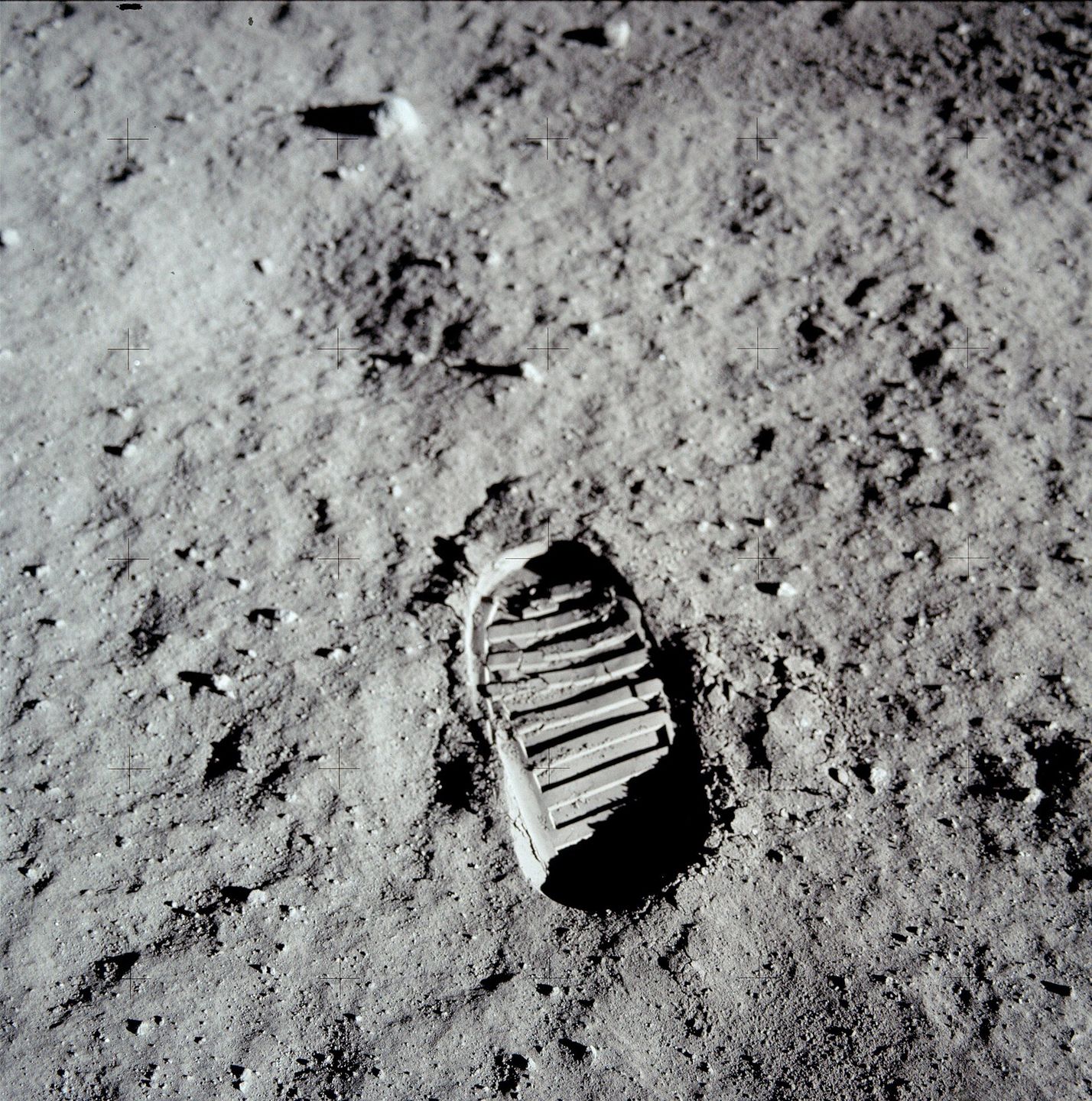
Bootprint on the Moon, Apollo 11 mission. NASA / Buzz Aldrin, Public domain, via Wikimedia Commons
The return was the riskiest part. The lunar module's ascent engine had to fire perfectly on the first try. There was no backup. If it failed, Armstrong and Aldrin would be stranded. Collins would have to return to Earth alone. The engine fired. The ascent stage lifted off, leaving the descent stage behind as a permanent monument. They docked with the command module, transferred the samples, and jettisoned the lunar module. It crashed into the Moon days later, its mission complete.
Apollo 11 splashed down in the Pacific on July 24. The crew spent three weeks in quarantine, just in case lunar dust carried unknown pathogens. It did not. The Moon is sterile. The rocks they brought back were older than any on Earth, untouched by atmosphere or biology. Scientists are still studying them.
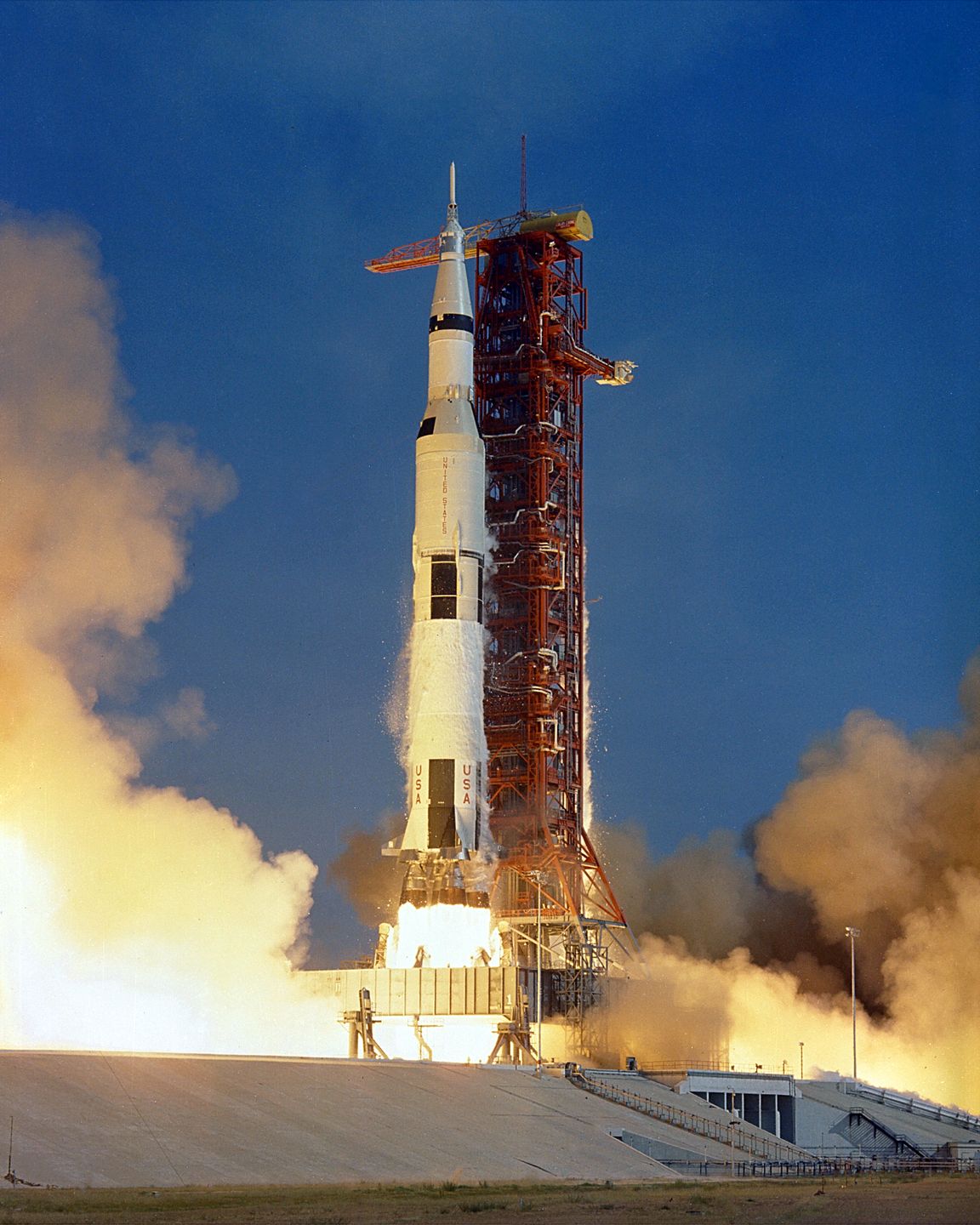
The Saturn v lifts Apollo 11 off the pad at Cape Kennedy, July 16, 1969. NASA, Public domain, via Wikimedia Commons
Twelve people have walked on the Moon. All of them went between 1969 and 1972. No one has been back since. The program ended not because the technology failed but because the funding did. Going to the Moon was a geopolitical project, a demonstration of capability during the Cold War. Once demonstrated, the interest faded. The machinery that made it possible was dismantled or repurposed. The blueprints for the Saturn V still exist, but building one today would require recreating an entire supply chain that no longer exists.
Armstrong left NASA in 1971 and became a professor of aerospace engineering. He avoided the spotlight, rarely giving interviews, never capitalizing on his fame. He saw himself as part of a team, not a singular hero. When he died in 2012, his family released a statement suggesting that people honor his memory by looking up at the Moon on a clear night and giving it a wink. Casual, understated, exactly right.
The footprint remains. Wind will never erase it. Rain will never wash it away. It sits in the Sea of Tranquility, a mark made by a machine designed by humans, worn by a human, pressed into dust that has not moved in billions of years. We went there once. We could go again. The question is not whether the design is possible. It is whether we decide it matters.
studio / on-this-day / Jul 20