studio / on-this-day / Jun 2
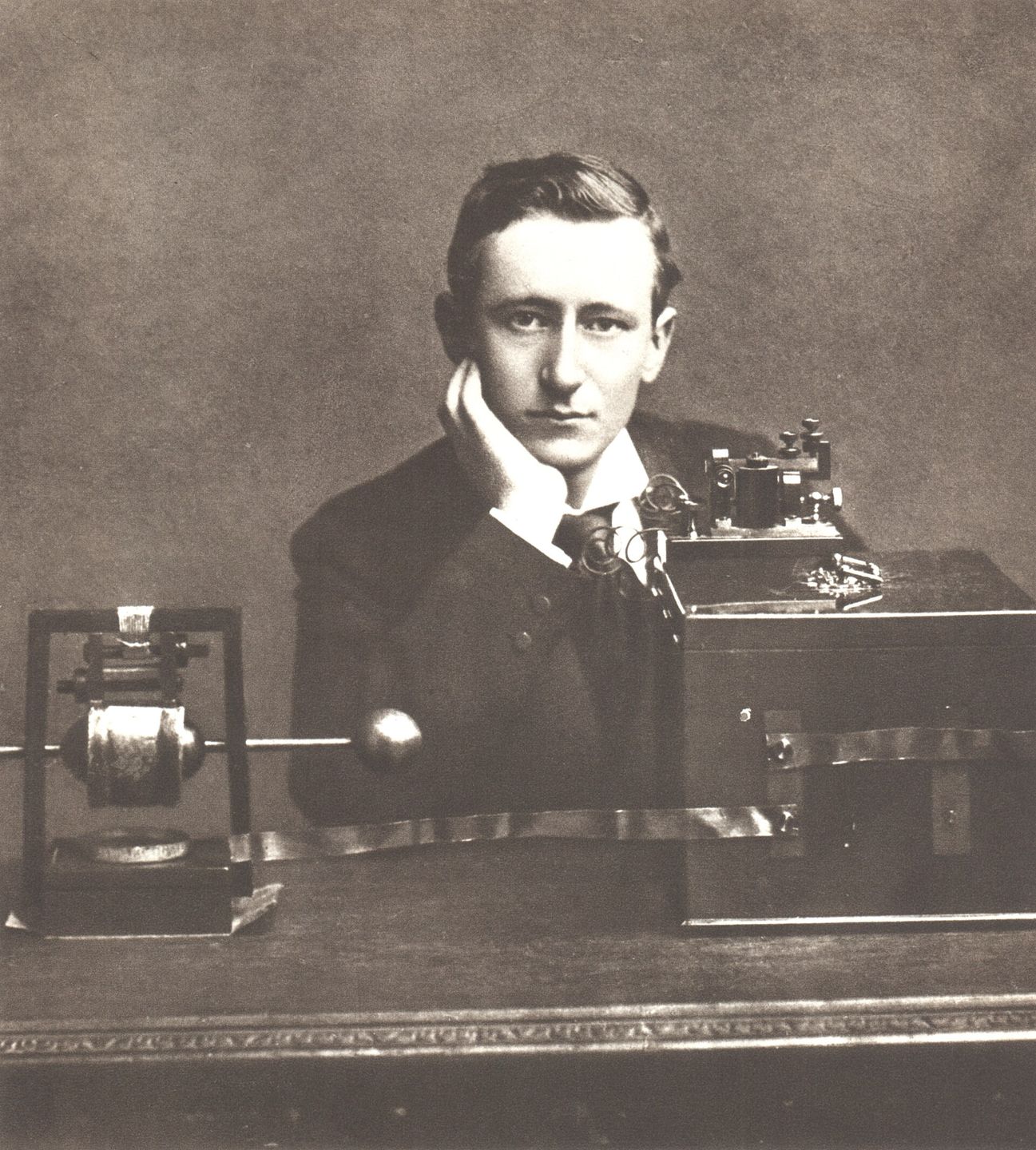
Guglielmo Marconi, engineer and physicist who pioneered wireless communication. Smithsonian Institution, No restrictions, via Wikimedia Commons
Words Without Wires
On this day in 1896 — Guglielmo Marconi filed his radio patent, and wireless communication existed on paper before it ever filled the air.
3 min read
Guglielmo Marconi arrived in London in February 1896 with a wooden box full of equipment, a letter of introduction from his mother, and an idea that sounded impossible. He was twenty-one. The Italian government had shown no interest in his work, so he brought it to Britain, where the patent office was more receptive to strange young men with strange proposals. On June 2, 1896, Marconi filed his patent for wireless telegraphy. He did not invent radio waves. Heinrich Hertz had proven their existence a decade earlier. But Marconi saw what Hertz had not: that invisible waves could carry information across distances without wires, and that such a capability might reshape how the world communicates.
The telegraph already existed, of course. Samuel Morse had demonstrated it half a century earlier, and by the 1890s, copper wires connected continents. But wires had constraints. They could not cross oceans easily. They could not reach ships at sea. They were vulnerable to sabotage, weather, and geography. Marconi's breakthrough was proving that you could send Morse code through the air itself, using electromagnetic waves instead of metal conductors. It was telegraphy without the tether, communication as broadcast rather than circuit.
Marconi's early experiments were modest. In 1895, he transmitted a signal across his family's estate in Bologna. By 1896, he was demonstrating the technology in Britain, sending signals across Salisbury Plain. In 1897, he transmitted across the Bristol Channel, a distance of nine miles. The distances kept growing. In 1899, he sent a signal across the English Channel. On December 12, 1901, he received the letter S in Morse code in Newfoundland, transmitted from Cornwall, England, over 2,000 miles of open ocean. Experts had insisted it was impossible. The curvature of the earth, they said, would prevent radio waves from traveling that far. Marconi did it anyway.
What he had proven was that information could move at the speed of light without infrastructure. No cables needed to be laid. No poles erected. Just an antenna, a transmitter, and the atmosphere itself. The implications were immediate. Ships at sea could communicate with shore. Remote outposts could coordinate without waiting for mail. Disasters could be reported instantly. In 1912, when the Titanic struck an iceberg, its distress signal was sent via Marconi equipment. The signal reached other ships, and over seven hundred people were rescued. Marconi's invention turned isolation into connection.
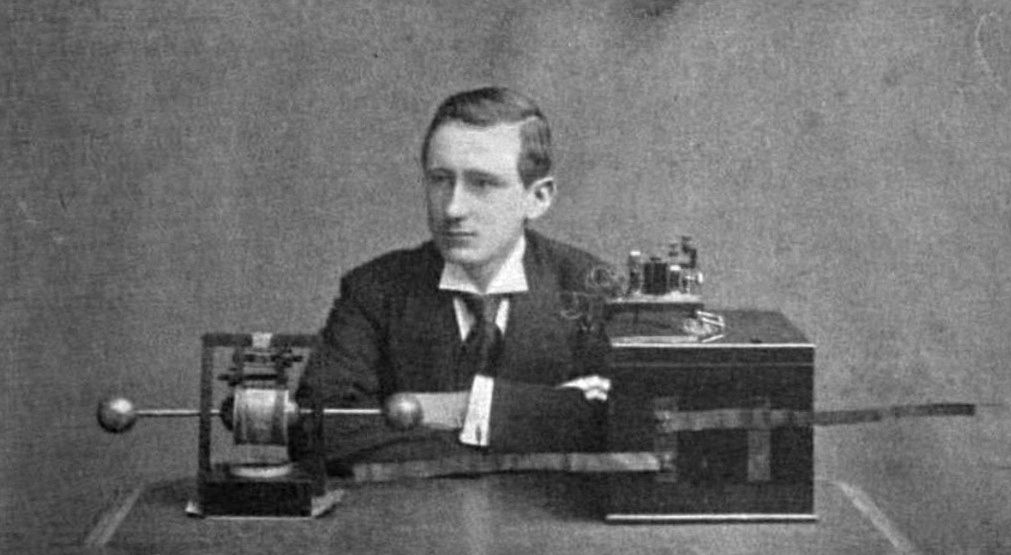
Early Marconi wireless telegraphy apparatus, similar to equipment used for the first transatlantic transmission. Public domain, via Wikimedia Commons
Radio became the backbone of twentieth-century communication. It carried voice, music, and eventually data. Radar emerged from the same principles during World War II. After the war, radio evolved into television, then cellular networks, then wifi. Every wireless technology traces its lineage back to Marconi's patent, the one filed on a spring day in 1896 by a young Italian who understood that air could carry more than sound.
Marconi won the Nobel Prize in Physics in 1909. He became a senator in Italy, a public figure, and a wealthy man. He died in 1937. When he did, radio stations around the world observed two minutes of silence in his honor, the airwaves briefly emptied of the signals he had taught them to carry. It was the most fitting tribute imaginable: the world pausing the very thing he had made possible, if only for a moment, to acknowledge what had been lost.
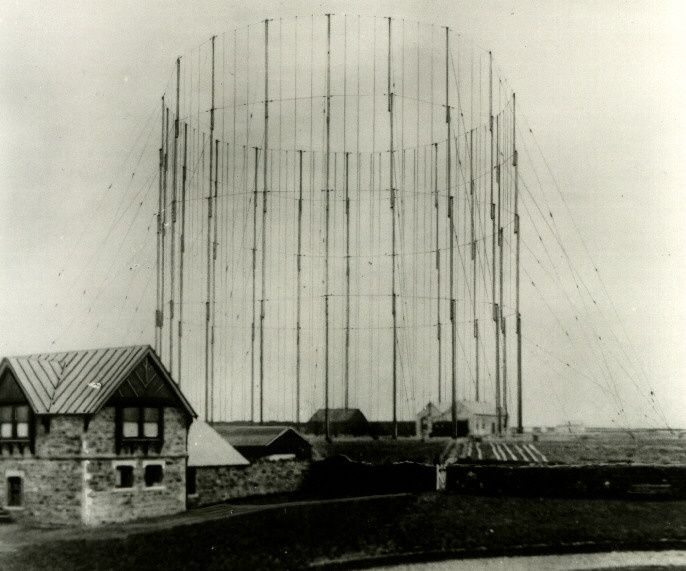
The first antenna system at the poldhu station, Cornwall, December 1901 — the transmitter that sent the first transatlantic signal. Public domain, via Wikimedia Commons
Today, the spectrum is crowded. Radio waves carry phone calls, streaming video, GPS signals, bluetooth connections, satellite transmissions. The air is thick with invisible traffic. It began with a wooden box, a young inventor, and a belief that distance could be collapsed without touching it. Marconi did not invent the wave. He just taught it to speak.
studio / on-this-day / Jun 2