studio / on-this-day / Feb 22
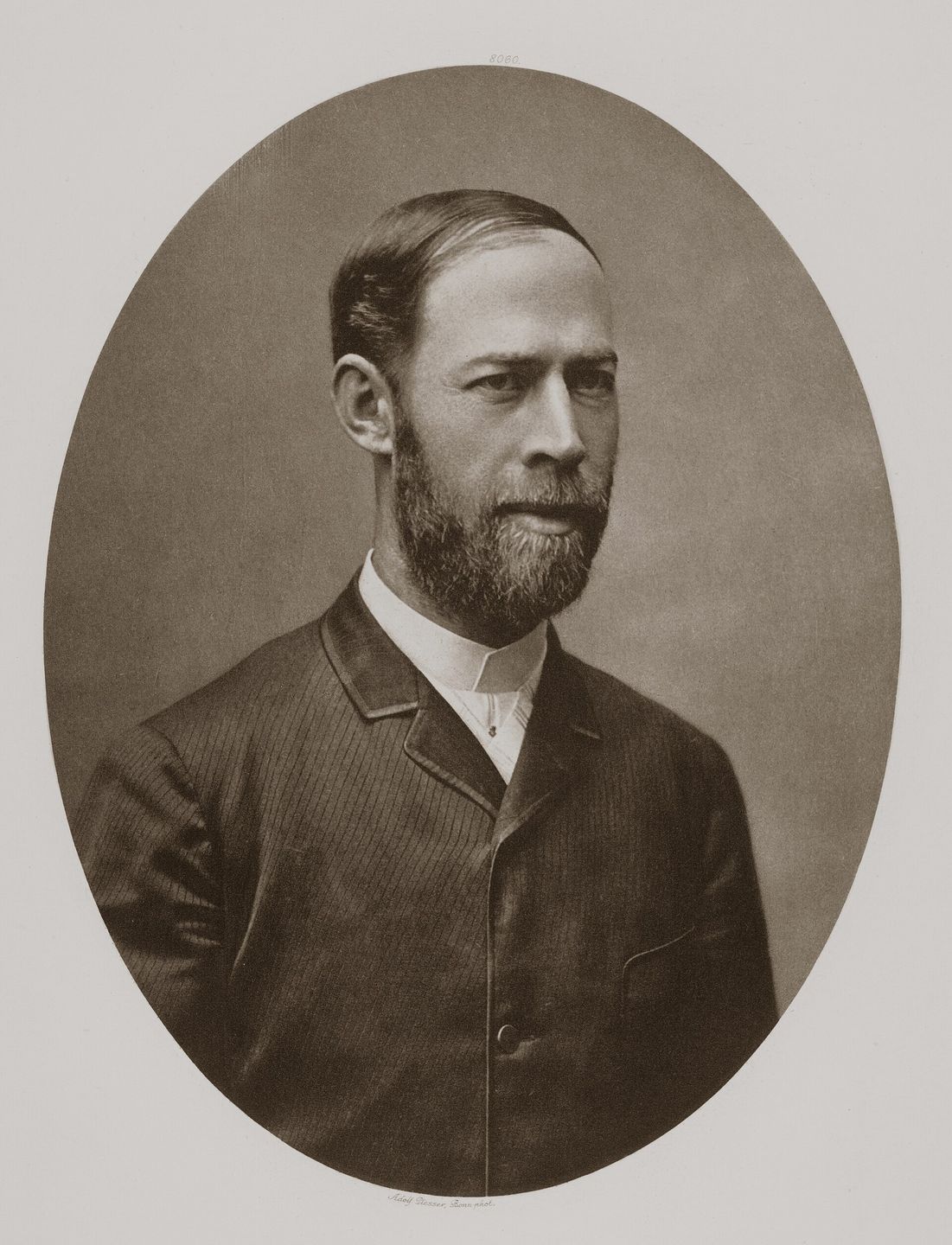
Heinrich Hertz (1857–1894), the German physicist born on February 22, 1857, who proved the existence of electromagnetic waves and whose name became the unit of frequency used to measure them. Robert Krewaldt, Kaiserplatz 16, Bonn, Public domain, via Wikimedia Commons
Proving the Invisible
On this day in 1857 — Heinrich Hertz was born, and would prove invisible electromagnetic waves are real, clearing the path for radio and television.
3 min read
Heinrich Hertz was born on February 22, 1857, in Hamburg, Germany. He was a gifted student with a talent for languages, mathematics, and physics. He studied engineering, then switched to physics, eventually earning a doctorate under Hermann von Helmholtz in Berlin. Hertz was a theorist and an experimentalist, someone who could work out the mathematics and then build the apparatus to test it. In the late 1880s, he set out to answer a question that had lingered for decades: do electromagnetic waves actually exist?
The question was rooted in the work of James Clerk Maxwell, a Scottish physicist who, in the 1860s, had developed a set of equations describing electricity and magnetism. Maxwell's equations predicted that oscillating electric and magnetic fields could propagate through space as waves, traveling at the speed of light. In fact, Maxwell suggested that light itself was an electromagnetic wave. The mathematics was elegant, but no one had proven that such waves existed beyond visible light.
Hertz decided to test the theory. Between 1886 and 1888, he conducted a series of experiments in his laboratory in Karlsruhe. He built a transmitter: a spark gap oscillator that generated rapid electrical discharges. He built a receiver: a loop of wire with a small gap. When the transmitter discharged, it created oscillating electromagnetic fields. If Maxwell was correct, those fields would propagate as waves and induce a spark in the receiver, even across a gap of air.
It worked. Hertz observed sparks in the receiver, proving that invisible electromagnetic waves had traveled through space. He measured their wavelength and frequency. He showed they could be reflected, refracted, and polarized, just like light. He confirmed Maxwell's prediction that electromagnetic waves traveled at the speed of light. He had discovered radio waves, though he did not call them that and did not see any practical use for them.
When asked about the applications of his discovery, Hertz is said to have replied that it had none. He was interested in pure research, in understanding the fundamental nature of the universe, not in building useful devices. He could not have predicted that his work would become the foundation for wireless communication. Every radio broadcast, every WiFi signal, every cell phone call, every Bluetooth connection, every television transmission relies on the electromagnetic waves Hertz proved existed.
Hertz continued his research, investigating cathode rays and the photoelectric effect, the phenomenon where light striking a metal surface causes it to emit electrons. His work on the photoelectric effect would later be explained by Albert Einstein in 1905, a contribution that earned Einstein the Nobel Prize. Hertz did not live to see it. He died in 1894 at the age of 36 from an infection, possibly a complication of Wegener's granulomatosis, an autoimmune disease.
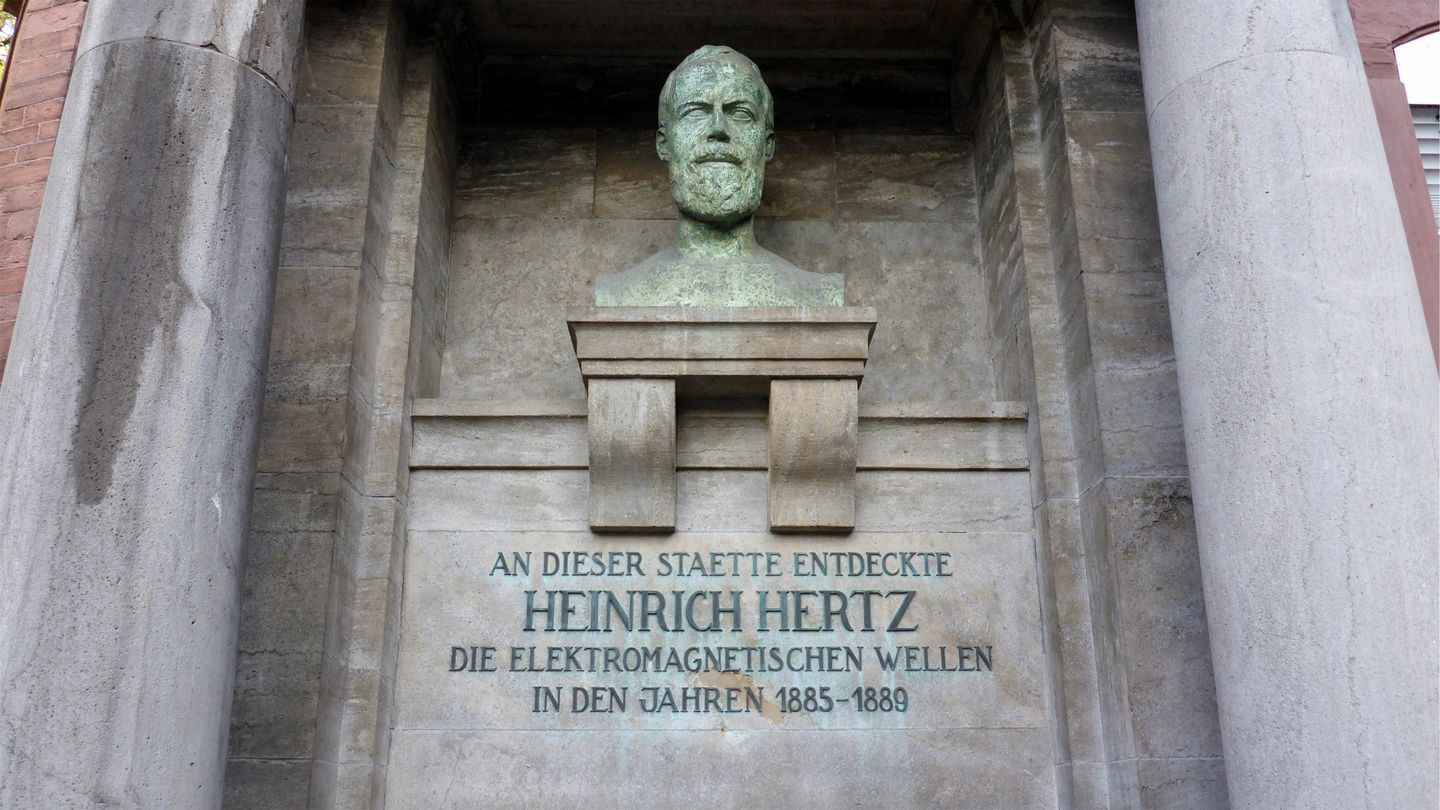
Memorial to Heinrich Hertz in Karlsruhe, Germany, where he conducted his landmark electromagnetic wave experiments between 1886 and 1888, proving James Clerk Maxwell's theoretical predictions. Günter Josef Radig, CC BY-SA 3.0 de, via Wikimedia Commons
After his death, the scientific community named the unit of frequency in his honor. One hertz equals one cycle per second. Radio stations broadcast at kilohertz or megahertz. WiFi operates at gigahertz. The invisible waves Hertz discovered are measured in the units that bear his name. His work was foundational, the kind of science that does not seek applications but makes them possible.
Hertz's experiments were exercises in precision and clarity. He designed simple, elegant setups that isolated the phenomenon he wanted to study. He eliminated interference, controlled variables, and documented his results meticulously. His laboratory notebooks are models of scientific practice. He proved something that no one could see, touch, or directly perceive. He made the invisible measurable.
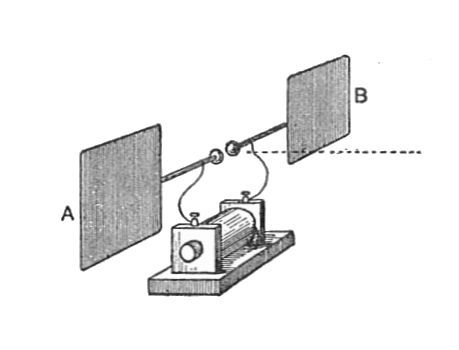
A diagram of Hertz's spark-gap transmitter, the apparatus he built to generate the oscillating electromagnetic fields that proved invisible waves travel through space. Andy Dingley (scanner), Public domain, via Wikimedia Commons
The modern world is saturated with electromagnetic radiation. It fills the air around us, carrying data, voices, images, and signals at the speed of light. We live in a designed environment where information moves invisibly through space, and we take it for granted. Hertz gave us the proof that this was possible. He did not invent radio, television, or the internet, but he showed that the physical laws underlying all of them were real. He turned Maxwell's mathematics into experimental fact. The waves exist. We just needed someone to demonstrate it.
studio / on-this-day / Feb 22