studio / on-this-day / Dec 12
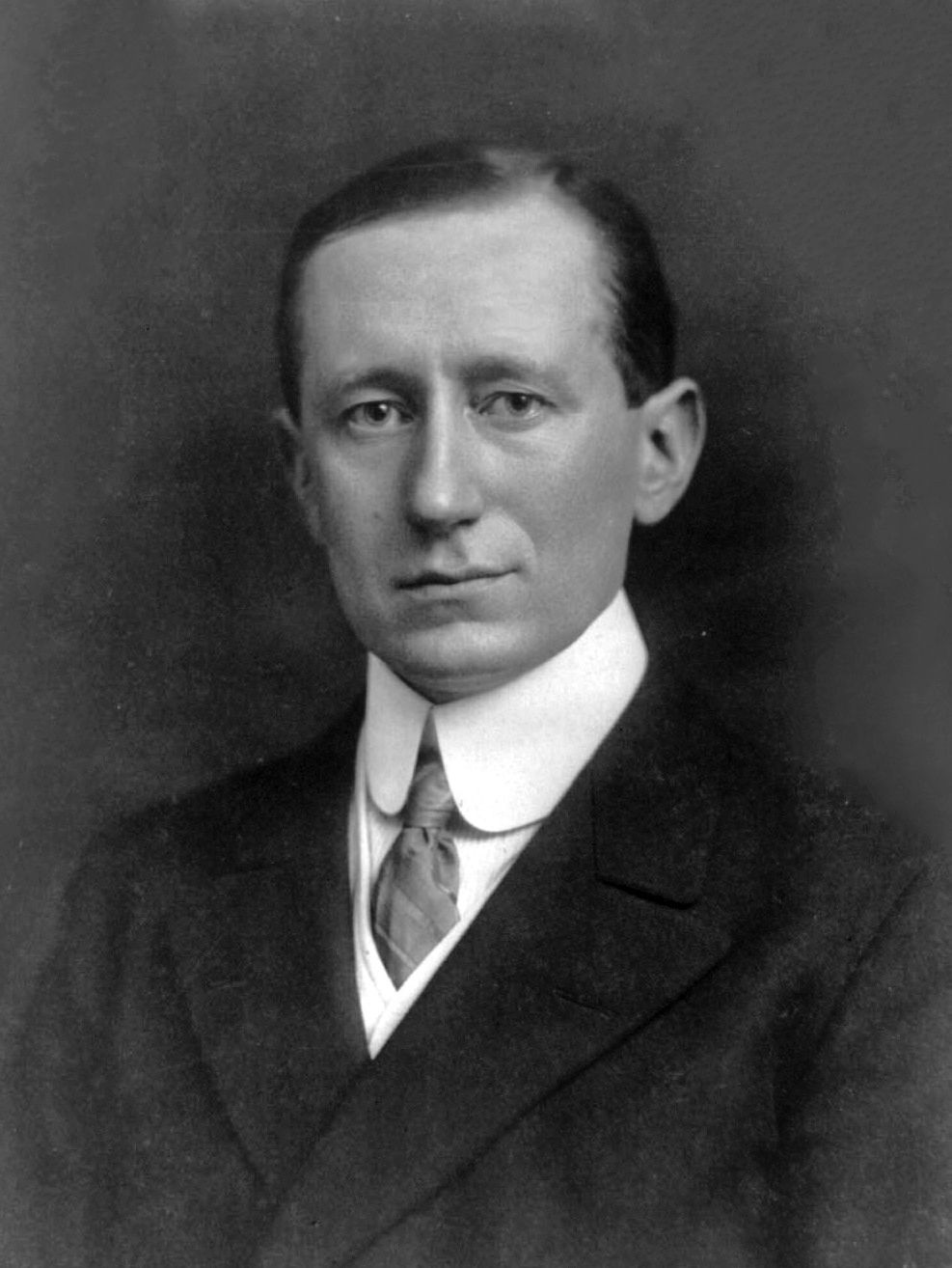
Guglielmo Marconi, inventor of Wireless telegraphy. Pach Brothers, Public domain, via Wikimedia Commons
Three Dots Across the Atlantic
On this day in 1901 — Guglielmo Marconi received the first transatlantic radio signal. Three dots for the letter "S."
3 min read
On December 12, 1901, at Signal Hill in St. John's, Newfoundland, Guglielmo Marconi sat in a cold, drafty room with a receiving apparatus and a pair of telephone earphones. At a prearranged time, a transmitter in Poldhu, Cornwall, England, 2,100 miles away across the Atlantic Ocean, sent a signal: three short pulses representing the letter "S" in Morse code. Marconi heard them. Faint, barely audible above the static, but unmistakable. It was the first wireless communication to cross an ocean. Radio waves, which many scientists believed would be blocked by the curvature of the Earth, had traveled across the Atlantic. Marconi proved them wrong.
The experiment was controversial. Scientists at the time understood that radio waves traveled in straight lines, like light. The Earth is round. Therefore, any signal transmitted from England should shoot off into space rather than curve around the planet to reach Newfoundland. Marconi's success suggested something more complex was happening. The signal was bouncing off the ionosphere, a layer of charged particles in the upper atmosphere, which reflected the waves back toward Earth. Marconi didn't know about the ionosphere. He just knew the signal worked. The theory caught up later.
Marconi had been developing wireless telegraphy for years. In 1895, at age 21, he transmitted signals over a distance of about a mile on his family's estate in Italy. By 1897, he had established the Wireless Telegraph and Signal Company in Britain and demonstrated ship-to-shore communication. In 1899, he sent signals across the English Channel. But transatlantic transmission was the real test. If wireless communication could cross oceans, it could replace undersea telegraph cables, which were expensive to maintain and vulnerable to breaks. Wireless was faster, cheaper, and didn't require physical infrastructure.
The Poldhu transmitter was enormous. It used a 20-kilowatt spark-gap transmitter and a massive antenna suspended between two 200-foot wooden masts. The receiving station in Newfoundland was far simpler: a wire antenna lifted by a kite in high wind. Marconi and his assistant, George Kemp, had to deal with harsh weather, technical failures, and skepticism from the scientific community. But when Marconi heard those three faint clicks in his earphones, he knew he had succeeded. He repeated the test over the next few days. Each time, the signal came through.
Not everyone believed him. Some scientists demanded proof. Marconi had no recording device, so the only evidence was his word and the testimony of his assistant. Critics suggested he had heard atmospheric noise, not a deliberate signal. But Marconi kept transmitting. By 1902, he had established regular transatlantic wireless communication. By 1907, commercial transatlantic wireless service was operational. Ships at sea could communicate with land, with each other, and call for help in emergencies. In 1912, the RMS Titanic sent distress signals via Marconi equipment, and over 700 passengers were rescued as a result. Wireless wasn't just a novelty. It saved lives.
Marconi's work laid the foundation for all broadcast communication. Radio, television, satellite transmission, Wi-Fi, cellular networks, GPS: all of them rely on the principle Marconi demonstrated in 1901. Information can be transmitted wirelessly over vast distances using electromagnetic waves. The medium is invisible, the infrastructure minimal compared to cables, and the reach theoretically unlimited. Marconi didn't invent radio waves. He engineered a system to make them useful. He turned physics into infrastructure.
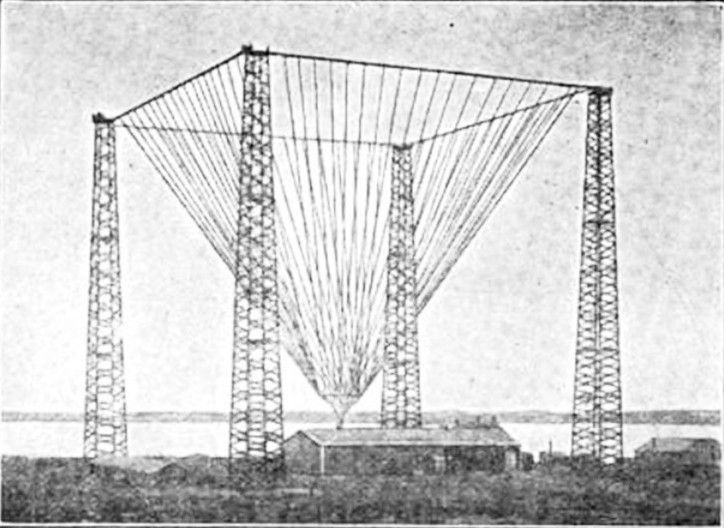
Poldhu Wireless station antenna, Cornwall, England. Archie Frederick Collins, Public domain, via Wikimedia Commons
In 1909, Marconi shared the Nobel Prize in Physics with Karl Ferdinand Braun for contributions to wireless telegraphy. He continued refining radio technology, working on shortwave transmission and pioneering microwave communication. During World War I, radio became critical for military communication. During World War II, radar, based on similar principles, changed the nature of air and naval warfare. Marconi's three dots in 1901 were the first message. Every wireless signal since is a descendant of that moment.
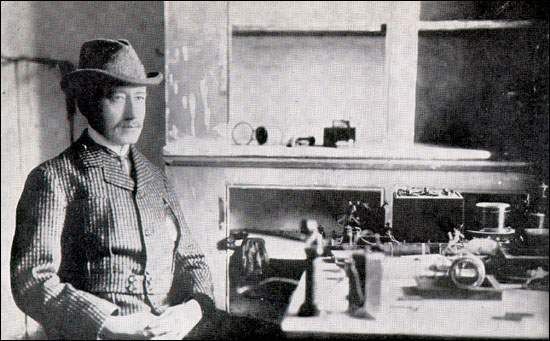
Marconi at Signal Hill, Newfoundland, with the receiving instruments, December 1901. Public domain, via Wikimedia Commons
What makes December 12, 1901, significant is not just the technical achievement. It's the shift in what was possible. Before Marconi's signal, communication across oceans required physical connections: ships carrying letters, undersea cables transmitting telegraph pulses. Afterward, communication became ethereal. You could send a message anywhere, instantly, without touching anything. The world got smaller. Distance became less relevant. Marconi didn't eliminate geography. He made it optional. Three dots, across 2,100 miles of ocean, in the middle of winter, heard by one man with a pair of earphones. That was enough. The wire was gone. The signal remained.
studio / on-this-day / Dec 12