studio / on-this-day / Apr 23
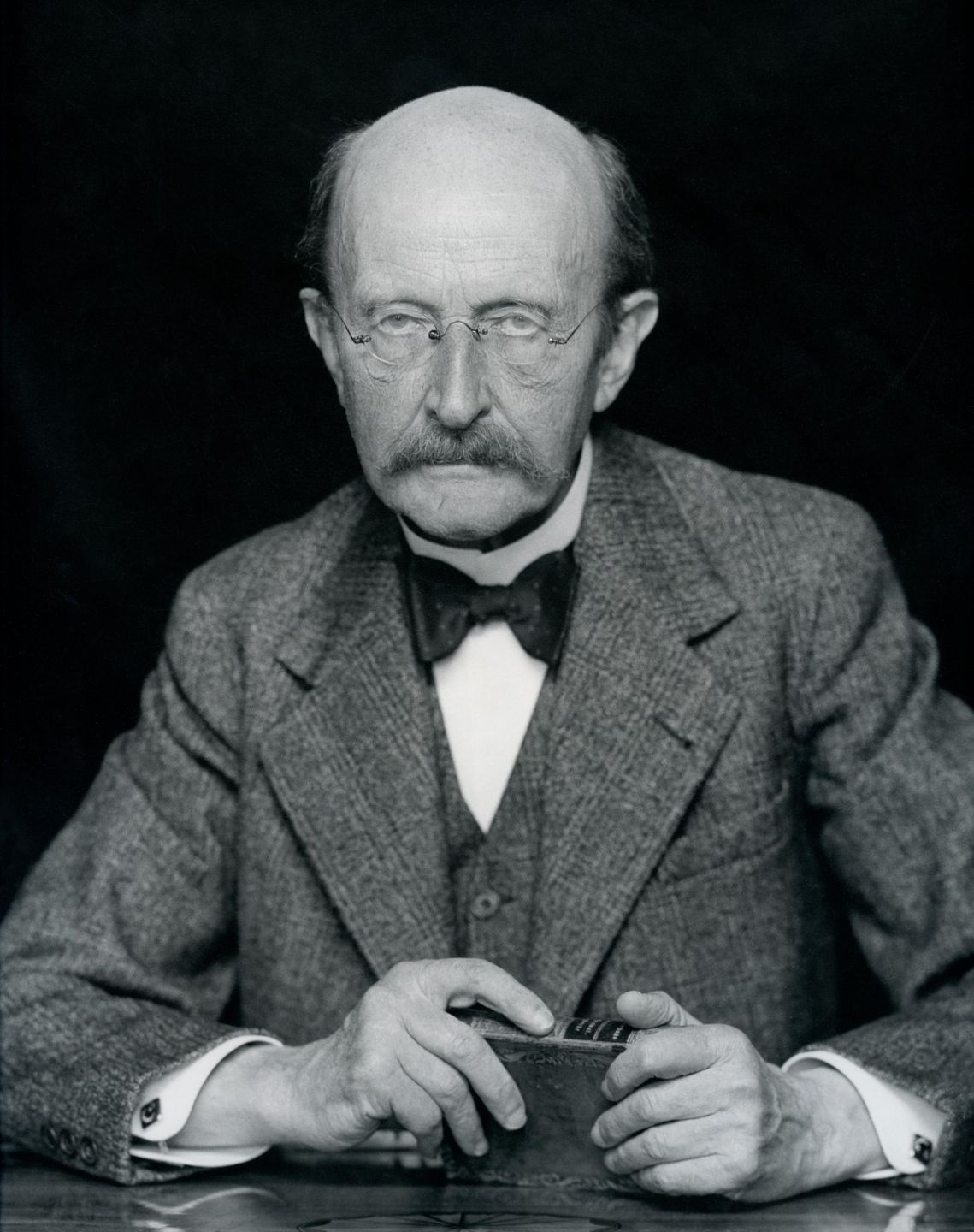
Max Planck, photographed by hugo erfurth in 1938. Planck called his quantum hypothesis "an act of desperation" — he did not believe energy was actually quantized, but the math forced his hand. Hugo Erfurth, Public domain, via Wikimedia Commons
Energy in Packets
On this day in 1858 — Max Planck was born, and would discover, reluctantly, that energy comes in discrete packets, and set off quantum physics.
3 min read
Max Planck was born on April 23, 1858, in Kiel, Germany, into a family of scholars and jurists. He was methodical, cautious, and deeply conservative in temperament. He did not set out to revolutionize physics. He set out to solve a problem that had been irritating physicists for decades: why do hot objects glow the way they do? The answer, which he stumbled upon reluctantly, dismantled the classical understanding of energy and opened the door to quantum mechanics. Planck called it an act of desperation. It turned out to be the foundation of modern physics.
The problem was called blackbody radiation. When you heat an object, it emits light. The hotter it gets, the shorter the wavelength. A piece of iron glows red, then orange, then white as the temperature rises. Classical physics predicted that as you moved toward shorter wavelengths, the energy emitted should increase without limit. This was called the ultraviolet catastrophe, because it suggested that everything should be radiating infinite energy in the ultraviolet range. Obviously, that did not happen. Something was wrong with the equations.
Planck tried to fix the math. In 1900, he proposed that energy was not continuous. It could not take any value. Instead, it came in discrete units, which he called quanta. Energy could only be emitted or absorbed in integer multiples of a fundamental constant, now known as Planck's constant. This was not a philosophical statement. It was a mathematical trick to make the equations match experimental data. Planck did not believe energy was actually quantized. He thought it was an approximation, a placeholder until a better theory came along.
The implications took years to surface. Albert Einstein used Planck's idea to explain the photoelectric effect in 1905, proposing that light itself came in packets called photons. Niels Bohr applied it to atomic structure in 1913, showing that electrons orbit nuclei only at specific energy levels. Werner Heisenberg and Erwin Schrödinger developed quantum mechanics in the 1920s, formalizing the mathematics of particles that behave like waves and waves that behave like particles. Planck's constant appeared in every equation. What started as a workaround became the architecture of reality at the smallest scales.
Planck himself was horrified. He spent years trying to reconcile quantum theory with classical physics, searching for a way to make energy continuous again. He could not. The evidence kept piling up. Quantization was not a mistake. It was how the universe worked. Energy, matter, and information all came in discrete chunks. There was a minimum size for everything. You could not have half a photon. You could not measure position and momentum simultaneously with infinite precision. The smooth, deterministic clockwork of Newtonian physics was an illusion, valid only at large scales. At the quantum level, reality was granular, probabilistic, and fundamentally uncertain.
The shift from continuous to discrete is not unique to physics. Digital systems work the same way. Analog audio is a continuous waveform. Digital audio samples that wave at fixed intervals, converting it into discrete values. The result is not identical to the original, but if you sample fast enough, the difference becomes imperceptible. The same principle applies to images, video, and computation. Everything digital is quantized. It has to be. Computers cannot process infinite precision. They work with bits, discrete units of information that are either one or zero. Planck's insight, that nature itself might operate this way, was the conceptual bridge between classical and digital thinking.
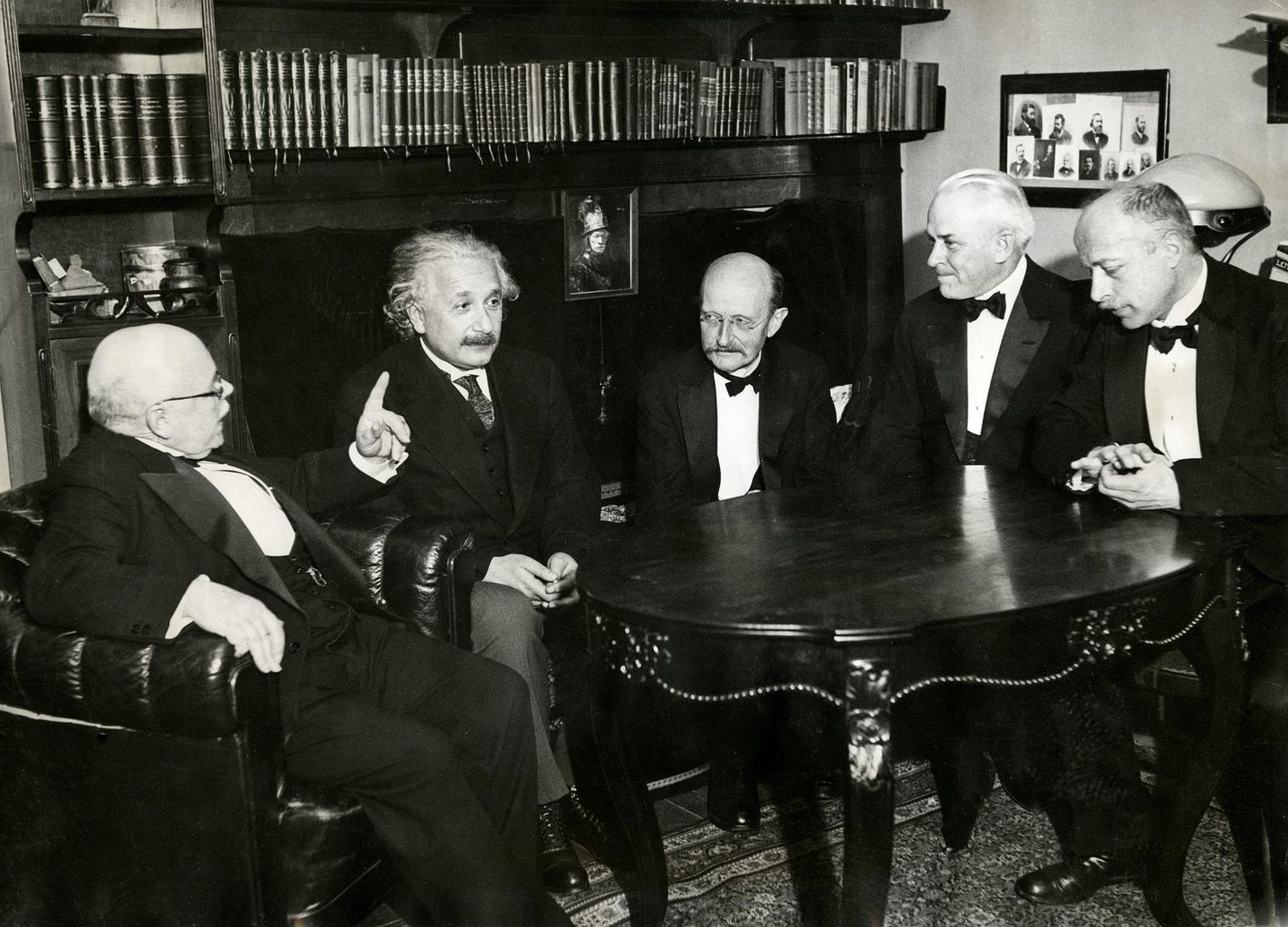
Five Nobel laureates in 1931 (l to r): walther nernst, albert Einstein, max Planck, robert millikan, and max von laue. Planck's quantum hypothesis had by then rewritten the foundations of physics that all of them built upon. Public domain, via Wikimedia Commons
What Planck discovered was not just a property of energy. It was a property of systems. When you model something as continuous, you assume infinite divisibility. When you model it as discrete, you acknowledge limits. Limits make calculation possible. They make prediction possible. They also introduce uncertainty. In quantum mechanics, you cannot know everything about a system at once. In digital systems, you cannot capture infinite detail. The act of measurement, of sampling, of representing something in discrete terms, loses information. That loss is the cost of making reality computable.
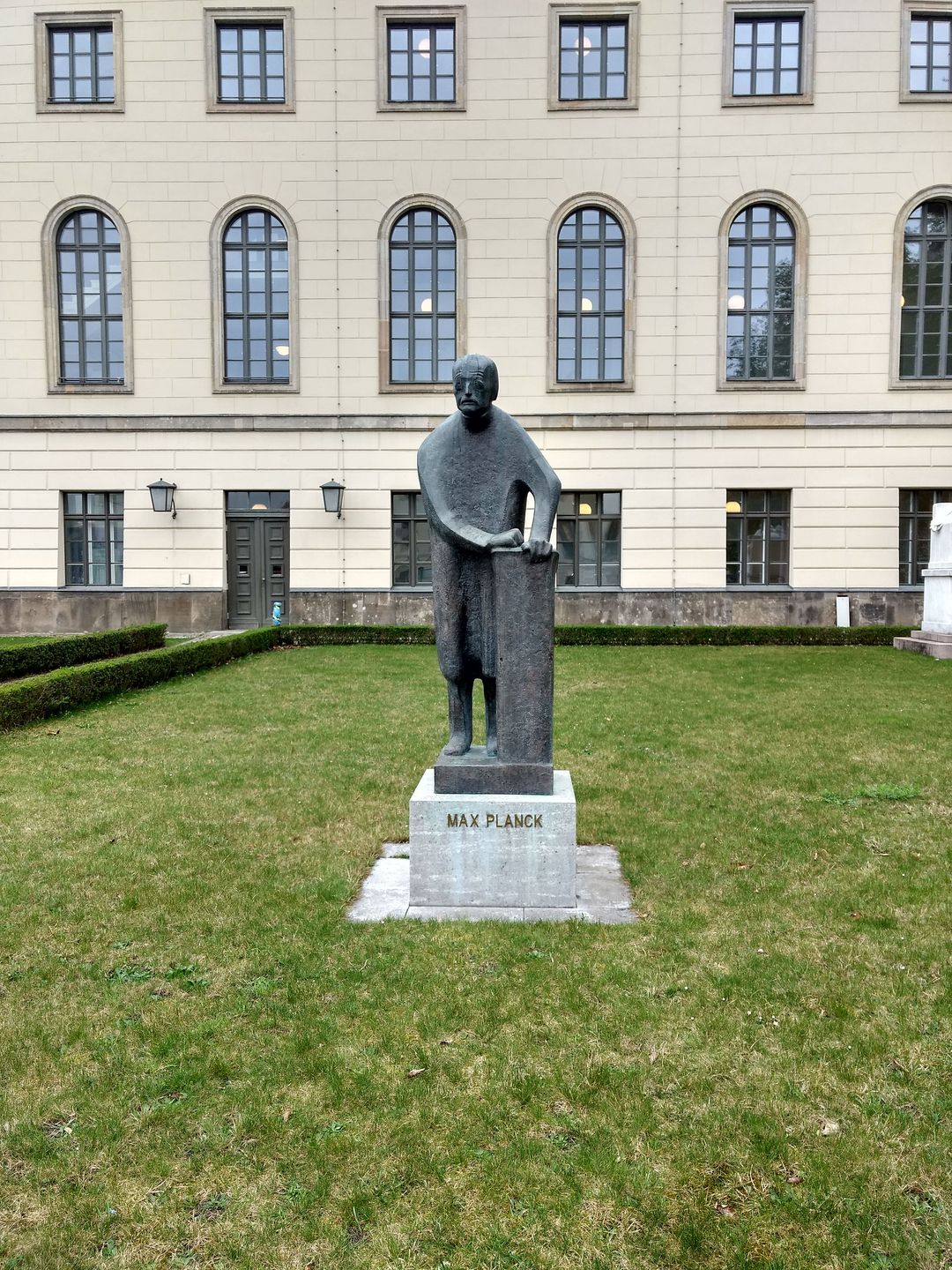
The bronze statue of Planck outside humboldt university in Berlin, where he taught theoretical physics for decades. The reluctant revolutionary cast in metal. Shyamal, CC BY-SA 3.0, via Wikimedia Commons
Planck received the Nobel Prize in 1918. By then, quantum mechanics was unstoppable. It explained atomic spectra, chemical bonding, and the behavior of semiconductors. It led to transistors, lasers, and eventually quantum computers. Planck lived long enough to see his reluctant discovery become the foundation of twentieth-century technology. He died in 1947, still uncertain whether he had uncovered a truth about the universe or simply invented a useful fiction. Either way, the world runs on it now. Energy comes in packets. So does information. So does everything we can measure. The universe is not smooth. It is pixelated, and the pixels are very, very small.
studio / on-this-day / Apr 23