studio / on-this-day / Mar 14
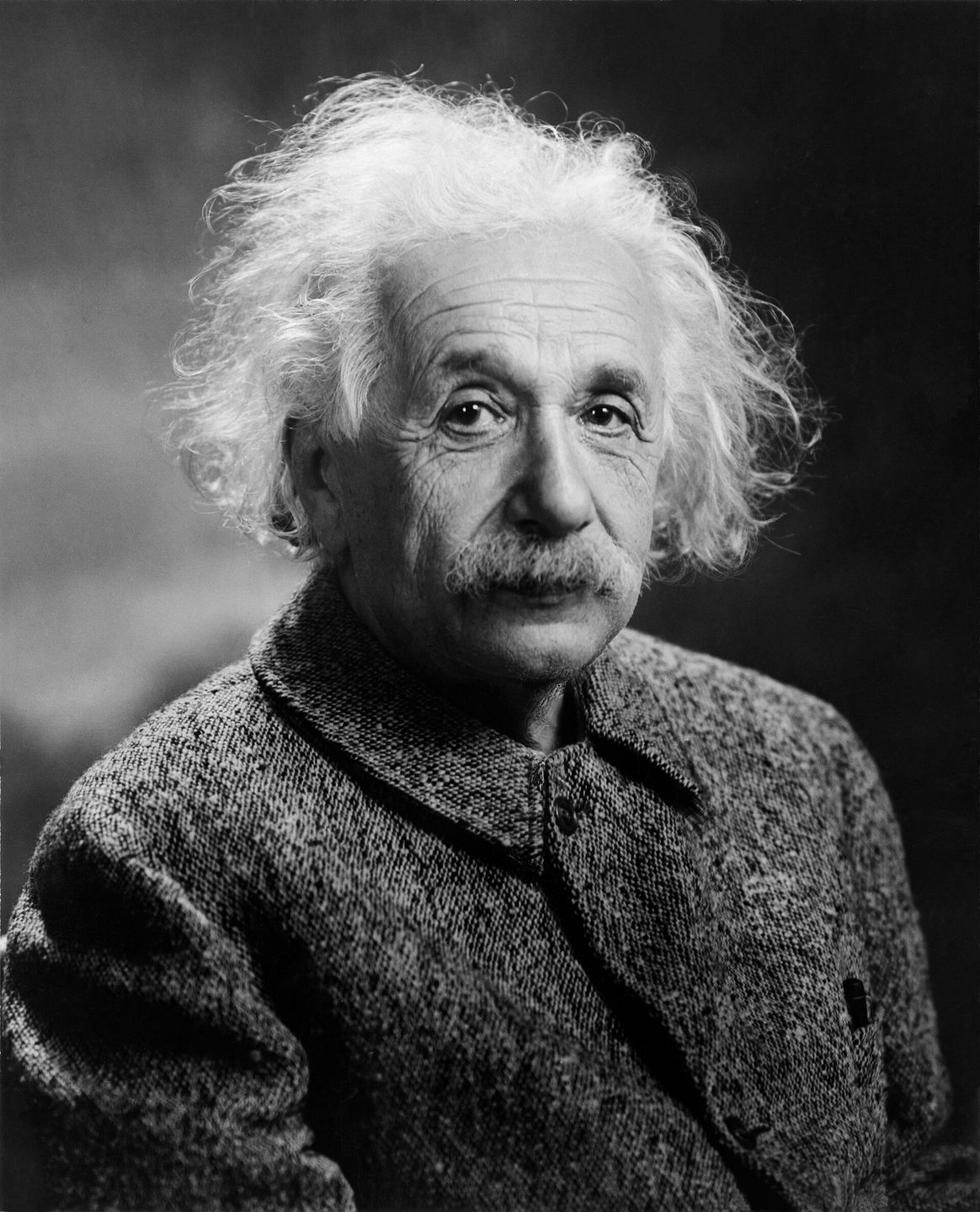
Albert Einstein, theoretical physicist and author of special and general relativity. Oren Jack Turner, Public domain, via Wikimedia Commons
Thought Experiments and a Pencil
On this day in 1879 — Albert Einstein was born, and would rebuild space, time, and energy largely out of thought experiments and a pencil.
3 min read
Albert Einstein was born on March 14, 1879, in Ulm, Germany. He became the most famous physicist of the 20th century, not because he ran experiments in laboratories but because he ran them in his head. His tools were thought, mathematics, and an intuition for how the universe should behave. In 1905, while working as a patent clerk in Bern, he published four papers that restructured physics. One explained the photoelectric effect, proving that light behaves as particles. Another described Brownian motion, confirming the existence of atoms. The third introduced special relativity. The fourth contained the equation E=mc², linking mass and energy in a way that would later enable nuclear power and atomic weapons.
Special relativity emerged from a simple question Einstein had been asking since he was 16: What would you see if you rode alongside a beam of light? Classical physics said you would see a frozen wave, light standing still. But Maxwell's equations, which described electromagnetism, said light always moves at the same speed, no matter how fast the observer is moving. Something had to give. Einstein concluded that time and space are not absolute. They are relative, dependent on the observer's motion. Two events that appear simultaneous to one observer might not be simultaneous to another. Time itself stretches and compresses depending on velocity.
The equation E=mc² was a byproduct of relativity. If mass and energy are equivalent, then matter is just highly concentrated energy. A small amount of mass contains an enormous amount of energy, because the speed of light squared is a very large number. The equation was theoretical when Einstein wrote it. It became practical when physicists realized it described what happens inside atomic nuclei. Splitting an atom releases energy because the fragments weigh slightly less than the original. The missing mass has been converted to energy, exactly as the equation predicts.
Einstein spent the next decade developing general relativity, which extended his earlier work to include gravity. He proposed that massive objects curve the fabric of spacetime, and that gravity is the result of objects following those curves. A planet orbits a star not because it is pulled by an invisible force but because the star warps the space around it, and the planet moves along the curved path. General relativity predicted phenomena no one had observed: light bending around massive objects, the expansion of the universe, black holes. All of these have since been confirmed.
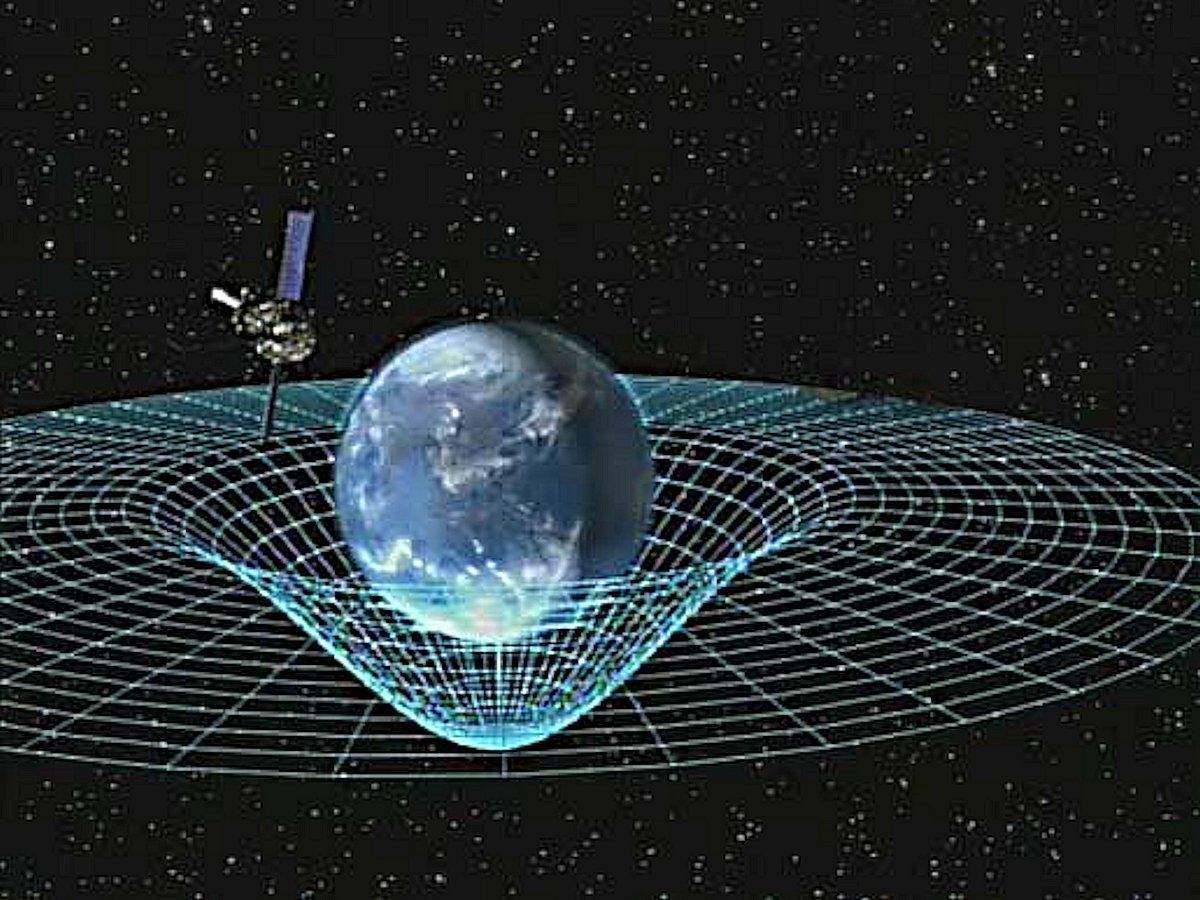
Illustration of spacetime curvature, as predicted by Einstein's general theory of relativity. NASA, Public domain, via Wikimedia Commons
Einstein did not like where quantum mechanics was heading. As physicists explored the behavior of particles at atomic scales, they found that determinism broke down. You could not know both the position and momentum of a particle with arbitrary precision. Outcomes were probabilistic, not certain. Einstein famously objected, saying that God does not play dice with the universe. He spent decades trying to prove that quantum mechanics was incomplete, that there must be hidden variables restoring determinism. He was wrong. Quantum mechanics has been tested exhaustively, and the randomness is fundamental, not a gap in knowledge.
Einstein became a public figure in 1919 when a solar eclipse expedition confirmed his prediction that light bends around the Sun. Newspapers called him a genius. He was invited to lecture around the world. His image, wild hair and rumpled sweater, became iconic. He used his fame to advocate for pacifism, civil rights, and international cooperation. He opposed nationalism and militarism. When the Nazis came to power, he left Germany and never returned. He settled in Princeton, where he spent the rest of his life searching for a unified theory that would reconcile gravity and quantum mechanics. He never found it.
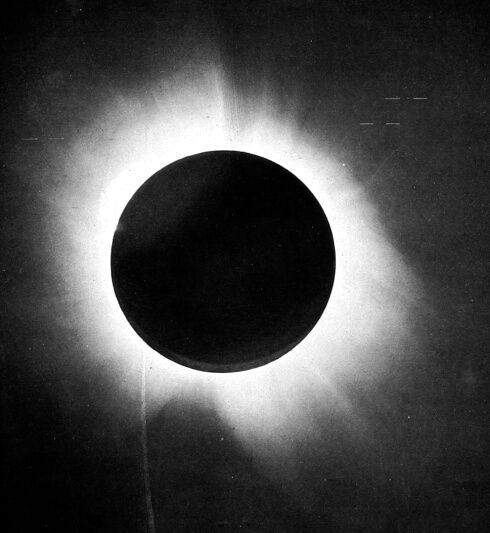
The 1919 total solar eclipse, whose photographs confirmed Einstein's prediction that light bends around the Sun. Frank Watson Dyson / Arthur Eddington / Charles Rundle Davidson, Public domain, via Wikimedia Commons
Einstein's legacy is not just his equations but his method. He trusted intuition and symmetry as guides to truth. He believed that the universe should be elegant, that the laws of physics should be the same for all observers. This was an aesthetic judgment as much as a scientific one. He was willing to follow his reasoning even when it led to conclusions that seemed absurd, like time dilation and spacetime curvature. He was right more often than not, but when he was wrong, as with quantum mechanics, he was spectacularly wrong. That willingness to take big risks on big ideas, to follow thought wherever it leads, is what separates transformative work from incremental refinement.
studio / on-this-day / Mar 14