studio / on-this-day / Mar 8
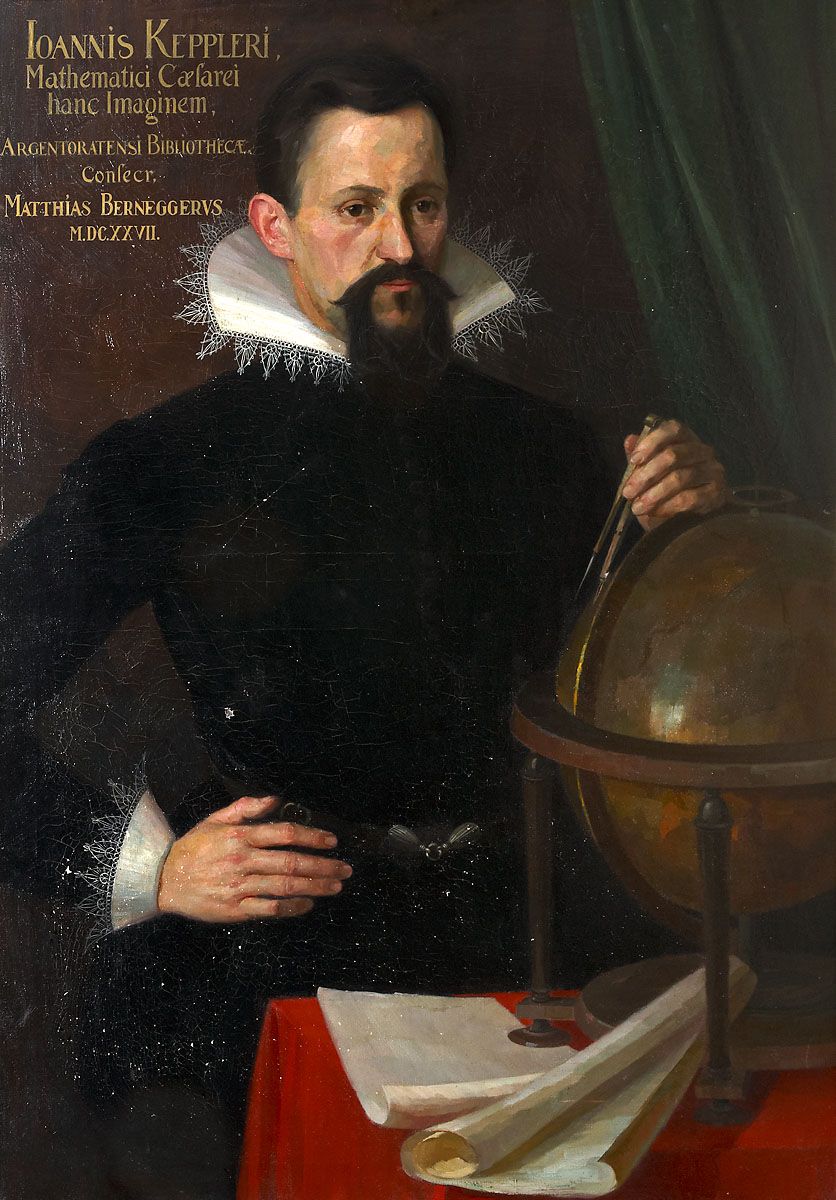
Portrait of johannes Kepler, c. 1610. August Köhler [1], Public domain, via Wikimedia Commons
When Orbits Became Equations
On this day in 1618 — Johannes Kepler arrived at his third law, and the motion of the planets became arithmetic instead of mythology.
3 min read
Johannes Kepler announced his third law of planetary motion on March 8, 1618. It stated that the square of a planet's orbital period is proportional to the cube of its average distance from the Sun. Written as an equation: T² ∝ a³. That single relationship unified the motion of all planets into one mathematical rule. It meant the solar system was not a collection of independent objects following divine whims. It was a mechanical system operating according to discoverable laws. The heavens, it turned out, were computable.
Kepler's path to this insight was anything but straightforward. He spent years analyzing the astronomical observations of Tycho Brahe, who had compiled the most accurate planetary data ever recorded. Brahe's measurements of Mars were precise enough to reveal discrepancies in existing models. Kepler tried to fit the data to circular orbits, as centuries of tradition demanded. The circles did not work. After exhaustive calculations, he concluded that planets move in ellipses, with the Sun at one focus. This was his first law, published in 1609. It violated 2,000 years of astronomical dogma.
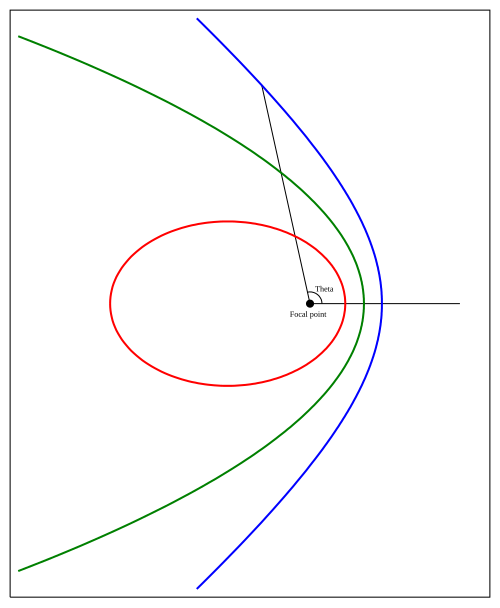
Diagram of Kepler orbital mechanics. Stamcose, CC BY-SA 4.0, via Wikimedia Commons
The second law followed quickly: a line connecting a planet to the Sun sweeps out equal areas in equal times. This meant planets move faster when they are closer to the Sun and slower when they are farther away. It was an elegant geometric statement about angular momentum, though Kepler did not have that language. What he had was data and a willingness to trust it over inherited assumptions. The laws were not guesses. They were descriptions of what the numbers showed.
The third law took another nine years to find. Kepler was searching for a harmonic relationship between planetary distances and orbital periods, convinced that the solar system reflected musical ratios. He was wrong about the music, but the search led him to the correct mathematical relationship. When he found it, the equation was so simple it felt inevitable. Any planet, any orbit, followed the same rule. Distance and time were locked together by a cube and a square.
Kepler's laws became the foundation of celestial mechanics. Isaac Newton later used them to derive his law of universal gravitation. If planets follow elliptical paths and sweep out equal areas, then the force holding them in orbit must decrease with the square of the distance. Kepler had described how planets move. Newton explained why. Together, they turned astronomy from observation into physics, from pattern-finding into prediction.
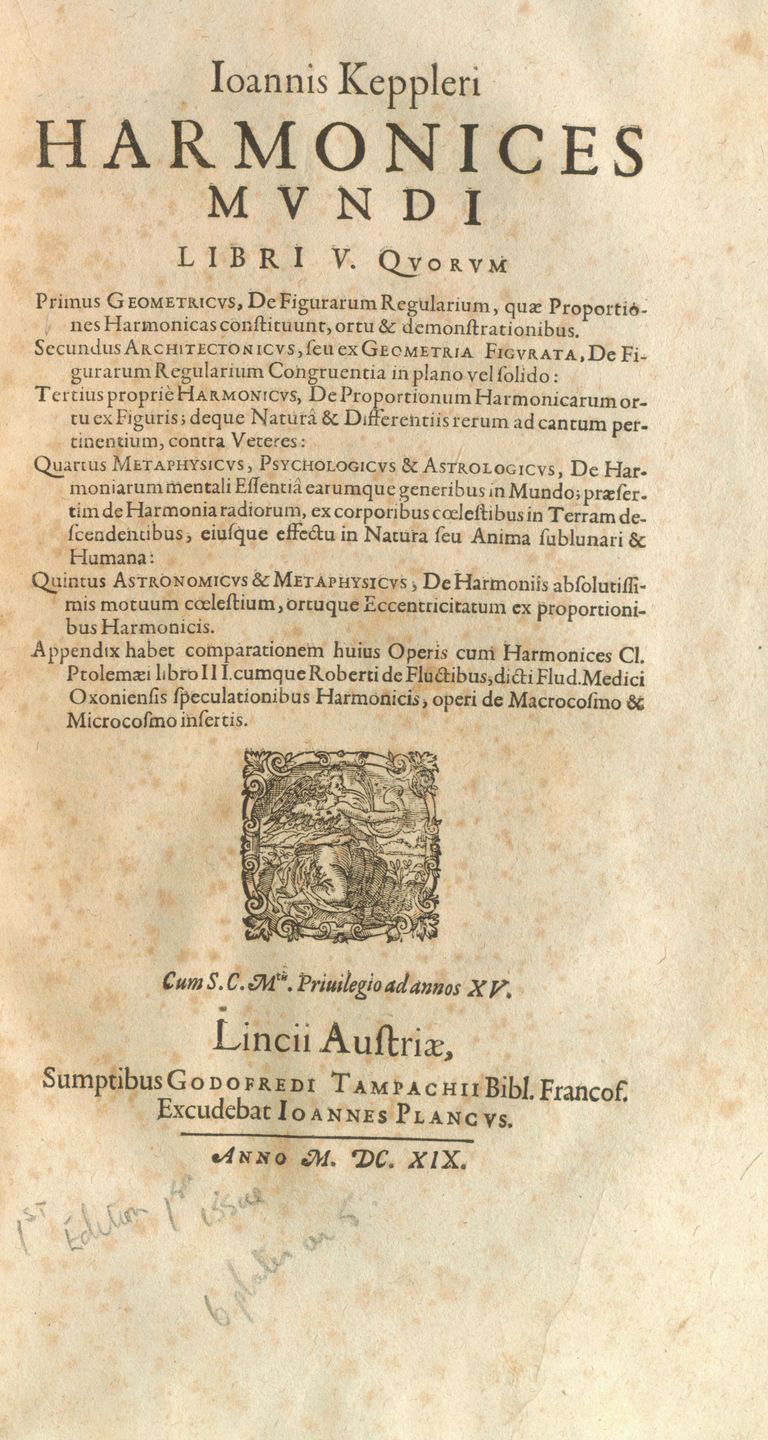
Title page of harmonices mundi (1619), where Kepler published his third law. Johannes Kepler, Public domain, via Wikimedia Commons
Kepler himself was a strange figure for the role. He was deeply religious, convinced that geometry was the language God used to design the universe. He published treatises on the mystical significance of the five Platonic solids and their relationship to planetary orbits. Most of his cosmological theology was nonsense. But buried within it were insights that reshaped science. His willingness to follow the data, even when it contradicted his own aesthetic preferences, separated him from his contemporaries.
The third law also enabled a new kind of calculation. If you knew the orbital period of a planet, you could determine its distance from the Sun. If you knew the distance, you could calculate the period. The solar system became a knowable structure, not a divine mystery. Astronomers used Kepler's laws to predict planetary positions decades in advance. The predictions worked. The universe, at least in this corner, behaved predictably.
Modern spacecraft navigation still relies on Kepler's laws. When engineers plot a trajectory to Mars or Jupiter, they are calculating elliptical orbits and transfer windows using the same principles Kepler discovered in 1618. The math has been refined, relativistic corrections have been added, but the core framework remains. A trajectory is just an orbit, and orbits follow rules. Kepler found those rules with a quill, parchment, and decades of patience. We still use them to navigate the solar system.
studio / on-this-day / Mar 8