studio / on-this-day / Feb 16

Women lining up for nylon stockings at miller's department store in oak ridge, postwar. Doe-oakridge, Public domain, via Wikimedia Commons
The Thread That Nature Never Made
On this day in 1937 — Wallace Carothers patented nylon, the first fully synthetic fiber, a thread nature had never once produced.
3 min read
Wallace Hume Carothers never lived to see what his invention would become. On February 16, 1937, the U.S. Patent Office granted him patent number 2,071,250 for "linear condensation polymers," a family of synthetic materials that included what DuPont would soon market as nylon. It was the first fully synthetic fiber ever created, a material with no analog in the natural world. Within two years it would transform the textile industry. Within a decade it would be everywhere.
Carothers came to DuPont in 1928 from Harvard, where he had been teaching organic chemistry. He was brilliant, meticulous, and quietly tormented by depression. DuPont gave him something rare: a corporate laboratory with the freedom to pursue fundamental research. No product mandate. No quarterly targets. Just the question of whether long-chain molecules, polymers, could be designed from scratch.
The question mattered because every fiber humans had ever worn came from something alive. Cotton grew in fields. Silk came from worms. Wool came from sheep. Even rayon, marketed as artificial silk, was derived from plant cellulose. Carothers wanted to build a fiber from nothing but chemical building blocks, molecule by molecule, the way an architect designs a building from raw materials rather than repurposing an existing structure.
His team's early work produced neoprene, a synthetic rubber, in 1930. But the real breakthrough came in 1935 when researcher Julian Hill pulled a strand of molten polymer from a beaker and found it could be drawn into a strong, elastic filament. The material resisted water, mold, and insects. It was stronger than silk and could be manufactured at industrial scale. They called it Fiber 66 before the marketing department settled on nylon.
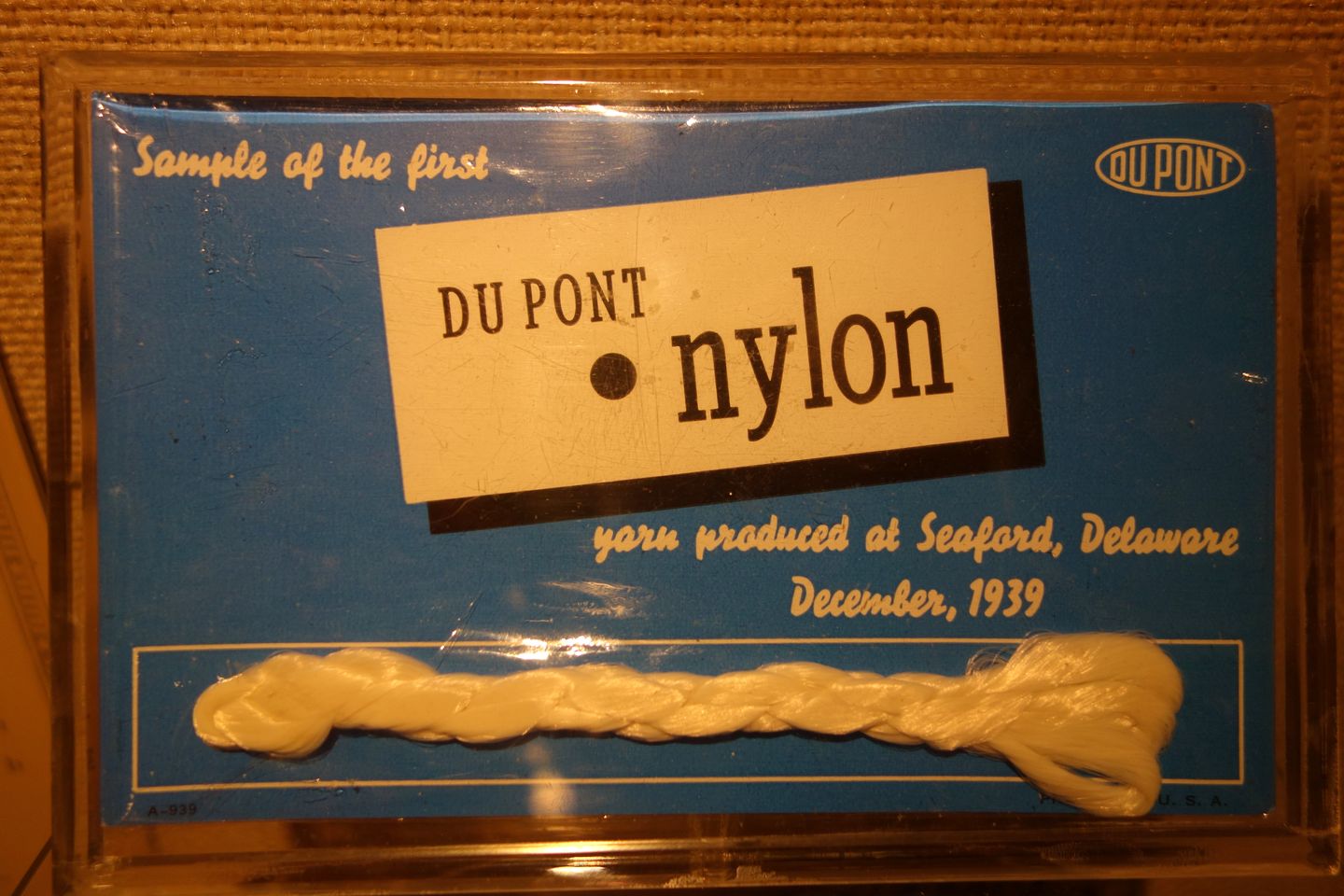
Sample of the first DuPont nylon, December 1939. Daderot, CC0, via Wikimedia Commons
The patent Carothers received in 1937 was foundational. It didn't just protect a single product; it described an entire class of materials that could be engineered for specific purposes. This was chemistry as design practice, the deliberate creation of matter with predetermined properties. It represented a philosophical shift as much as a technical one: nature was no longer the only source of raw materials. Just as Joseph Jacquard's programmable loom had turned textile weaving into something closer to computation a century earlier, Carothers turned material science into something closer to architecture.
DuPont introduced nylon stockings to the public in 1939. They sold five million pairs in the first year. During World War II, nylon production was diverted entirely to military use: parachutes, tire cords, rope, and flak vests. Women drew seam lines on the backs of their bare legs to imitate the look of stockings they could no longer buy. When the war ended and nylon returned to consumer markets, stores saw near-riots. The "nylon riots" of 1946 remain one of the stranger episodes in the history of consumer demand.
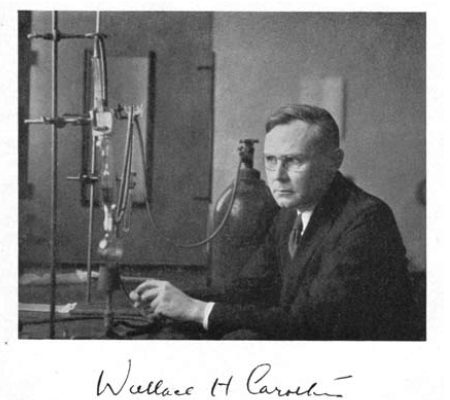
Wallace Carothers, the DuPont chemist who invented nylon. Роджер Адамс, Copyrighted free use, via Wikimedia Commons
Carothers never witnessed any of it. Struggling with severe depression and devastated by the death of his sister, he took his own life on April 29, 1937, just two months after receiving the patent. He was 41. He had been elected to the National Academy of Sciences the year before, the first industrial organic chemist to receive that honor.
What Carothers left behind was more than a fiber. He established the principle that materials could be designed to specification, that molecular structure could be a blueprint. Every engineered polymer since, from polyester to Kevlar to the vulcanized rubber Charles Goodyear stumbled upon a century earlier, exists in the conceptual space Carothers opened. He proved that chemistry is, at its core, a design discipline. The molecules just happen to be very, very small.
studio / on-this-day / Feb 16