studio / on-this-day / Jun 14
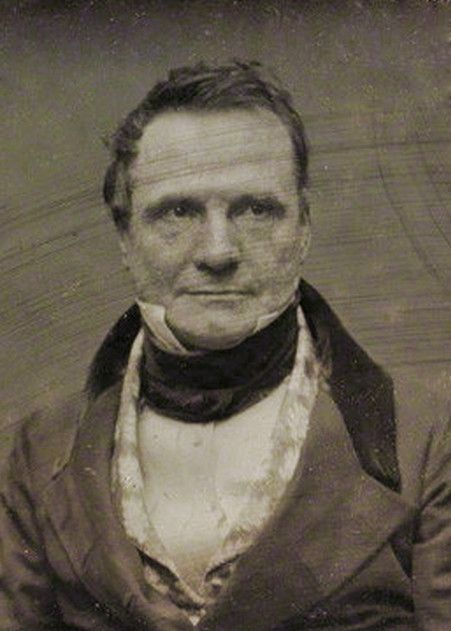
Charles Babbage, around 1850. public domain, via Wikimedia Commons
The Computer Made of Brass
On this day in 1822 — Charles Babbage proposed a machine that could calculate by turning a crank, and sketched the idea of the computer more than a century before one could be built.
4 min read
On June 14, 1822, Charles Babbage stood before the Royal Astronomical Society in London and described a machine that could do arithmetic by itself. Turn a crank, and it would calculate. It sounds modest now, but in 1822 the numbers that ran the world, the tables used for navigation, banking, engineering, artillery, were all computed by hand, by rooms full of people whose job title was literally "computer." Those tables were riddled with errors, and at sea an error in a navigation table could put a ship on the rocks. Babbage's idea was to replace the fallible humans with an unerring machine of gears.
He called it the Difference Engine. It worked by a mathematical trick called the method of differences, which reduces the calculation of complicated functions to nothing but repeated addition, and addition is something brass gears can do. Better still, it would set its own results in type and print them directly, cutting out the copyists and typesetters who introduced fresh errors at every step. It was a calculator the size of a room, assembled from thousands of precision-made parts.
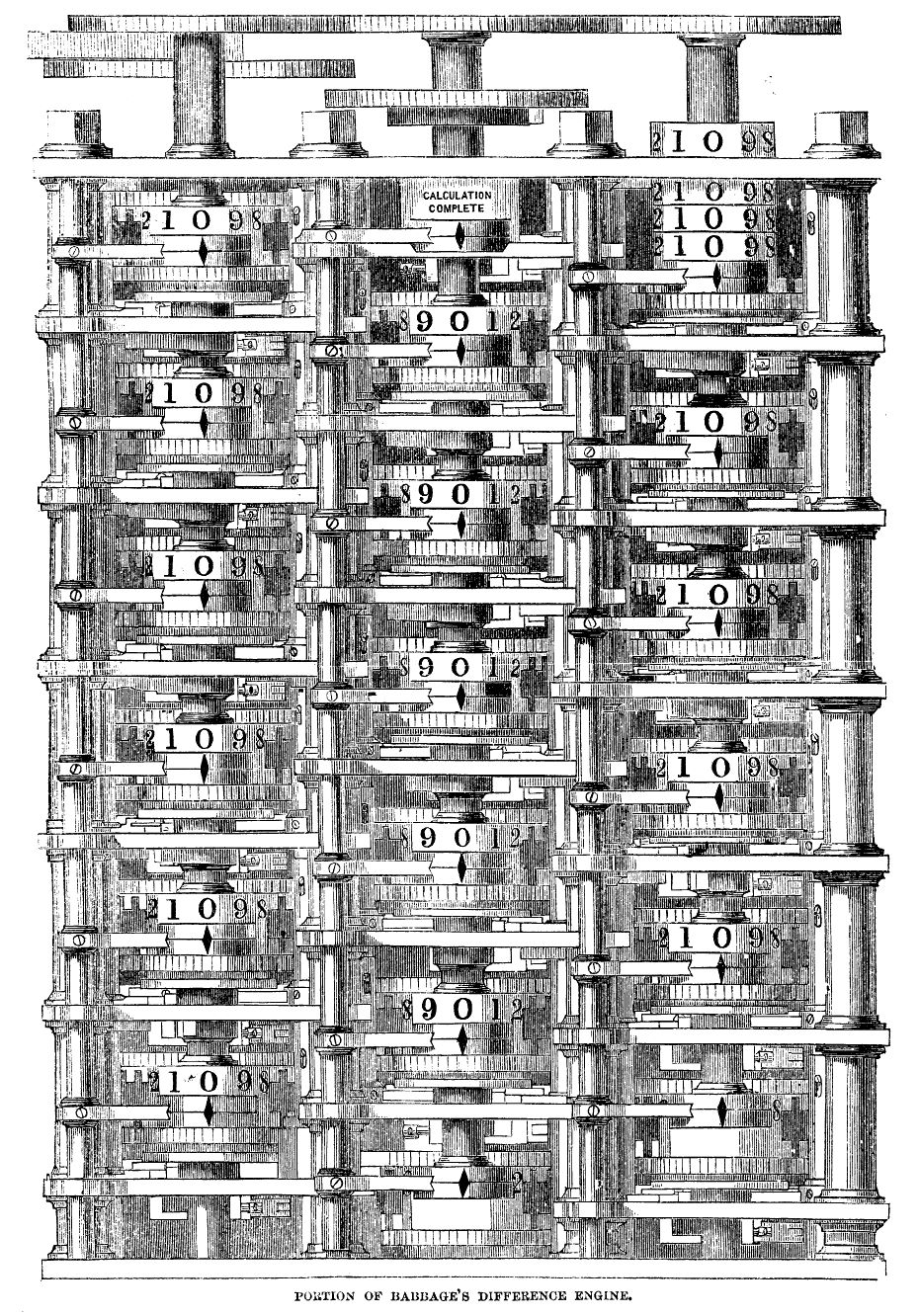
A drawing of a portion of Babbage's Difference Engine. Public domain, via Wikimedia Commons
The British government, persuaded, funded it, one of the first large public investments in what we would now call research and development. It did not go well. The engine demanded metalwork more precise than the era could reliably produce, the budget ballooned, Babbage feuded with his engineer, and the machine was never finished in his lifetime. Judged as a project, it was a costly failure.
But Babbage had already leapt past it in his head. He began designing a second, far more ambitious machine, the Analytical Engine, and in doing so he described, in brass and cardwork, essentially everything a computer is. It would be programmed with punched cards borrowed from the Jacquard weaving loom. It had a "store," which is to say memory, and a "mill," which is to say a processor. It could make decisions and loop, doing one thing if a number came out one way and something else if it came out another. It was a general-purpose computer, sketched in the 1830s, a full century before electronics existed to build one.
Ada Lovelace, translating a paper about the machine, saw further than almost anyone, including arguably Babbage himself. She grasped that if the engine could manipulate numbers, it could manipulate anything that could be represented as numbers, including music, and she wrote out a detailed method for the machine to compute a sequence, often described as the first algorithm written for a computer. She was reasoning about software before there was any hardware to run it.
The lesson of Babbage is not failure but timing. He was right, and about a hundred years early. The concept was sound; the world simply could not yet manufacture it. The proof came in the 1990s, when the London Science Museum built a Difference Engine from his original drawings, using tolerances he could have specified but not achieved, and it worked exactly as he said it would. The design had been correct the whole time. It had only been waiting for the rest of technology to catch up.
So the entire architecture of computing, memory and processor, program and data, conditional logic and loops, existed on paper, in gears, a century before the first working electronic computers switched on. Babbage did not build the computer. He designed it, and then handed the problem, unsolved, to a future that would need almost everything else to be invented first before it could finally turn his crank by other means.
studio / on-this-day / Jun 14