studio / on-this-day / Jan 8
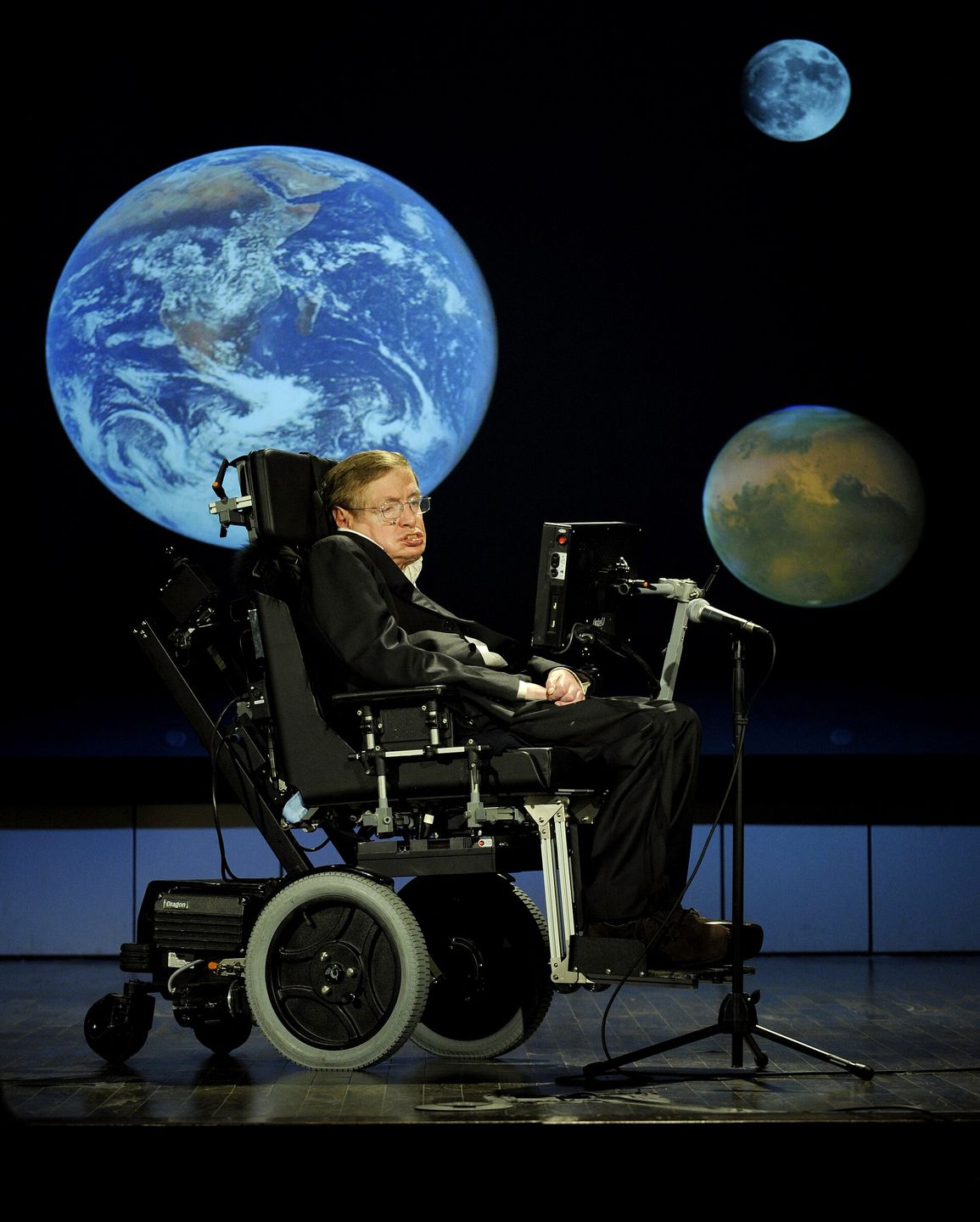
Stephen Hawking at NASA headquarters during the 50th anniversary celebration in 2008. NASA/Paul E. Alers, Public domain, via Wikimedia Commons
The Universe in a Wheelchair
On this day in 1942 — Stephen Hawking was born, and would spend a life inside a failing body mapping the physics of black holes.
3 min read
Stephen Hawking was born in Oxford on January 8, 1942, exactly 300 years after Galileo died. He liked to point that out. He also liked to note that he was born on the anniversary of Elvis Presley's birth, though he was less proud of that coincidence. Hawking had a sense of humor about the universe and his place in it, which was fortunate, because the universe gave him plenty of material.
He was diagnosed with amyotrophic lateral sclerosis, ALS, at age 21 while studying cosmology at Cambridge. Doctors gave him two years to live. He lived for 55 more. The disease gradually paralyzed him, taking his ability to walk, then to write, then to speak. By his 40s, he could communicate only through a speech synthesizer controlled by tiny muscle movements in his cheek. The voice it produced was flat, robotic, American-accented. It became one of the most recognizable voices in science.
Hawking's greatest work came from a thought experiment about black holes. In the 1970s, most physicists believed black holes were simple: they swallowed everything that fell into them and nothing ever came out. But Hawking realized that quantum mechanics complicated the picture. At the edge of a black hole, particle pairs could spontaneously form. One particle would fall in, the other would escape. From the outside, it would look like the black hole was radiating. Over billions of years, a black hole could evaporate completely.
This was radical. It meant black holes weren't eternal. It meant they had thermodynamics, temperature, entropy. It connected gravity, quantum mechanics, and thermodynamics in a way no one had done before. The radiation is now called Hawking radiation. It has never been directly observed because the effect is infinitesimally small, but the math is compelling. It remains one of the most elegant ideas in theoretical physics.
Hawking's popular science book, A Brief History of Time, was published in 1988. It stayed on the bestseller list for 237 weeks. Millions of people bought it. Far fewer actually finished it. But it mattered anyway. Hawking wrote about the big bang, the nature of time, the search for a unified theory of physics. He made cosmology feel urgent and personal, not just abstract equations on a chalkboard. He asked whether the universe had a beginning, whether time had a direction, whether we could ever understand the mind of God.

Stephen Hawking delivering a public lecture at the hebrew university of jerusalem, December 2006. CC BY-SA 3.0, via Wikimedia Commons
He became famous not just for his science, but for his refusal to let his condition define him. He appeared on Star Trek, The Simpsons, and The Big Bang Theory. He wrote children's books with his daughter. He took zero-gravity flights. He became a symbol of human persistence, proof that a mind could transcend the body it was trapped in.
Critics sometimes said Hawking was overrated, that his celebrity exceeded his scientific contributions, that he became more icon than physicist. There's some truth to that. But his work on black holes and cosmology was genuinely groundbreaking, and his ability to communicate complex ideas to a general audience was unmatched. Just as Isaac Asimov made robots feel moral, Hawking made the cosmos feel comprehensible.
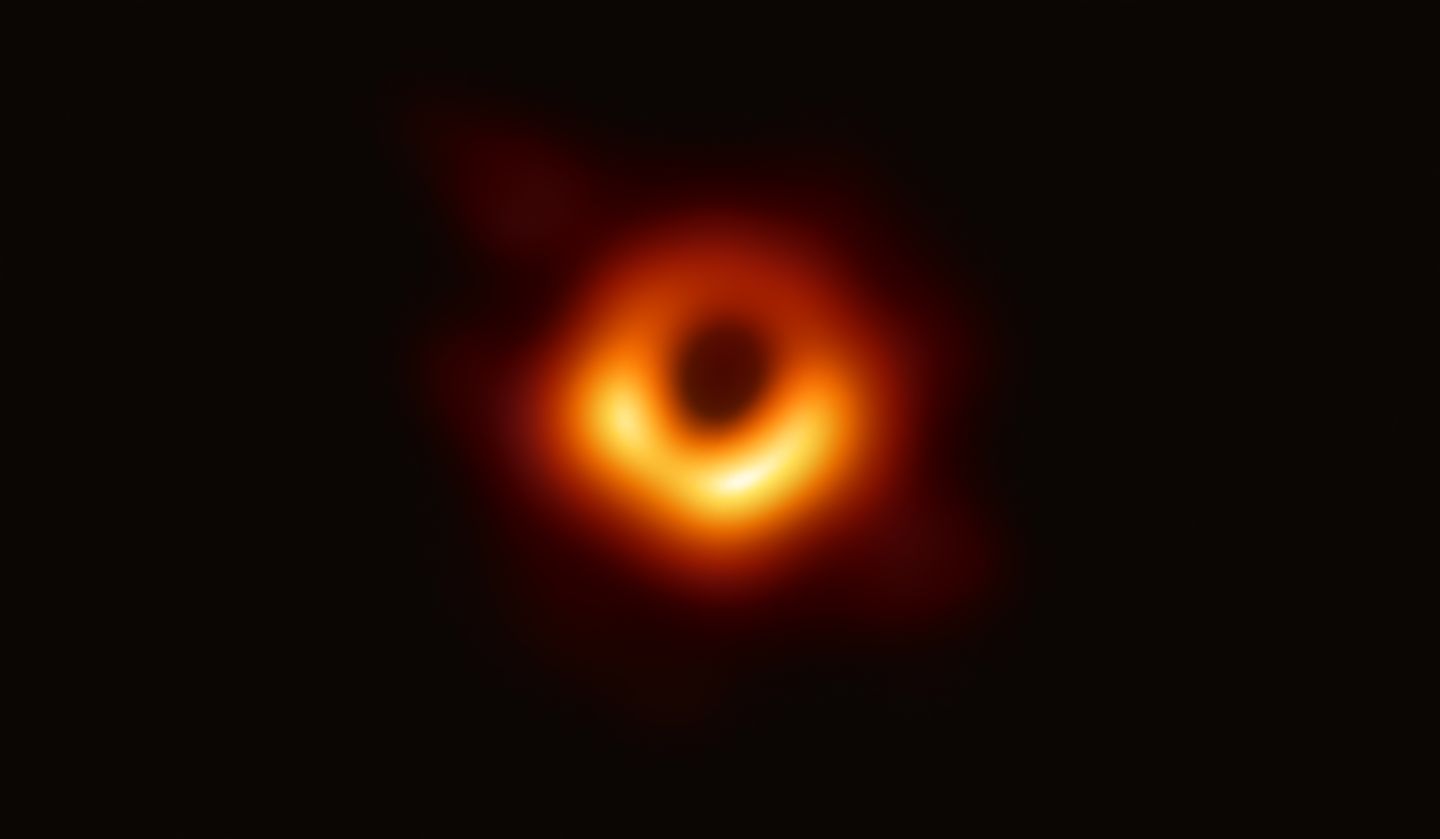
The first direct image of a black hole, captured at the center of galaxy m87 by the event Horizon Telescope in 2019, a year after Hawking's death. Event Horizon Telescope, CC BY 4.0, via Wikimedia Commons
Hawking died on March 14, 2018, another date he would have enjoyed. It was Pi Day, and the anniversary of Einstein's birth. His ashes were interred in Westminster Abbey, between Newton and Darwin. He spent his life asking how the universe worked, why it exists, whether it had to be this way. He didn't answer all those questions. But he showed that they were worth asking, and that a single human mind, however constrained, could reach across billions of light years and glimpse the structure of reality.
studio / on-this-day / Jan 8