studio / on-this-day / Jan 7
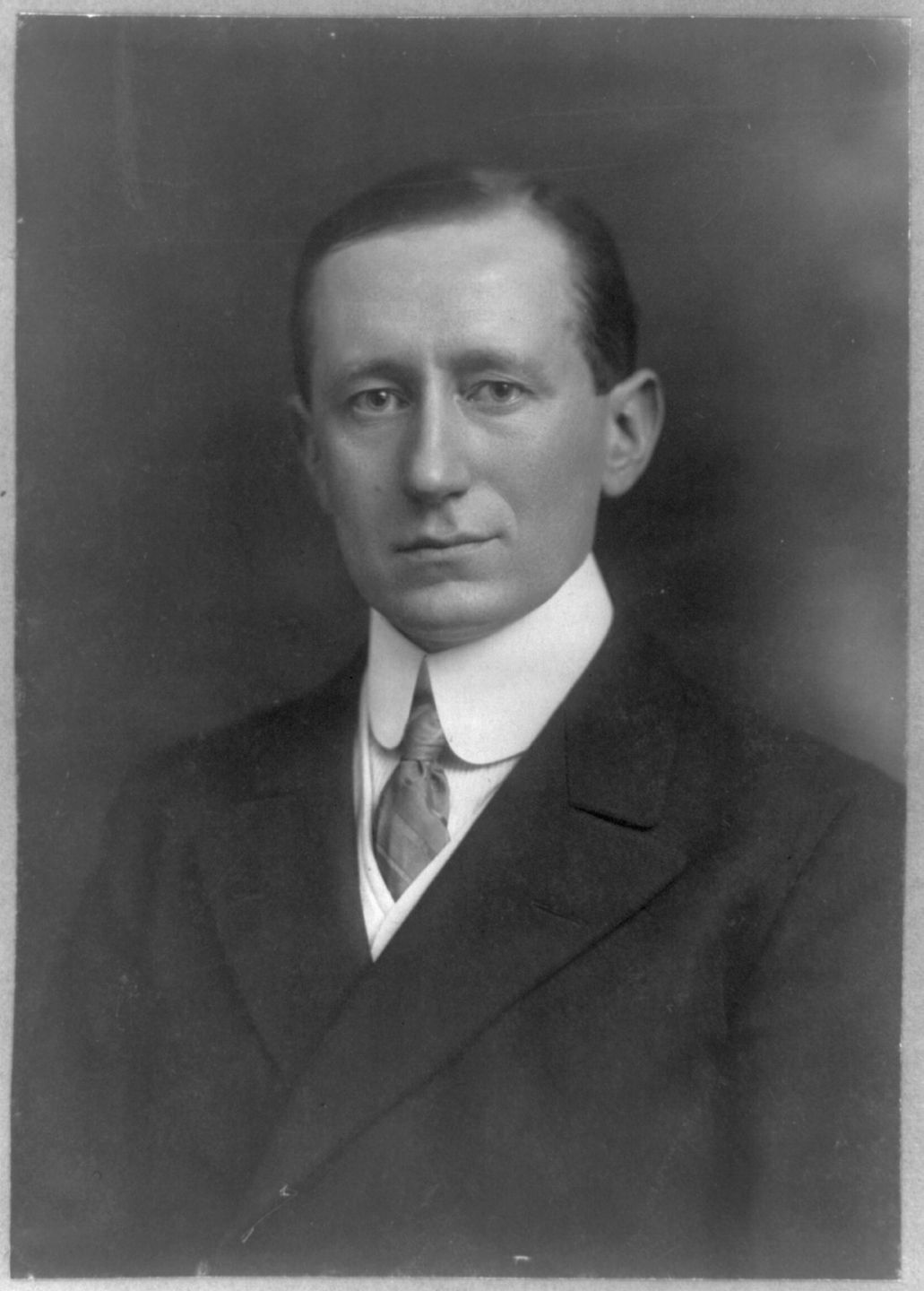
Guglielmo Marconi, inventor of the wireless telegraph, whose Marconi Company established the CQD Distress signal in 1904. Miscellaneous Items in High Demand, PPOC, Library of Congress, Public domain, via Wikimedia Commons
The Signal Everyone Understood
On this day in 1904 — the CQD distress call was adopted, the first agreed way for a ship in trouble to say so to anyone listening.
3 min read
On January 7, 1904, the Marconi International Marine Communication Company issued a new directive to all ships equipped with its wireless telegraph systems. If a vessel was in distress, the radio operator should transmit "CQD." CQ was already the general call in wireless telegraphy, a signal meaning "all stations." The D stood for distress. Together, they meant: everyone listen, we need help.
It was the first standardized distress signal in the age of wireless communication. Before radio, ships in trouble fired rockets, flew signal flags, or simply hoped someone would notice. Distance was fatal. A ship could sink a few miles from shore and no one would know until it failed to arrive at port. Wireless changed that. A ship could call for help across hundreds of miles of open ocean. But only if everyone agreed on what that call should sound like.
CQD worked, but it wasn't perfect. In Morse code, it required eleven separate signals: dash-dot-dash-dot, dash-dash-dot-dash, dash-dot-dot. It was easy to mistake for other transmissions. And because it was a Marconi standard, not all ships recognized it. German vessels used SOE. Some British operators used the letters in their company's name. The ocean was filling with voices, but they weren't all speaking the same language.
In 1906, at the International Radiotelegraphic Conference in Berlin, nations agreed on a new standard: SOS. It wasn't an acronym. It didn't stand for "save our ship" or "save our souls." It was chosen because it was distinctive. In Morse code, SOS is three dots, three dashes, three dots, sent as a continuous signal with no gaps between the letters. Dot-dot-dot-dash-dash-dash-dot-dot-dot. Once you heard it, you knew exactly what it was. No ambiguity. No confusion. Pure signal.

A Marconi wireless telegraph station — the type of installation that transmitted Distress signals across the ocean. Andrew Woodvine, CC BY-SA 2.0, via Wikimedia Commons
The first ship to use SOS in a real emergency was the Cunard liner Slavonia, which ran aground off the Azores in 1909. Everyone survived. But the signal that made SOS famous came three years later, on April 14, 1912, when the RMS Titanic struck an iceberg in the North Atlantic. The radio operator, Jack Phillips, sent both CQD and SOS, alternating between the old signal and the new. CQD was what he knew. SOS was what the world had agreed on. He sent them both until the power failed and the ship went down.
SOS became the universal distress call not because of regulation, but because everyone understood it. It worked across languages, across national boundaries, across the chaos of overlapping transmissions. It was a design solution to a coordination problem. Just as Morse code reduced language to dots and dashes, SOS reduced emergency to a pattern anyone could recognize.
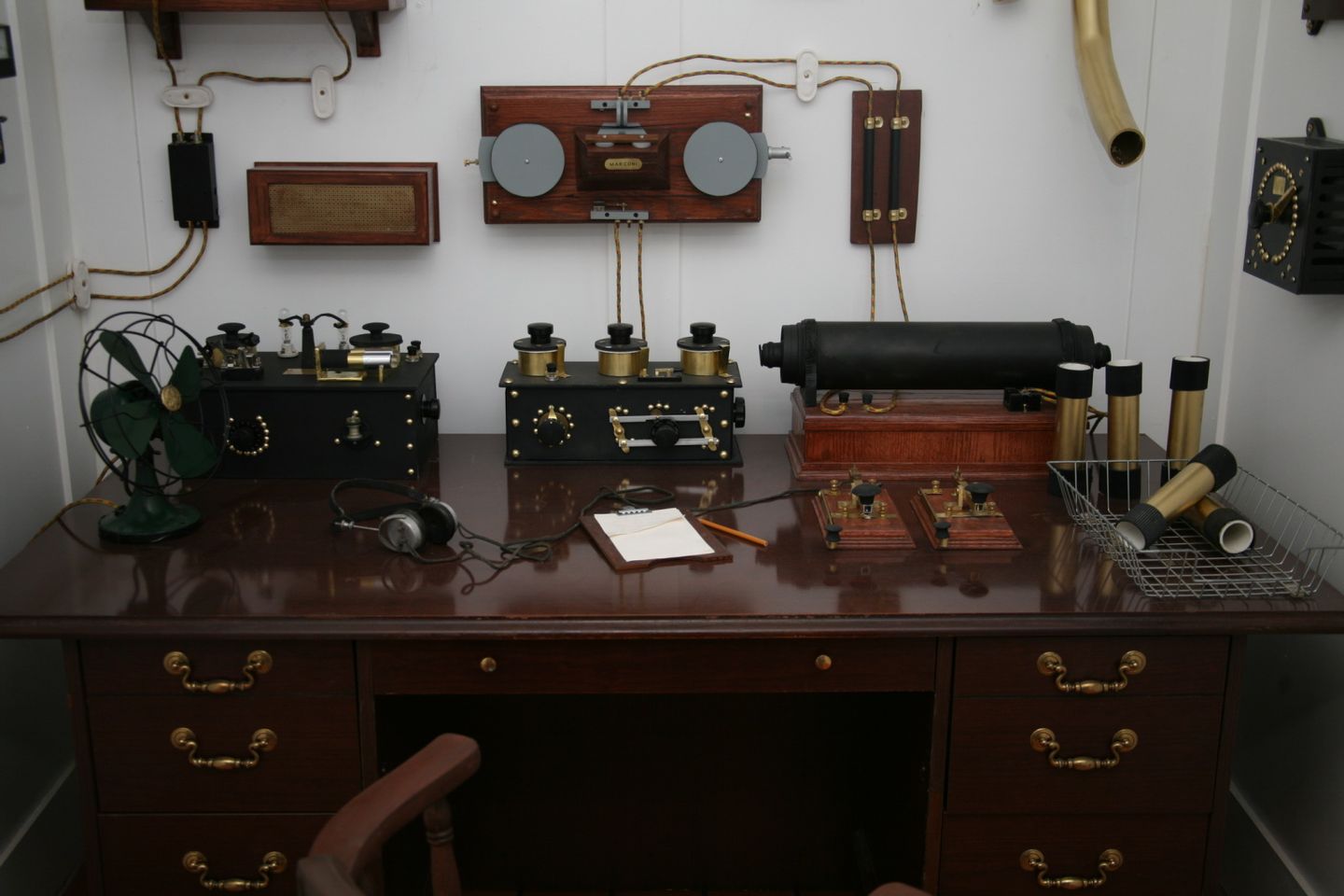
The Marconi wireless apparatus aboard the RMS Titanic — the room from which Jack Phillips alternated CQD and SOS until the power failed. Cliff1066, CC BY 2.0, via Wikimedia Commons
The signal remained in use for nearly a century. Ships sent it through two world wars, through countless storms, through the gradual replacement of Morse telegraphy with voice radio. It was officially retired in 1999, replaced by the Global Maritime Distress and Safety System, which uses digital signals and satellite communication. No one sends SOS anymore. But everyone still knows what it means.
What SOS proved was that universal standards save lives. A signal is only useful if everyone agrees on its meaning. That agreement requires coordination, compromise, and the willingness to abandon local solutions for global ones. The distress signal worked because it was simple, distinctive, and adopted by everyone. It was infrastructure made of rhythm and repetition, a pattern that cut through noise and distance to say the only thing that mattered: we are here, and we need help.
studio / on-this-day / Jan 7