studio / on-this-day / Sep 5
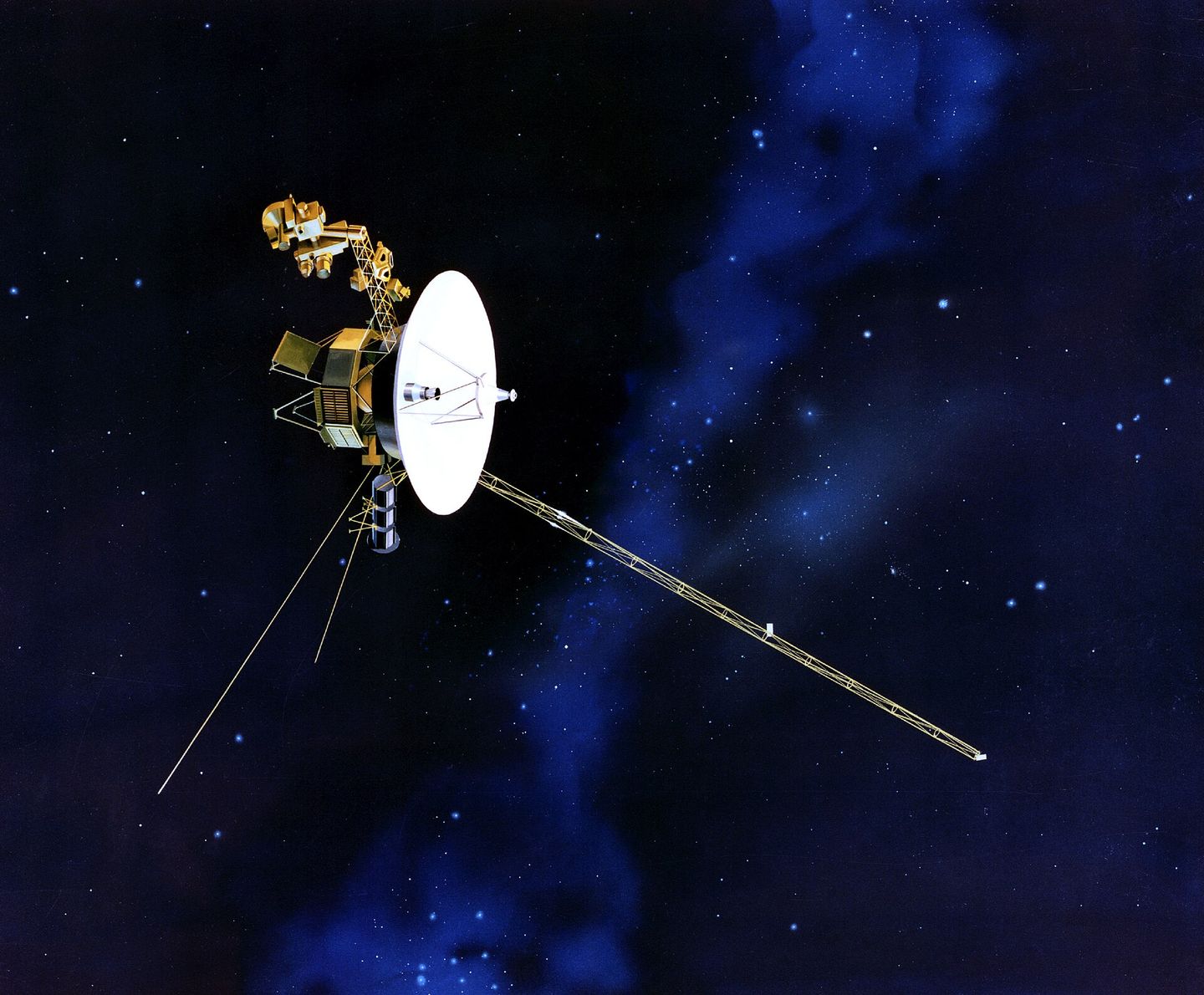
Artist's concept of the Voyager spacecraft. NASA/JPL, Public domain, via Wikimedia Commons
The Message in a Bottle We Threw at the Stars
On this day in 1977 — Voyager 1 launched, and is now the most distant human-made object in existence, still faintly calling home.
3 min read
On September 5, 1977, a Titan IIIE rocket lifted off from Cape Canaveral carrying a 722-kilogram spacecraft called Voyager 1. Its mission was to fly by Jupiter and Saturn, send back photographs and data, and then continue into the outer solar system. The spacecraft was designed to last five years. Nearly five decades later, it is still operating, now over 15 billion miles from Earth, moving through interstellar space at 38,000 miles per hour. It is the farthest human-made object from our planet, and it is still sending data home.
Voyager 1 was built during a brief window when the outer planets aligned in a way that happens once every 176 years. The alignment meant a spacecraft could use gravity assists, slingshotting from one planet to the next without needing massive amounts of fuel. The mission was originally called the Grand Tour, and it was audaciously ambitious. Voyager 1 and its twin, Voyager 2, would visit all four gas giants: Jupiter, Saturn, Uranus, and Neptune. The engineering margins were tight, the budget was constrained, and the timeline was compressed. But the opportunity was too rare to pass up.
The spacecraft itself was a marvel of redundancy and constraint. Every component had a backup. The computers ran on 8-bit processors with 69 kilobytes of memory, less than a digital watch today. The instruments were powered by plutonium-238 radioisotope thermoelectric generators, slowly decaying radioactive material that would provide electricity for decades. The communications antenna was a 12-foot dish designed to send data back to Earth at an agonizingly slow 160 bits per second. Everything about Voyager was designed for longevity, durability, and the assumption that no one would ever be able to repair it.
Voyager 1 reached Jupiter in March 1979, sending back the first close-up images of the planet's Great Red Spot and discovering active volcanoes on its moon Io. In November 1980, it flew by Saturn, photographing its rings in unprecedented detail and revealing new moons. After Saturn, its trajectory took it upward, out of the plane of the solar system, heading toward the boundary where the sun's influence fades and interstellar space begins. The mission, as originally designed, was over. But the spacecraft kept going.
On February 14, 1990, at the request of astronomer Carl Sagan, Voyager 1 turned its camera back toward Earth one last time. From 3.7 billion miles away, it captured an image of our planet as a pale blue dot suspended in a sunbeam, smaller than a single pixel. Sagan later wrote that the photograph was a reminder of our fragility, our isolation, and the preciousness of the only home we have ever known. It was the last photograph Voyager 1 ever took. Its cameras were shut down to conserve power.
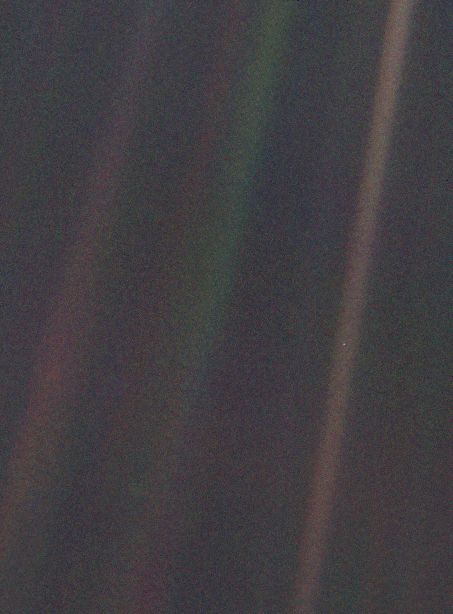
The Pale Blue Dot — Earth photographed by Voyager 1 from 3.7 billion miles away, February 14, 1990. Voyager 1, Public domain, via Wikimedia Commons
In August 2012, Voyager 1 crossed the heliopause, the boundary where the solar wind from the sun gives way to the interstellar medium. It became the first human-made object to enter interstellar space. The spacecraft is now traveling through a region where the density of particles is only about one atom per cubic centimeter, a near-perfect vacuum by any terrestrial standard. Yet it can still measure magnetic fields, cosmic rays, and plasma waves. Every day, it sends that data back to Earth, a signal that takes over 22 hours to arrive.
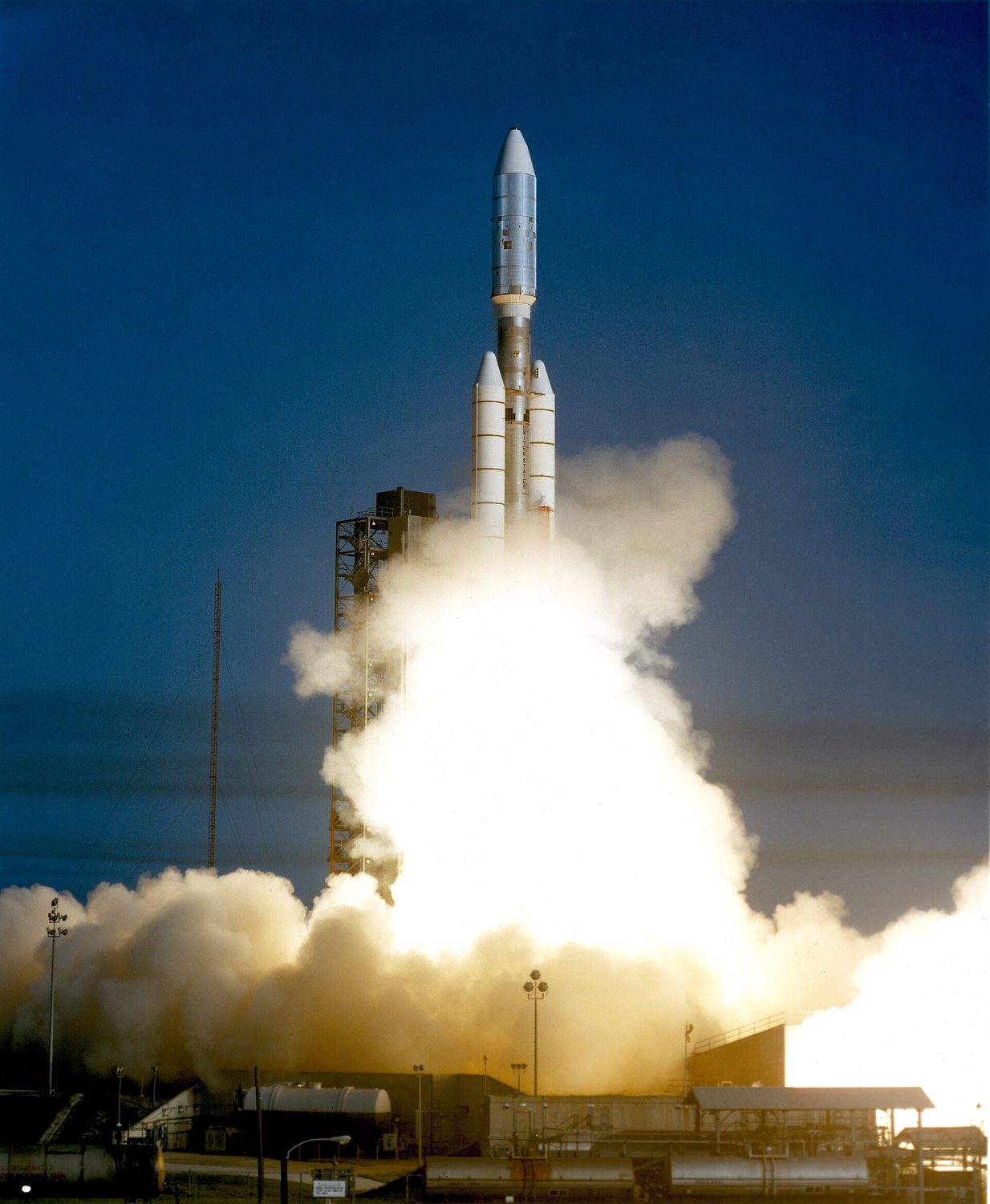
A Titan-Centaur rocket launching a Voyager probe in 1977. Public domain, via Wikimedia Commons
Mounted to the side of Voyager 1 is a golden record, a 12-inch gold-plated copper disk containing sounds and images selected to represent the diversity of life on Earth. There are greetings in 55 languages, music from Bach to Chuck Berry, sounds of rain, wind, and laughter, and 116 images encoded in analog form. The record includes instructions for how to play it, etched in symbols intended to be understood by any species capable of retrieving it. It is a message to whoever might find it, millions of years from now, long after Earth and its civilizations have changed beyond recognition or ceased to exist.
Voyager 1 will keep transmitting until around 2025, when its power supply will no longer be able to run its instruments. After that, it will go silent, continuing its journey as a ghost ship drifting through the galaxy. In about 40,000 years, it will pass within 1.6 light-years of the star Gliese 445. Long after humanity is gone, Voyager 1 will still be out there, carrying our music, our languages, and our photographs into the dark. It is the farthest thing we have ever made, and the longest message we have ever sent.
studio / on-this-day / Sep 5