studio / on-this-day / Dec 20
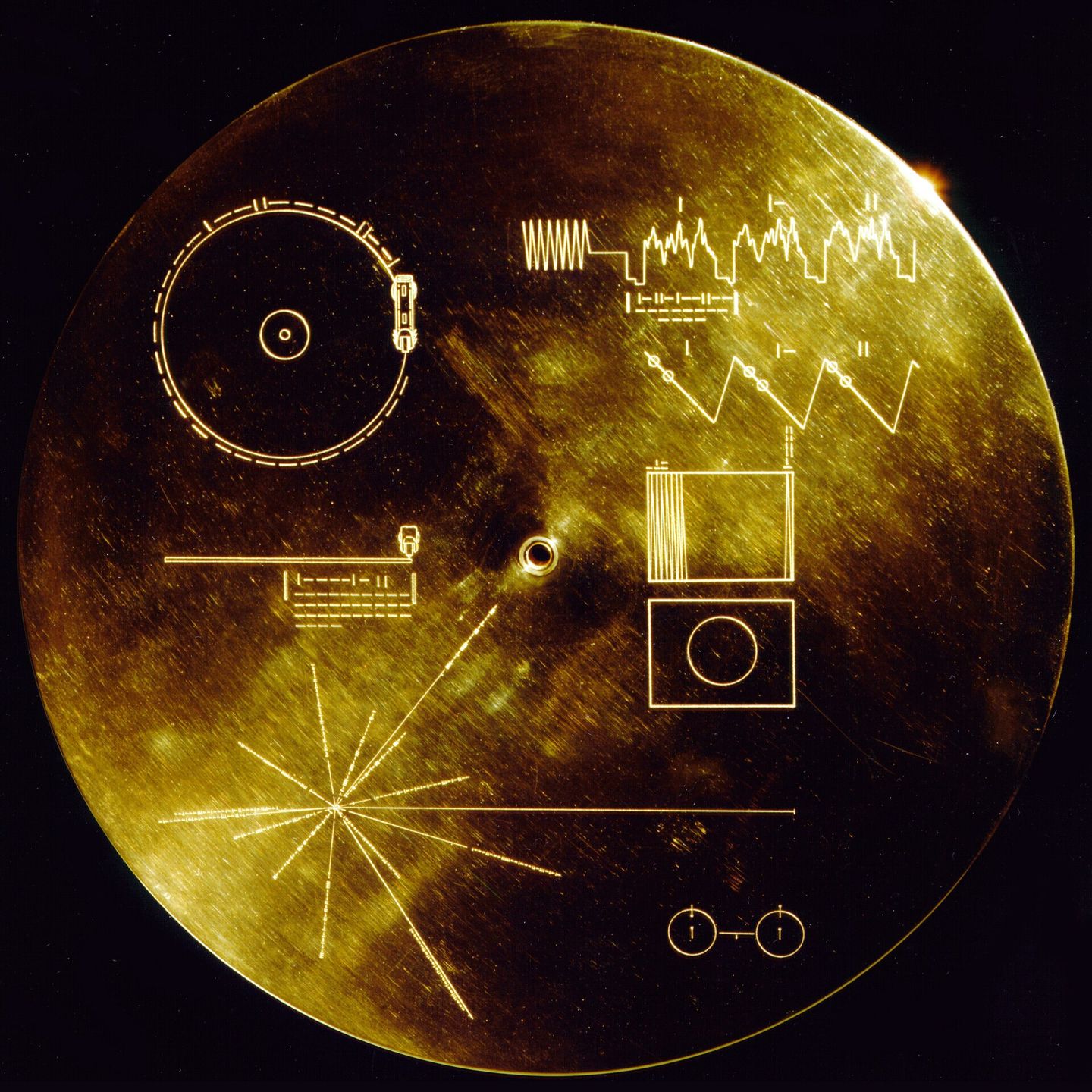
The gold-plated cover of the Voyager Golden Record, a message to the Cosmos Sagan helped assemble. NASA/JPL, Public domain, via Wikimedia Commons
The Pale Blue Dot
On this day in 1996 — Carl Sagan died, having spent a career making the cosmos feel personal and a pale blue dot feel like home.
3 min read
Carl Sagan died on December 20, 1996, at the age of 62, from pneumonia related to bone marrow disease. He had spent his career making the universe feel accessible, turning astronomy into poetry, science into storytelling. His voice, warm and measured, became the sound of curiosity itself. He said "billions and billions" even though he claimed he never actually said it that way. It did not matter. The phrase became shorthand for scale, for the staggering size of everything out there.
Sagan was a scientist first. He worked on the Mariner, Viking, Voyager, and Galileo missions. He helped choose the landing sites for the Viking landers on Mars. He was instrumental in getting NASA to turn the Voyager 1 spacecraft around in 1990 to photograph Earth from 3.7 billion miles away. That photograph became the Pale Blue Dot, a single pixel of light containing every human who had ever lived. Sagan wrote about it with the kind of humility and wonder that made people stop and think about what any of this meant.
He wrote books. Contact, his only novel, explored the question of what first contact with extraterrestrial intelligence might look like. It was not about explosions or invasion. It was about communication, about how we might understand something entirely unlike ourselves. The book became a film after his death, but the core idea remained his: that the universe is vast and largely indifferent, but also full of possibility, and that our job is to keep listening.
His television series Cosmos aired in 1980 and became the most-watched public television program in history. Sagan stood in front of galaxies and nebulae and talked about time, about the origin of stars, about how we are made of the same stuff. He said we are a way for the cosmos to know itself. It was not hyperbole. It was chemistry. Carbon, oxygen, nitrogen, all forged in dying stars, reassembled into conscious beings capable of looking back at where they came from.
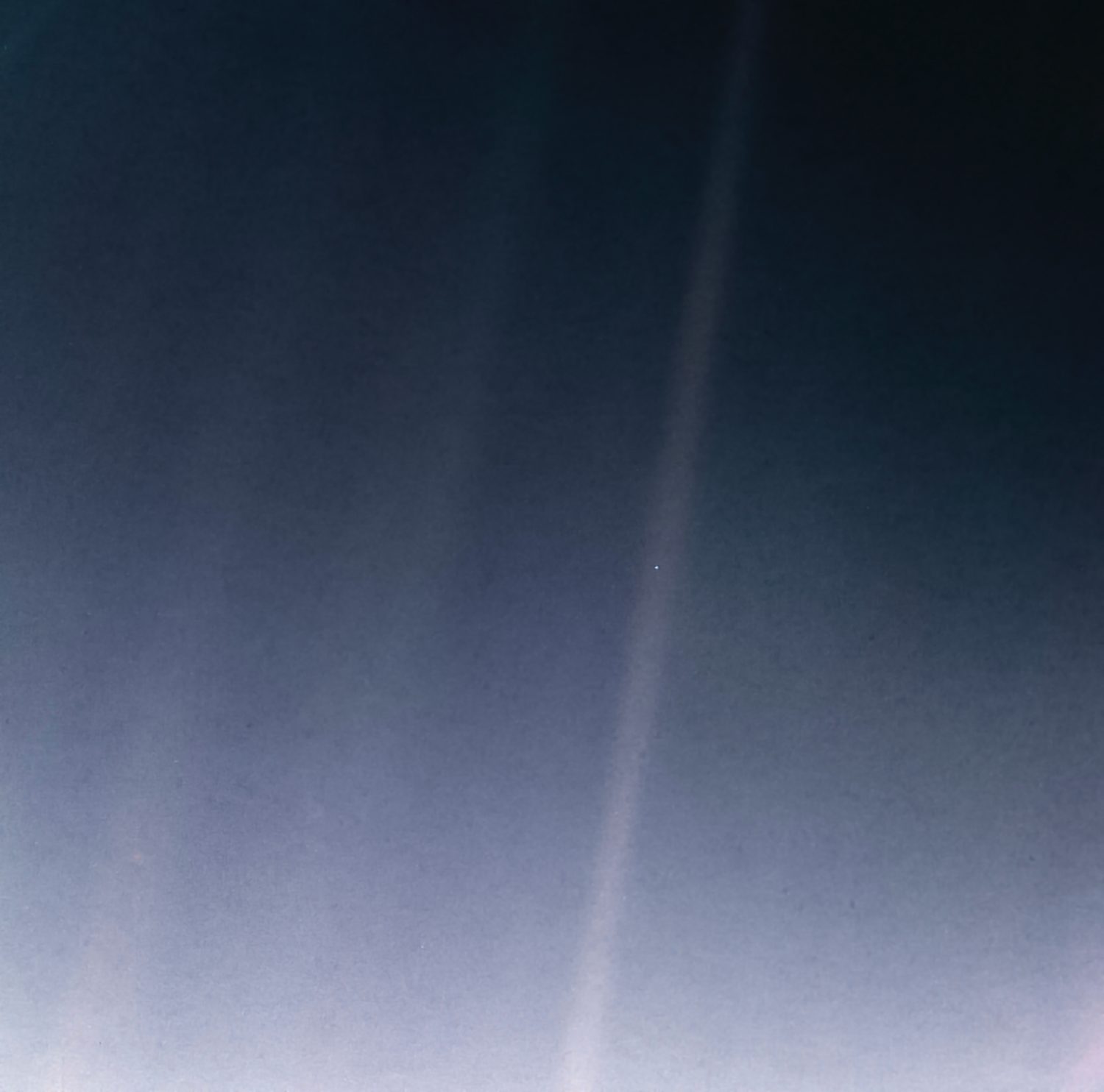
The Pale Blue Dot: Earth seen by Voyager 1 from six billion kilometers away, reprocessed in 2020. Public domain, via Wikimedia Commons
Sagan fought against nuclear weapons. He published research on nuclear winter, the theory that a large-scale nuclear war would throw so much debris into the atmosphere that it would block sunlight and collapse global agriculture. His work helped shift the conversation around deterrence and mutually assured destruction. He testified before Congress. He spoke publicly about the danger of designing systems that could end civilization. Science, for Sagan, was not neutral. It had moral weight.
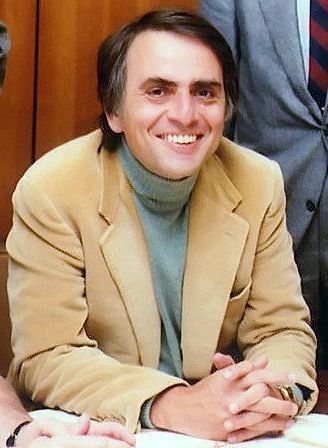
Carl Sagan, astronomer and science communicator. NASA/JPL, Public domain, via Wikimedia Commons
He also fought pseudoscience. He believed in critical thinking, in skepticism as a tool for finding truth. He wrote The Demon-Haunted World as a defense of science in an age of superstition and misinformation. He argued that science is not a body of facts but a way of thinking, a method for testing claims against evidence. He worried that society was losing that skill, that people were becoming comfortable with belief unsupported by reason. The book reads like a warning, one that feels more urgent every year.
What Sagan understood, and what made him effective, was that science is not just about data. It is about narrative. The story of where we come from, how the universe works, why we exist at all. These are the oldest human questions, and Sagan treated them with the seriousness they deserve. He connected the moon landing to the urge that drove early humans out of Africa. He connected the search for extraterrestrial intelligence to the question of whether we are alone. He made science feel like a continuation of philosophy, of art, of the long human project of understanding.
On that pale blue dot, suspended in a sunbeam, every empire rose and fell, every war was fought, every love story unfolded. Sagan saw that dot and felt humility. He saw the fragility of our one small world and argued that we should take care of it, that we should take care of each other. He died before the internet reshaped communication, before climate science became a political battlefield, before private companies started launching people into orbit. But the questions he asked are still the ones that matter. What are we doing here? What do we owe each other? What kind of future are we building? The cosmos is still out there, indifferent and infinite, and we are still here, asking.
studio / on-this-day / Dec 20