studio / on-this-day / Sep 27
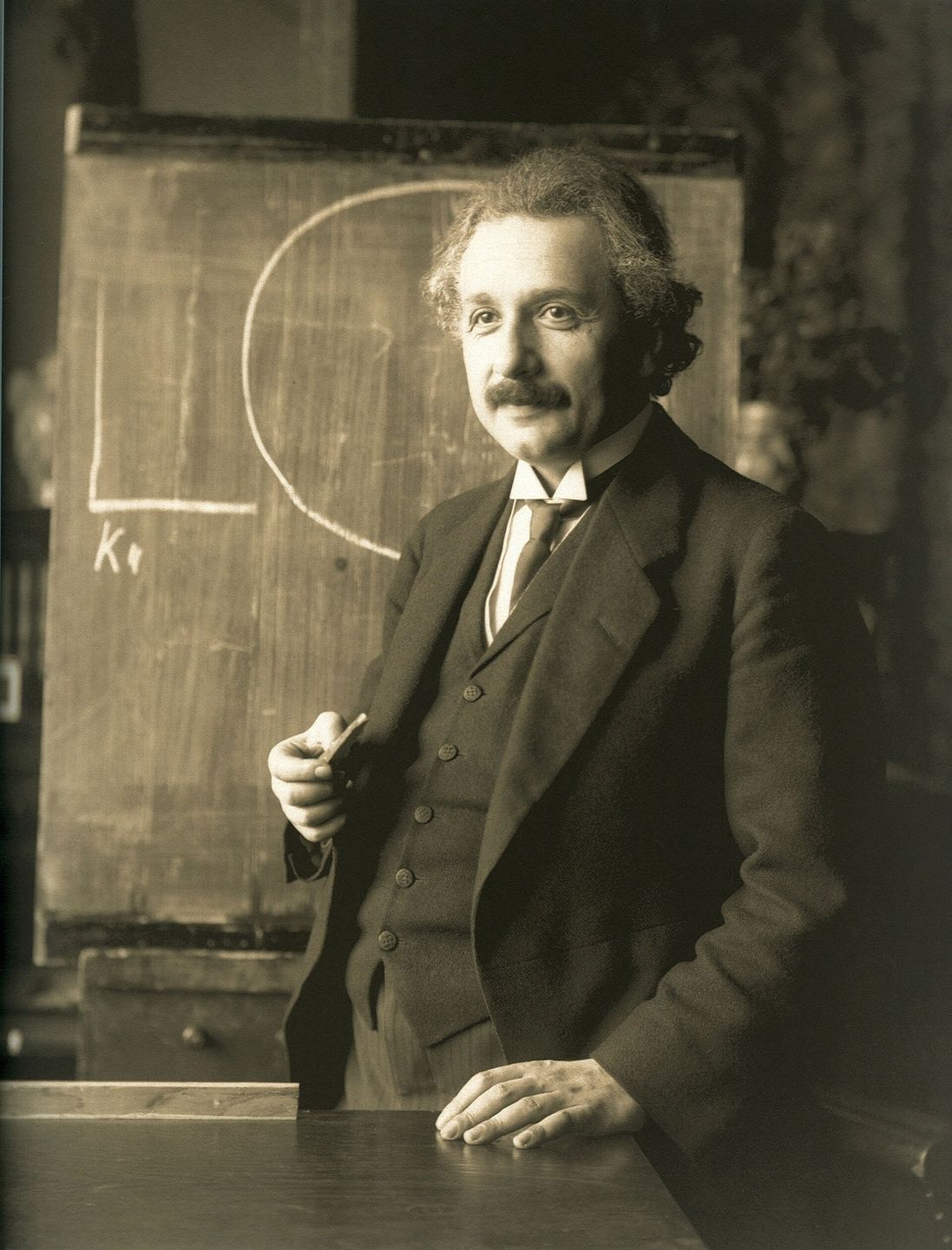
Albert Einstein during a lecture in Vienna, 1921. photograph by Ferdinand Schmutzer. Ferdinand Schmutzer / Adam Cuerden, Public domain, via Wikimedia Commons
Space, Time, and One Very Good Year
On this day in 1905 — Einstein published the work that fused space and time, and made the speed of light the one fixed thing in the universe.
3 min read
On September 27, 1905, the journal Annalen der Physik published a paper by Albert Einstein titled "Does the Inertia of a Body Depend Upon Its Energy Content?" It was a short paper, only three pages, and it contained the equation that would become the most famous in the history of science. E = mc2. Mass and energy are equivalent. A small amount of mass contains an enormous amount of energy, because the speed of light squared is an enormous number. It was the coda to a longer paper published earlier that year, the actual theory of special relativity, and it closed the argument with a conclusion that still feels startling: matter itself is frozen energy.
The year 1905 was Einstein's annus mirabilis, his miracle year. He was twenty-six, working as a patent examiner in Bern because he had been unable to secure an academic position. He published four papers that year, any one of which would have established him as a major physicist. Together they rewrote the foundations of the field. The photoelectric effect paper earned him the Nobel Prize sixteen years later. The Brownian motion paper helped prove the existence of atoms. The special relativity paper resolved a contradiction between Newtonian mechanics and James Clerk Maxwell's equations for electromagnetism that had been troubling physicists for decades. And the September paper drew the implication that relativity demanded: E = mc2.
Special relativity rests on two postulates. First, the laws of physics are the same for all observers moving at constant velocity relative to one another. Second, the speed of light in a vacuum is the same for all such observers, regardless of the motion of the source. These seem like reasonable starting points, but their consequences are vertiginous. Time passes at different rates for observers moving at different speeds. Objects in motion are shorter along the direction of motion than they are at rest. Simultaneity is not absolute. Two events that appear simultaneous to one observer appear sequential to another. Space and time are not independent dimensions but aspects of a single four-dimensional continuum called spacetime.
What's remarkable from a design perspective is the economy of the theory. Two postulates, consistently applied, produce an entire restructuring of how reality works at high velocities. Einstein wasn't building on a mountain of new experimental data. The Michelson-Morley experiment of 1887 had produced puzzling results that suggested the speed of light didn't vary with the motion of the earth, but Einstein later claimed he wasn't primarily motivated by that experiment. He was motivated by a conceptual inconsistency: the equations of electromagnetism implied that the speed of light was constant, and Newtonian mechanics said that speeds must add together in the obvious way. One of them had to give. Einstein's instinct was that Newton's framework, at high velocities, was the approximation.
The theory is sometimes described as saying that everything is relative, but that's nearly the opposite of the point. What special relativity establishes is that certain quantities, the spacetime interval, the speed of light, the laws of physics, are absolutely invariant. It's precisely because those things are absolute that everything else, lengths, times, masses, must be relative. The relativity is a consequence of deeper invariance.
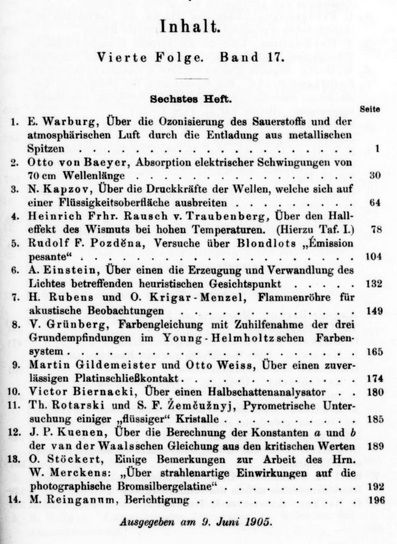
A table of contents from Annalen der Physik, 1905 — the journal that carried Einstein's relativity papers that year. Nerd271, CC0, via Wikimedia Commons
The practical consequences arrived slowly, then all at once. GPS satellites orbiting the earth move fast enough and are far enough from Earth's gravitational field that their onboard clocks run at a measurably different rate than clocks on the ground. Without relativistic corrections, GPS positioning would drift by kilometers per day. Special relativity is not an abstraction. It's built into the infrastructure of modern navigation.
Einstein published four papers that year from a rented apartment in Bern, while working a day job. Steve Jobs would later describe computers as bicycles for the mind. What Einstein demonstrated in 1905 was that the mind, given the right conceptual tools, can reach places no instrument had yet gone. He looked at two equations that didn't agree and concluded that the universe was stranger than anyone had imagined. He was right, and the strangeness has been useful ever since.
studio / on-this-day / Sep 27