studio / on-this-day / Sep 14
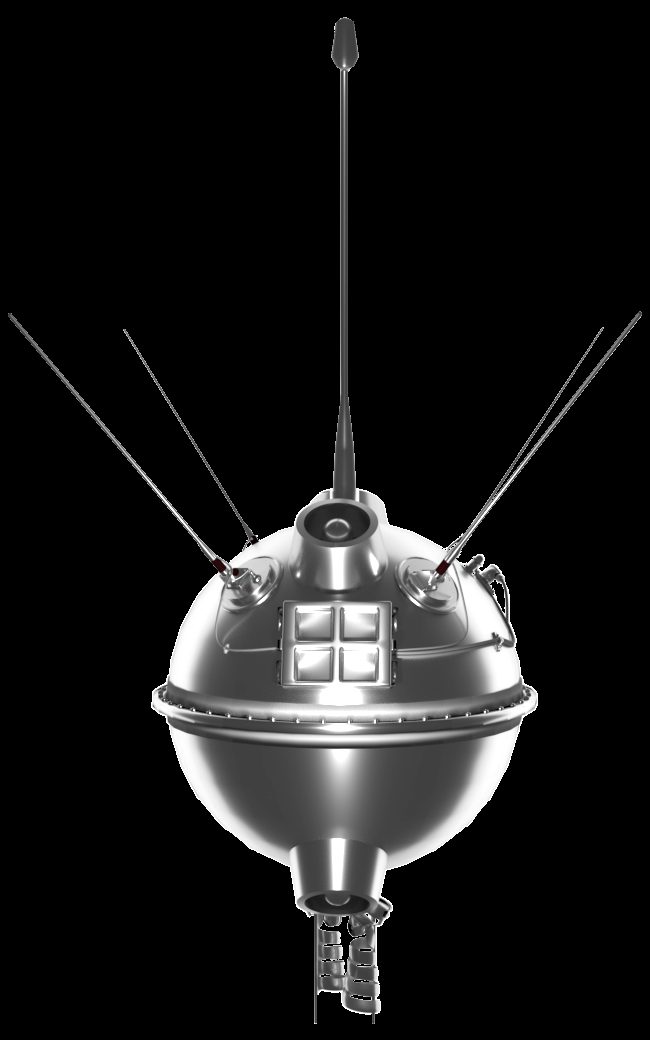
A diagram of the Soviet Luna 1 and Luna 2 probes; Luna 2 was the first object to reach the Moon. Public domain, via Wikimedia Commons
First Contact
On this day in 1959 — the Soviet Luna 2 struck the Moon, the first human-made object ever to touch another world.
2 min read
At 9:02 p.m. Moscow time on September 14, 1959, Luna 2 impacted the moon's surface at over 3,300 meters per second. The spacecraft, a 390-kilogram sphere bristling with antennas, was obliterated on contact. There was no soft landing, no parachute, no attempt to preserve the hardware. Luna 2 was designed to crash, and it did so with precision. The impact site was east of Mare Imbrium, near the craters Aristides, Archimedes, and Autolycus. For the first time in history, a human-made object had touched another celestial body.
The mission confirmed what scientists had suspected but not proven: the moon has no significant magnetic field, cosmic radiation levels in interplanetary space are higher than around Earth, and the lunar surface is not covered in a thick layer of dust that would swallow spacecraft. Luna 2 carried magnetometers, Geiger counters, and micrometeorite detectors, transmitting data until the moment of impact. The signal cut out exactly when calculations predicted it would. The mathematics worked. The targeting worked. The Soviet Union had hit a moving target 240,000 miles away.
Before impact, the spacecraft released two metal spheres engraved with Soviet emblems and the date of launch. The spheres were designed to shatter on contact, scattering pentagonal fragments across the lunar surface. It was propaganda, but it was also a claim: we were here. The fragments are still there, buried in regolith, invisible and irretrievable. They are the first human artifacts on another world, left not as a carefully preserved time capsule but as shrapnel from a controlled crash.
The timing was deliberate. Luna 2 launched on September 12, two days before impact, just as Soviet Premier Nikita Khrushchev was preparing to visit the United States. He brought a replica of one of the lunar pennants as a gift for President Eisenhower. The message was clear: the Soviet Union had reached the moon. The United States had not. The space race, already underway since Sputnik in 1957, had just escalated. Luna 2 was not just a scientific mission. It was a statement of capability, a proof of concept that Soviet engineering could aim at the moon and hit it.
There was no image of the impact. No camera on Luna 2, no telescope that could see the crash from Earth. The only confirmation came from the sudden cessation of the radio signal at the calculated time. Engineers on the ground knew the spacecraft had hit because it stopped transmitting. That was enough. The math had worked. The mission was a success. A decade later, astronauts would walk on the moon and return safely. But Luna 2 got there first. It just did not slow down.
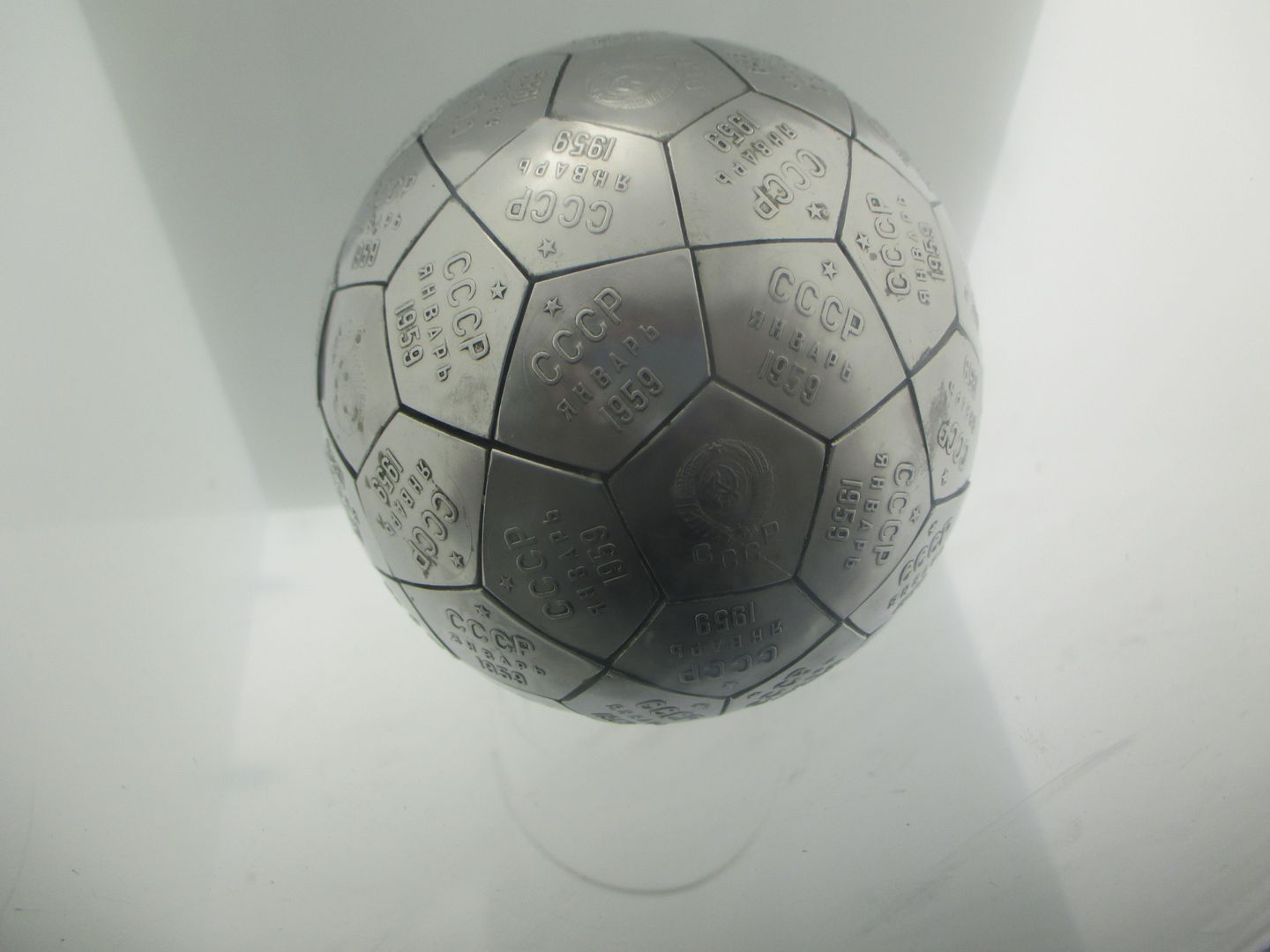
A Luna 2 pennant sphere — one of the metal spheres engraved with Soviet emblems, on display at the Kansas Cosmosphere. Patrick Pelletier, CC BY-SA 3.0, via Wikimedia Commons
The debris field is still there, somewhere in the Sea of Serenity. No one has ever found it. No one has tried. The fragments are too small, too scattered, and too buried to locate. But they are permanent. Unlike footprints, which lunar dust will eventually erase, metal does not degrade in a vacuum. The Soviet emblems scattered across the moon will outlast every government, every empire, and every human institution that created them. They are the first human mark on another world, and they will be there long after there is no one left to remember what they meant.
studio / on-this-day / Sep 14