studio / on-this-day / Aug 7
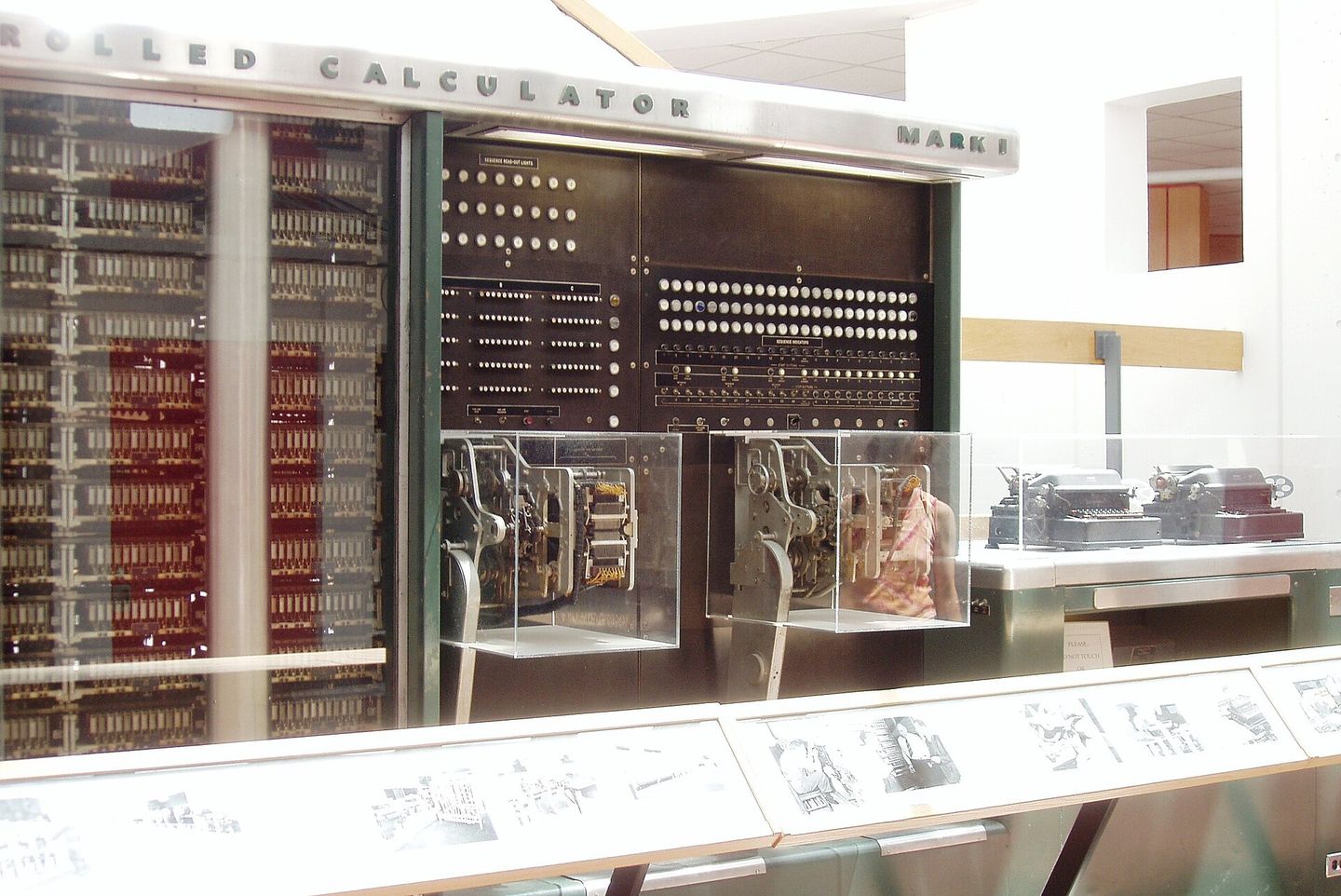
Harvard Mark i computer. CC BY-SA 3.0, via Wikimedia Commons
The Machine That Took Up a Room
On this day in 1944 — IBM dedicated the Harvard Mark I, a fifty-one-foot electromechanical computer that clattered its way through calculations.
3 min read
On August 7, 1944, IBM and Harvard University formally dedicated the Automatic Sequence Controlled Calculator, better known as the Harvard Mark I. It was 51 feet long, 8 feet tall, and weighed five tons. Inside were 765,000 components: mechanical switches, relays, rotating shafts, and clutches. It could perform three additions or subtractions per second, or one multiplication every six seconds. By modern standards, it was impossibly slow. By 1944 standards, it was a revelation. It could compute continuously, without human intervention, following a sequence of instructions fed into it on punched paper tape. It was a machine that could think, in a very narrow, mechanical sense.
The Mark I was designed by Howard Aiken, a Harvard physicist who understood that certain calculations required so much repetitive arithmetic that human computers, people hired to perform calculations by hand, could not keep up. Aiken envisioned a machine that could automate the process. He approached IBM with his proposal in 1937. IBM agreed to fund and build it. The project took seven years. When it was finally completed, it was immediately put to work on classified calculations for the Manhattan Project and the U.S. Navy, crunching numbers for ballistics tables and nuclear physics.
The Mark I was not the first computer. Charles Babbage had designed the Analytical Engine a century earlier, though it was never built. Konrad Zuse's Z3, completed in 1941 in Germany, was a programmable electromechanical computer that predated the Mark I. But the Mark I was the first large-scale automatic digital computer in the United States, and it proved that machines could handle complex calculations faster and more reliably than humans. It was a turning point, not because it was the first, but because it worked, it was useful, and it was built at a scale that made the concept of automated computation real.
The machine operated on a simple principle: it could store a sequence of operations and execute them in order. Instructions were encoded on a long roll of punched paper tape, similar to the kind used in player pianos. Each hole represented a command or a number. The machine read the tape, translated the punches into mechanical movements, and performed the calculations. The output was printed on a typewriter or punched onto cards. It was a batch processing system, designed to run through problems sequentially, one after another, without stopping. There was no interactive interface, no screen, no keyboard. You fed it a problem, walked away, and came back later for the answer.
Grace Hopper, a mathematician and U.S. Navy officer, was one of the first programmers to work on the Mark I. She joined the project in 1944 and quickly became one of its most important contributors. Hopper wrote the machine's operating manual, developed new programming techniques, and understood that the real power of computers was not just speed, but the ability to encode complex logic into repeatable sequences. She later pioneered the development of programming languages, arguing that code should be readable by humans, not just machines. Her work on the Mark I laid the groundwork for everything that came after.

Commodore Grace Hopper, one of the first programmers to work on the Harvard Mark i and a pioneer of programming languages. James S. Davis, Public domain, via Wikimedia Commons
The Mark I was obsolete almost as soon as it was completed. Electronic computers like ENIAC, which used vacuum tubes instead of mechanical relays, were already in development. They would be faster, more flexible, and eventually much smaller. But the Mark I proved something essential: that computation could be automated, that machines could follow instructions, and that complex problems could be solved by breaking them into sequences of simple operations. It was a bridge between human calculation and machine intelligence, between the slide rule and the microprocessor.
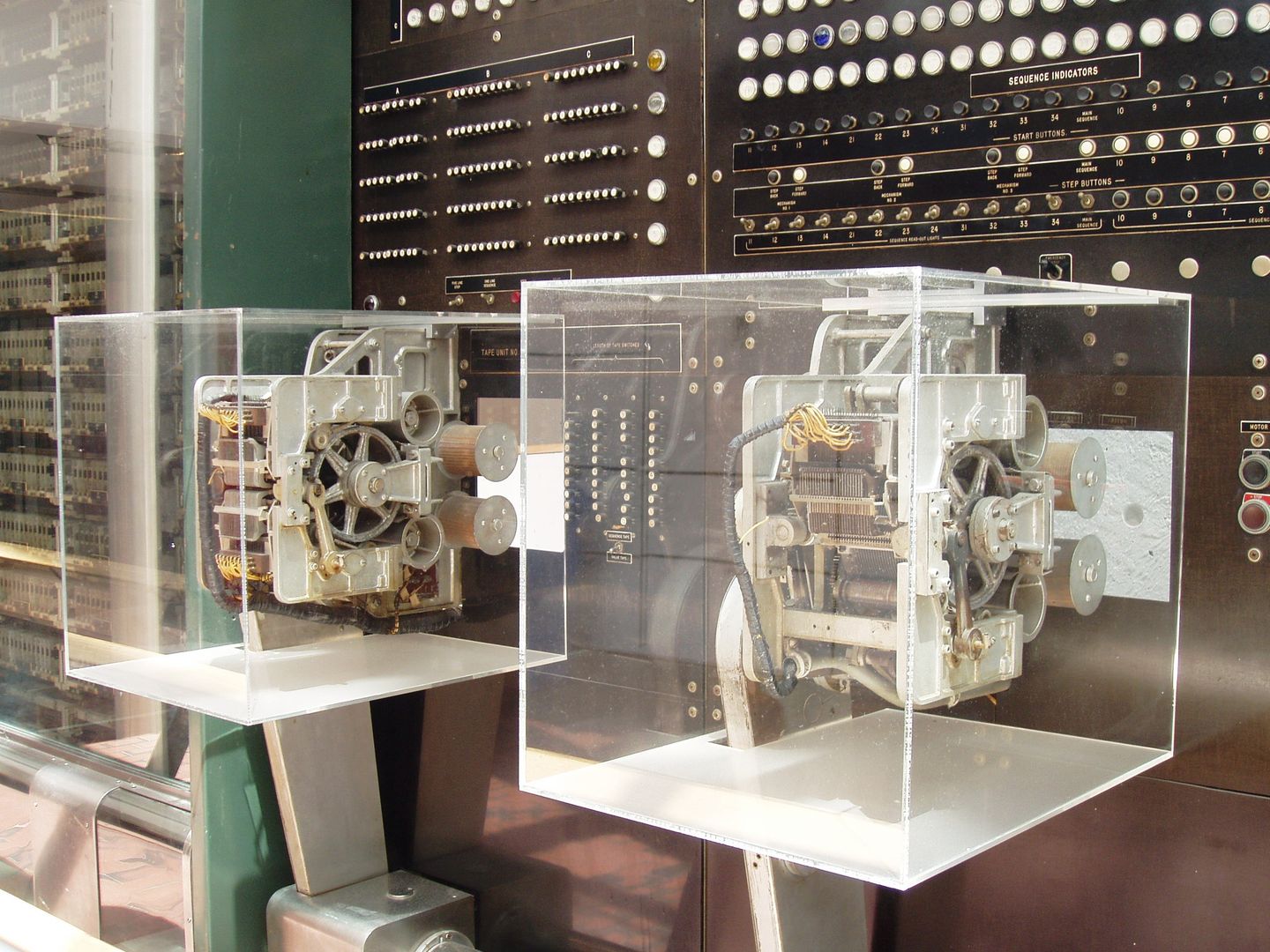
Input and output details of the Mark i, where punched paper tape and cards were read and results were printed. The original uploader was Daderot at English Wikipedia., CC BY-SA 3.0, via Wikimedia Commons
Today, the Mark I sits in the Harvard Science Center, a relic of a different era of computing. It is silent, static, a monument to a time when computers were machines you could walk inside of. But the principles it embodied, sequential instruction execution, programmability, and automation, are the same principles that power every computer in existence. The size changed. The speed changed. The interface changed. But the logic, the idea that machines can think if you tell them exactly what to do, that started here, in a room-sized machine that clicked and whirred and calculated its way into history.
studio / on-this-day / Aug 7