studio / on-this-day / Aug 12
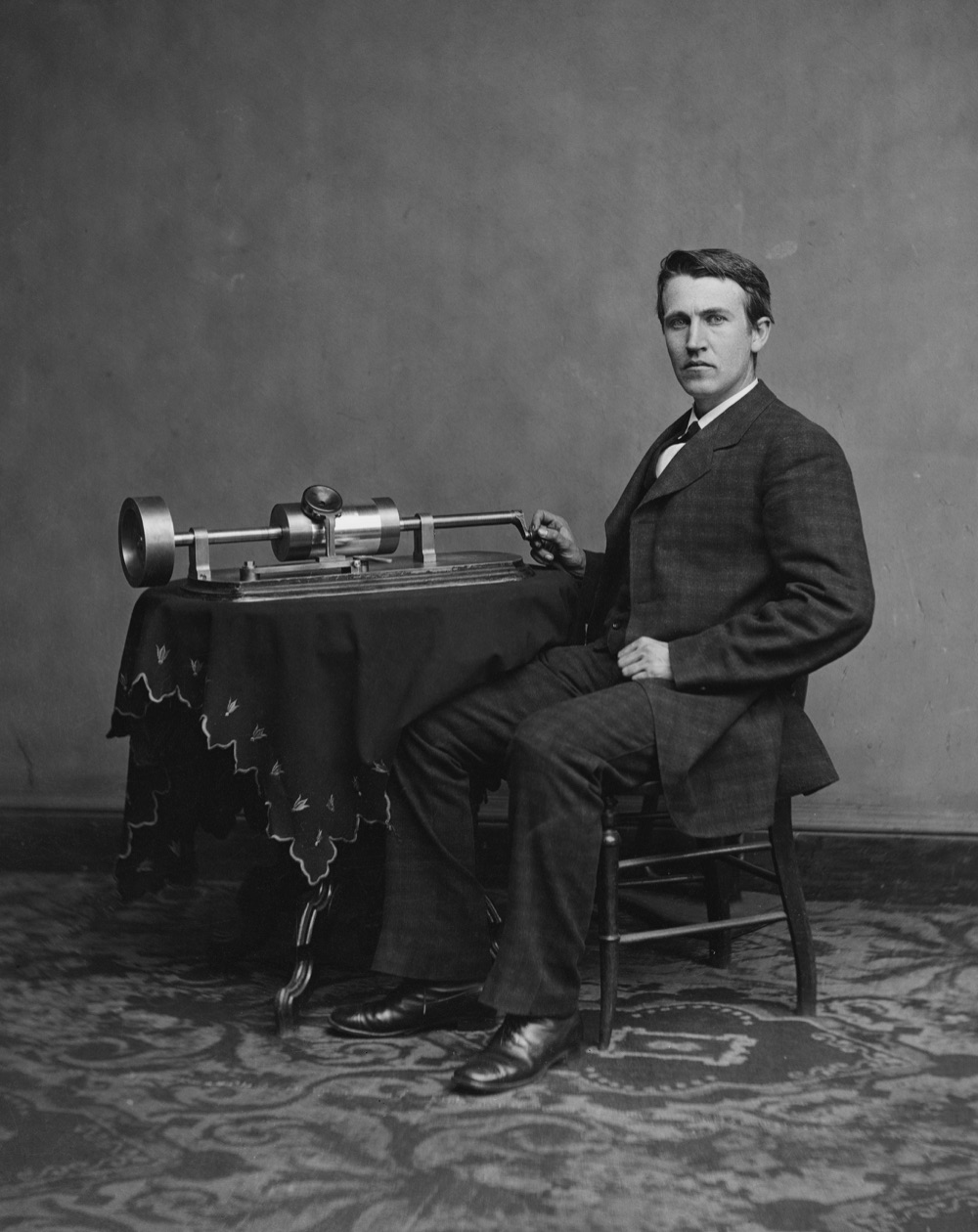
Thomas Edison with his phonograph, 1878. Levin C. Handy, Public domain, via Wikimedia Commons
The Machine That Remembered Sound
On this day in 1877 — Edison is credited with inventing the phonograph, and for the first time a sound could outlive the moment it was made.
2 min read
On August 12, 1877, Thomas Edison sketched a design for a machine that could record and reproduce sound. He handed the drawing to his mechanic, John Kruesi, with instructions to build it. A few weeks later, Edison wrapped a sheet of tinfoil around a grooved cylinder, turned a crank, and recited into a mouthpiece: "Mary had a little lamb." When he played it back, the machine spoke. The words were faint, scratchy, barely intelligible. But they were there. Sound, which had always been ephemeral, tied to the moment of its creation, could now be stored and replayed. The phonograph was born.
The principle was simple. A stylus attached to a vibrating diaphragm carved patterns into the tinfoil as the cylinder rotated. The vibrations of Edison's voice created the grooves. When the stylus traced those grooves in reverse, the vibrations were recreated, and the sound returned. It was a purely mechanical process, no electricity required. The machine was analog in the truest sense: the grooves were a physical imprint of the sound waves themselves. To record was to inscribe. To play back was to read.
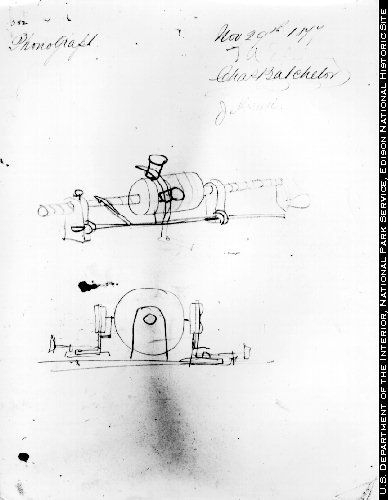
Edison's sketch of the phonograph design. Thomas Edison / Charles Batchelor / John Kruesi, Public domain, via Wikimedia Commons
Edison saw the phonograph as a business tool. He imagined it recording letters, preserving the last words of dying relatives, teaching language. He did not immediately grasp that it would become an entertainment medium. That realization came later, when others saw the potential to record and sell music. By the early 1900s, phonographs were in homes, and sound recording had become an industry. Music no longer had to be performed live to be heard. A symphony, a voice, a moment in time, all of it could be captured, pressed onto a disc, and played again and again.
The phonograph changed how humans relate to time. Before recording, sound existed only in the present. Once spoken or played, it was gone. Memory could recall it, imperfectly. Notation could represent it, abstractly. But the sound itself vanished. The phonograph broke that rule. It allowed the past to speak in the present, not as a memory, but as a reproduction. A voice from 1877 could be heard in 1977. The dead could be played back. Sound became portable, repeatable, and permanent.

Edison's tinfoil phonograph, which first recorded and replayed sound. Public domain, via Wikimedia Commons
Every recording technology since, from vinyl to cassette to digital audio, descends from Edison's idea. The medium changed, but the principle remained: translate sound into a storable form, then reverse the process to retrieve it. The phonograph was the first information storage system for sound, the first machine that could remember what it heard. It was also the first machine that could lie, because a recording is never neutral. It is always a perspective, a selection, a designed artifact. What gets recorded, what gets played, these are choices. And choices have power. The phonograph did not just capture sound. It determined what sound would survive.
studio / on-this-day / Aug 12