studio / on-this-day / Aug 11

Hedy Lamarr, 1944. Public domain, via Wikimedia Commons
The Movie Star Who Invented WiFi
On this day in 1942 — Hedy Lamarr patented frequency-hopping, a wartime idea from a movie star that underpins modern wireless.
3 min read
On August 11, 1942, U.S. Patent 2,292,387 was granted to Hedy Kiesler Markey and George Antheil for a "Secret Communication System." The patent described a method for controlling torpedoes using frequency-hopping radio signals that would be nearly impossible to jam or intercept. The technology was decades ahead of its time. The U.S. Navy ignored it. Hedy Kiesler Markey was better known by her stage name, Hedy Lamarr, and in 1942 she was one of the most famous actresses in Hollywood. The idea that a movie star could invent a sophisticated radio guidance system seemed implausible. But she did.
Lamarr was born in Vienna in 1914. Her first husband was Friedrich Mandl, an Austrian arms dealer who sold munitions to the Nazis and Fascist Italy. She attended his business meetings, listening to engineers and military officers discuss weapons technology. She absorbed everything. When the marriage became intolerable, she fled to London, then to Hollywood, where she became a star. But she never stopped thinking about engineering. During World War II, she wanted to help the Allied war effort. She just needed the right collaborator.
She found him in George Antheil, an avant-garde composer known for experimental music. Antheil had written a piece called "Ballet Mécanique" that required 16 synchronized player pianos. Lamarr realized that the same mechanism used to synchronize pianos could synchronize radio frequencies. If a transmitter and receiver both hopped between frequencies in a predetermined pattern, the signal would be nearly impossible to intercept or jam. Enemy forces wouldn't know which frequency to block. The system would be secure by design.
The patent they filed used a piano roll, a perforated paper scroll that controlled player pianos, to manage the frequency changes. Eighty-eight frequencies, one for each key on a piano. The transmitter and receiver would each have an identical roll, synchronized to hop through frequencies in lockstep. It was elegant, practical, and entirely feasible with 1940s technology. The Navy received the patent, classified it, and did nothing. One official reportedly told Lamarr she could better help the war effort by selling war bonds. So she did. She raised $25 million, one of the most successful bond drives of the war. Her invention sat unused in a file cabinet.
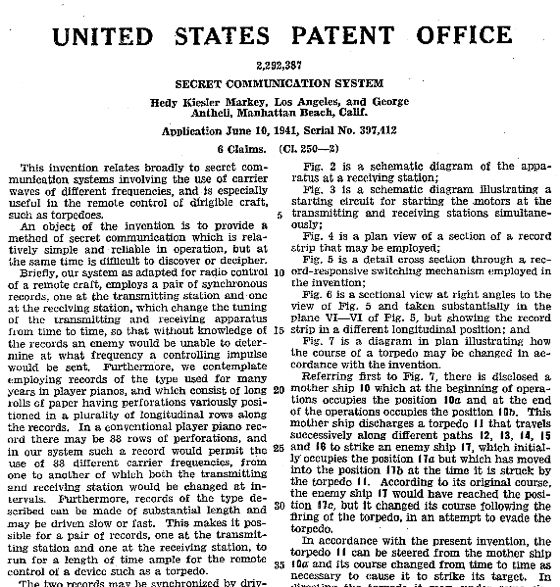
A figure from U.S. patent 2,292,387, the "Secret Communication System" granted to Hedy Kiesler Markey and George Antheil on August 11, 1942. U.S. Patent Office, Public domain, via Wikimedia Commons
Frequency-hopping spread spectrum was eventually declassified and rediscovered in the 1960s. The military began using it for secure communications. By the 1990s, the technology had become foundational for wireless communication. WiFi, Bluetooth, GPS, and modern cell phones all use variations of the system Lamarr and Antheil invented. The piano roll mechanism was replaced by digital circuits, but the core concept remained the same: rapidly switching between frequencies to create a secure, resilient signal.
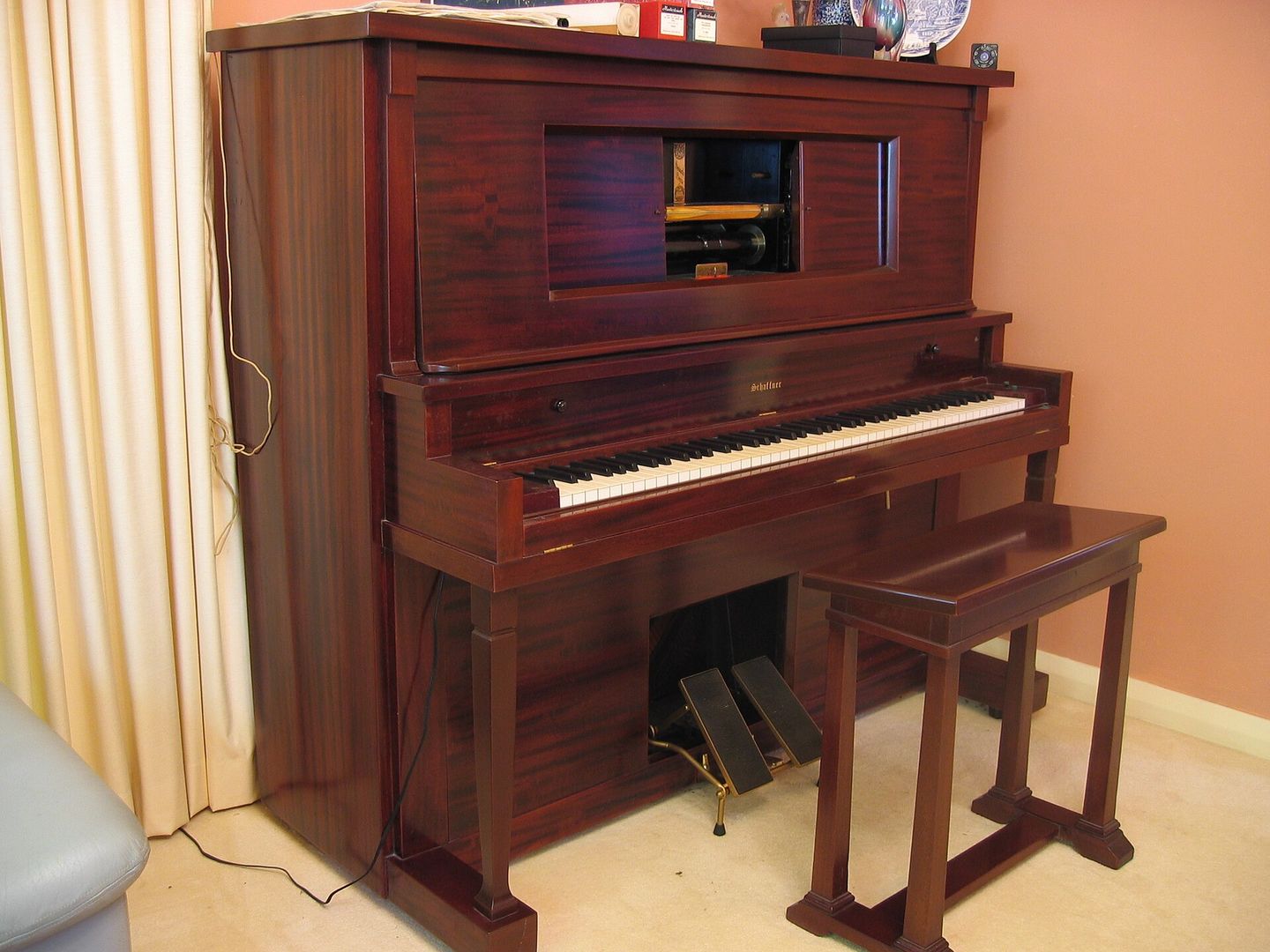
A player piano — Lamarr and Antheil adapted the piano roll mechanism of synchronized player pianos to control Frequency-hopping in their 1942 patent. CC BY-SA 3.0, via Wikimedia Commons
Lamarr received almost no recognition for her invention during her lifetime. She was celebrated as a beauty, an icon, a symbol of glamour. But her work as an inventor was ignored. It was not until the 1990s, when the technology became ubiquitous, that engineers and historians began to trace its origins back to her 1942 patent. In 1997, she and Antheil were honored with the Electronic Frontier Foundation Pioneer Award. She was 83 years old. When informed of the award, she reportedly said she was glad someone finally understood what she had done.
The story of Hedy Lamarr's patent is a reminder that expertise does not always come from expected places. She was not a trained engineer. She had no formal education in radio technology. But she understood systems, she understood problems, and she had the creativity to see a solution where others saw only complexity. The world wanted her to be one thing. She insisted on being many things at once. That insistence, that refusal to be limited by other people's expectations, is what made the invention possible. Every time a device connects to WiFi, a signal hops between frequencies, invisible and secure, a movie star's idea still working decades after she thought of it.
studio / on-this-day / Aug 11