studio / on-this-day / Jul 5
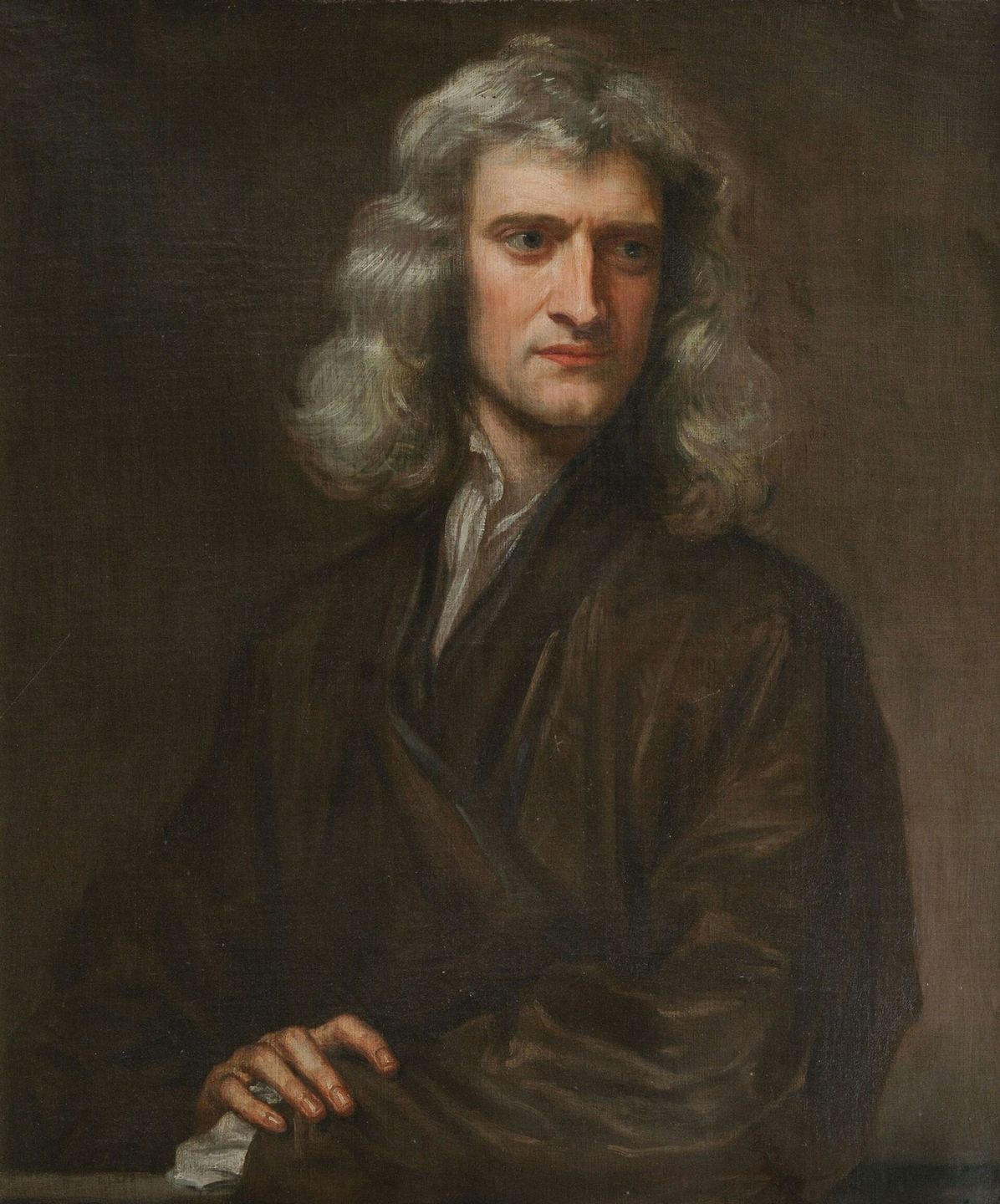
Isaac Newton, portrait by godfrey kneller, 1689. Godfrey Kneller, Public domain, via Wikimedia Commons
The User Manual for the Universe
On this day in 1687 — Newton published the Principia, folding gravity, motion, and calculus into a single book about how everything moves.
3 min read
On July 5, 1687, the Royal Society of London published Philosophiæ Naturalis Principia Mathematica, Isaac Newton's mathematical principles of natural philosophy. It was 500 pages of dense Latin prose and geometric diagrams, and it changed everything. The book explained why planets move in ellipses, why tides rise and fall, why objects fall to Earth, and why the moon does not. It provided, for the first time, a unified mathematical framework for understanding motion and force. Before Newton, the heavens and the Earth followed different rules. After Newton, they followed the same ones.
Newton had worked out most of the ideas decades earlier, but he was famously reluctant to publish. The story goes that astronomer Edmond Halley visited Newton in 1684 and asked what path a planet would follow if pulled toward the sun by a force inversely proportional to the square of the distance. Newton answered immediately: an ellipse. Halley asked how he knew. Newton said he had calculated it years before but misplaced the paper. Halley convinced him to redo the work and publish it. What began as a short tract grew into the Principia, one of the most important books ever written.
The book is structured around three laws of motion. First, an object at rest stays at rest, and an object in motion stays in motion, unless acted upon by a force. Second, force equals mass times acceleration. Third, every action has an equal and opposite reaction. These laws sound simple now because they have been taught to generations of students, but in 1687 they represented a radical departure from centuries of Aristotelian physics, which held that objects naturally came to rest and that different substances had different natural motions. Newton showed that all motion, from a falling apple to the orbit of Jupiter, could be described with the same mathematical rules.
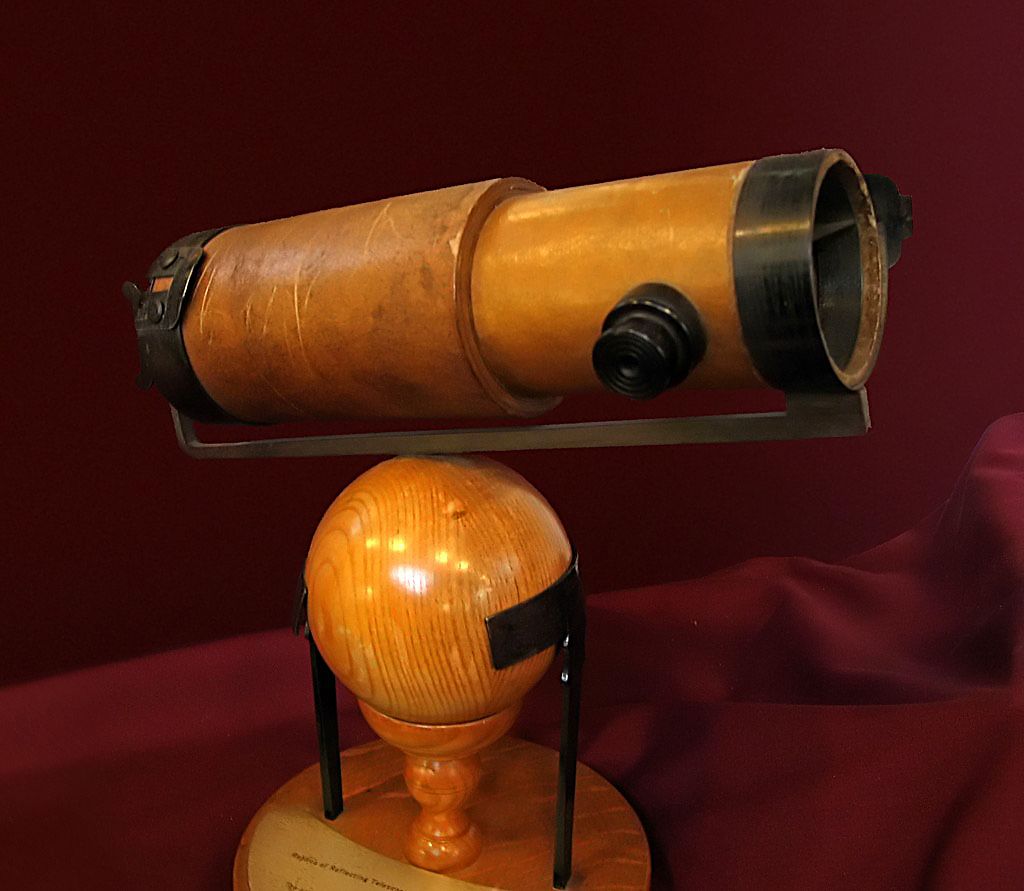
A replica of the reflecting telescope Newton designed and built in 1668, years before the Principia. User:Solipsist (Andrew Dunn), CC BY-SA 2.0, via Wikimedia Commons
The real breakthrough was the law of universal gravitation. Newton proposed that every object in the universe attracts every other object with a force proportional to their masses and inversely proportional to the square of the distance between them. This single equation explained not just terrestrial gravity but also the motion of the moon, the tides, the perturbations in planetary orbits, and the paths of comets. It unified celestial and terrestrial mechanics into one system. The cosmos was no longer a collection of separate phenomena but a single machine governed by mathematical law.
Newton wrote the Principia in Latin using geometric proofs rather than the algebraic calculus he had developed but not yet published. Some historians believe he did this deliberately to make the book harder to understand, limiting its readership to serious mathematicians. Others think he simply preferred the rigor of classical geometry. Either way, the Principia was not an easy read. Even accomplished scientists struggled with it. But those who understood it recognized its significance immediately. The poet Alexander Pope later wrote: "Nature and nature's laws lay hid in night; God said, Let Newton be, and all was light."
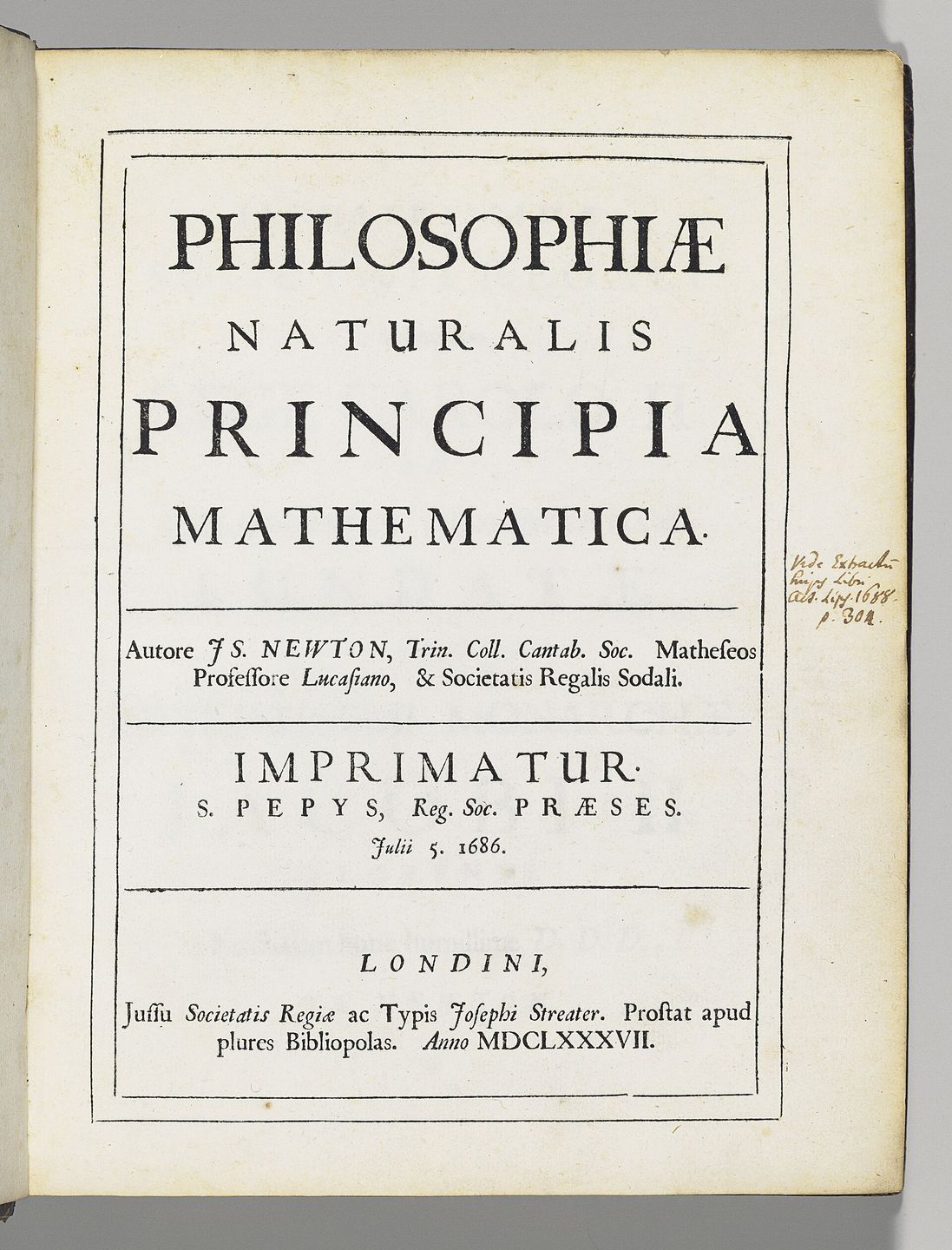
Newton's Principia Mathematica, 1687 — presentation copy to james ii. Joseph Streater, Public domain, via Wikimedia Commons
The publication nearly did not happen. The Royal Society had spent its printing budget on a book about fish and could not afford to publish the Principia. Halley paid for the printing himself. It was not a bestseller. The first edition sold fewer than 300 copies. But it reached the people who mattered. Within a generation, Newtonian mechanics was being taught across Europe. By the eighteenth century, it was the foundation of physics, engineering, and astronomy. Scientists used Newton's laws to predict the return of comets, discover new planets, and calculate the mass of the Earth and sun.
What Newton gave the world was not just a theory but a method. He showed that the universe operates according to mathematical principles that can be discovered through observation and reason. This idea, that nature is comprehensible and predictable, became the cornerstone of modern science. Every spacecraft trajectory, every bridge calculation, every simulation of physical systems traces back to the framework Newton established. Einstein would later revise Newton's picture with relativity, showing that gravity is not a force but a curvature of spacetime. But for most purposes, at most scales, Newton's laws are sufficient. Three centuries later, we still use them to design and build the world.
studio / on-this-day / Jul 5