studio / on-this-day / Jul 3
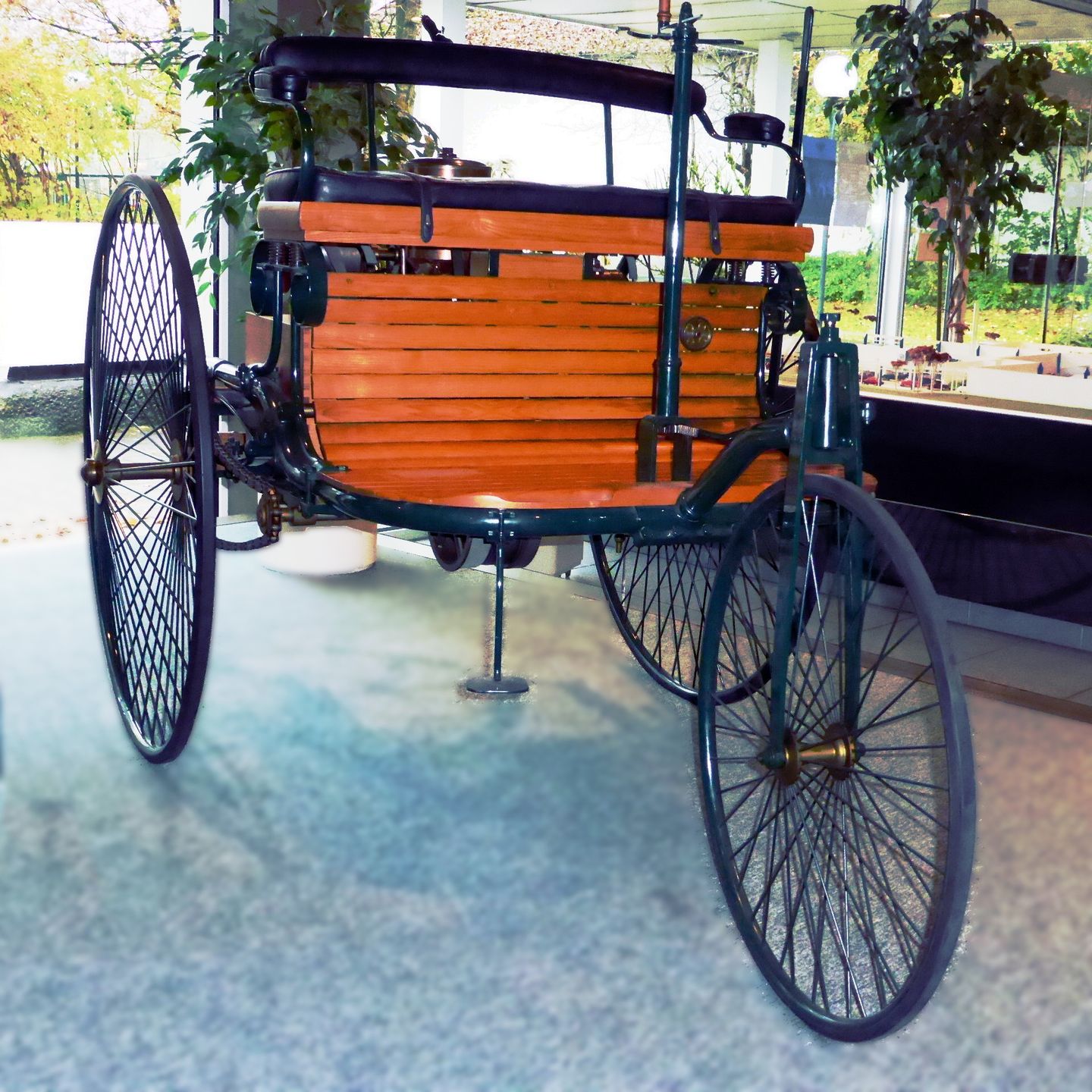
Benz patent-Motorwagen, 1886 — the world's first true automobile. Aisano, FAL, via Wikimedia Commons
The End of the Horse
On this day in 1886 — Karl Benz drove his motorwagen in public, three wheels and one cylinder that spelled the slow end of the horse.
3 min read
Karl Benz took his Motorwagen for a test drive on July 3, 1886, in Mannheim, Germany. It had three wheels, a single-cylinder engine, and a top speed of about ten miles per hour. It looked like a carriage that had lost its horse, which is more or less what it was. The steering was done with a tiller, like a boat. There were no brakes, just a wooden block that pressed against the rear wheels when you pulled a lever. It ran on gasoline, which at the time was considered a waste byproduct of petroleum refining, something you could buy at pharmacies in small bottles.
Benz had been working on the problem of horseless transportation for years. He was a mechanical engineer who had started his own company building stationary gas engines for factories. The challenge was not just making an engine small and light enough to move itself, but also designing a vehicle that could steer, accelerate, and stop reliably. Previous experiments with steam-powered vehicles had been impractical, too heavy and slow to start. What Benz invented was not just a motorized carriage, but an integrated system: engine, transmission, chassis, and steering all designed to work together.
The first Motorwagen had a four-stroke engine displacing less than one liter. It produced about two-thirds of a horsepower, which sounds ridiculous now but was enough to move the 500-pound vehicle and a single passenger at a walking pace. Benz patented the design in January 1886, and by summer he was testing it on the streets. Neighbors thought he was mad. The machine was loud, smelled terrible, and broke down constantly. But it moved under its own power, without hay or stables or the constant care that horses required.
What made the automobile revolutionary was not speed or comfort, it was independence from biology. Horses are living systems. They get tired, sick, hungry. They have moods. They require years of training and constant maintenance. An engine, by contrast, is a mechanical problem. You can understand it completely. You can fix it with tools. You can turn it off when you are done. The automobile turned personal transportation into an engineering discipline rather than an agricultural one. It was the same shift Henry Ford would later industrialize, but Benz made it possible first.
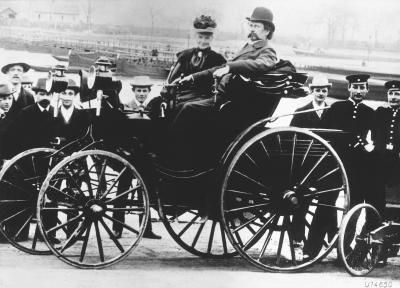
Bertha and carl Benz in a Benz-viktoria, 1894. Public domain, via Wikimedia Commons
Benz's wife, Bertha, understood the potential better than he did. In August 1888, she took the Motorwagen on the first long-distance automobile trip in history, driving 66 miles from Mannheim to Pforzheim with their two teenage sons. She did not tell Karl she was going. The trip took all day. They had to stop at pharmacies to buy fuel, use her hat pin to clear a blocked fuel line, and get a cobbler to add leather to the brake pads when they wore out. When they arrived, she sent a telegram to let him know the car worked. The publicity from the journey helped convince people that automobiles were practical.
Within a decade, dozens of companies were building cars. Some used steam, some electricity, most used gasoline. The designs varied wildly, but the basic concept spread quickly. By 1900, there were thousands of automobiles in Europe and America. By 1920, the horse was disappearing from cities. The shift happened faster than almost anyone predicted. Streets that had been covered in manure for centuries became paved and relatively clean. Entire industries, farriers, harness makers, stable keepers, vanished or adapted. New ones appeared: mechanics, gas stations, road construction.
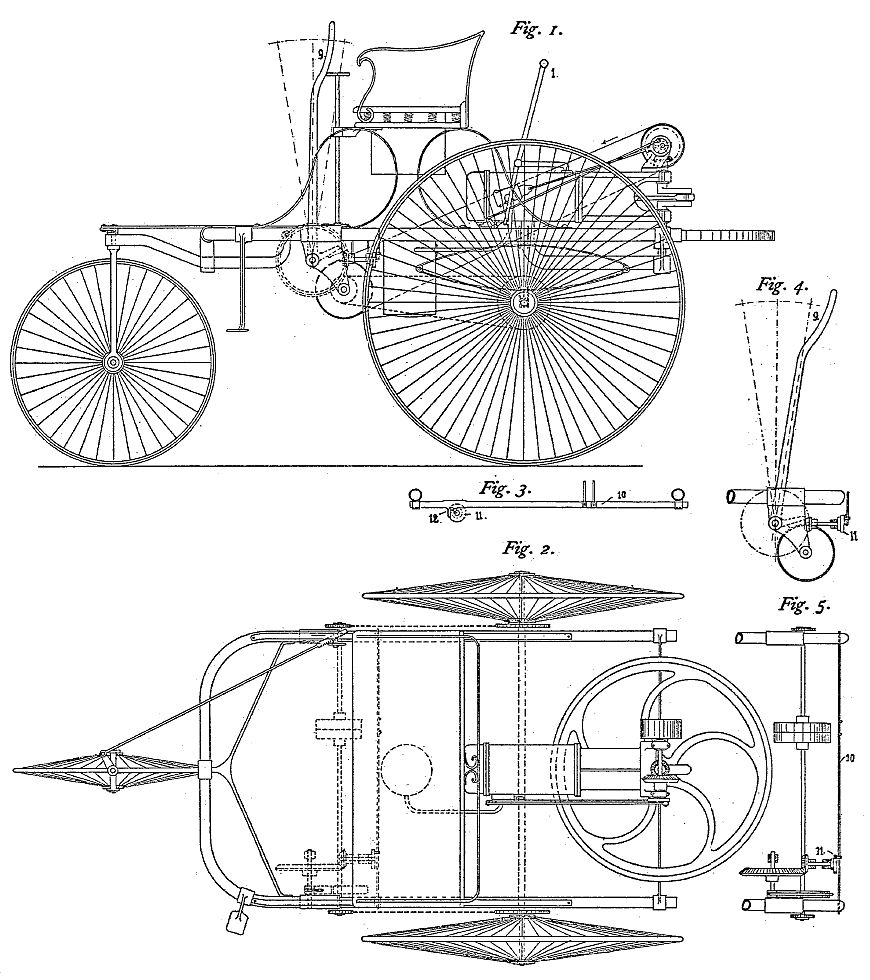
Benz's German patent no. 37435, granted January 1886, for a "vehicle powered by a gas engine." RobertSimons, CC0, via Wikimedia Commons
The automobile reshaped cities, economies, and landscapes in ways Benz could not have imagined. Suburbs became possible because people could live farther from work. Highways replaced rail lines as the primary infrastructure for moving goods. The internal combustion engine, refined and scaled, became the dominant technology of the twentieth century. But the core insight, that personal mobility could be a designed artifact rather than a partnership with an animal, that began on a street in Mannheim with a three-wheeled machine that barely worked.
studio / on-this-day / Jul 3