studio / on-this-day / Jul 23
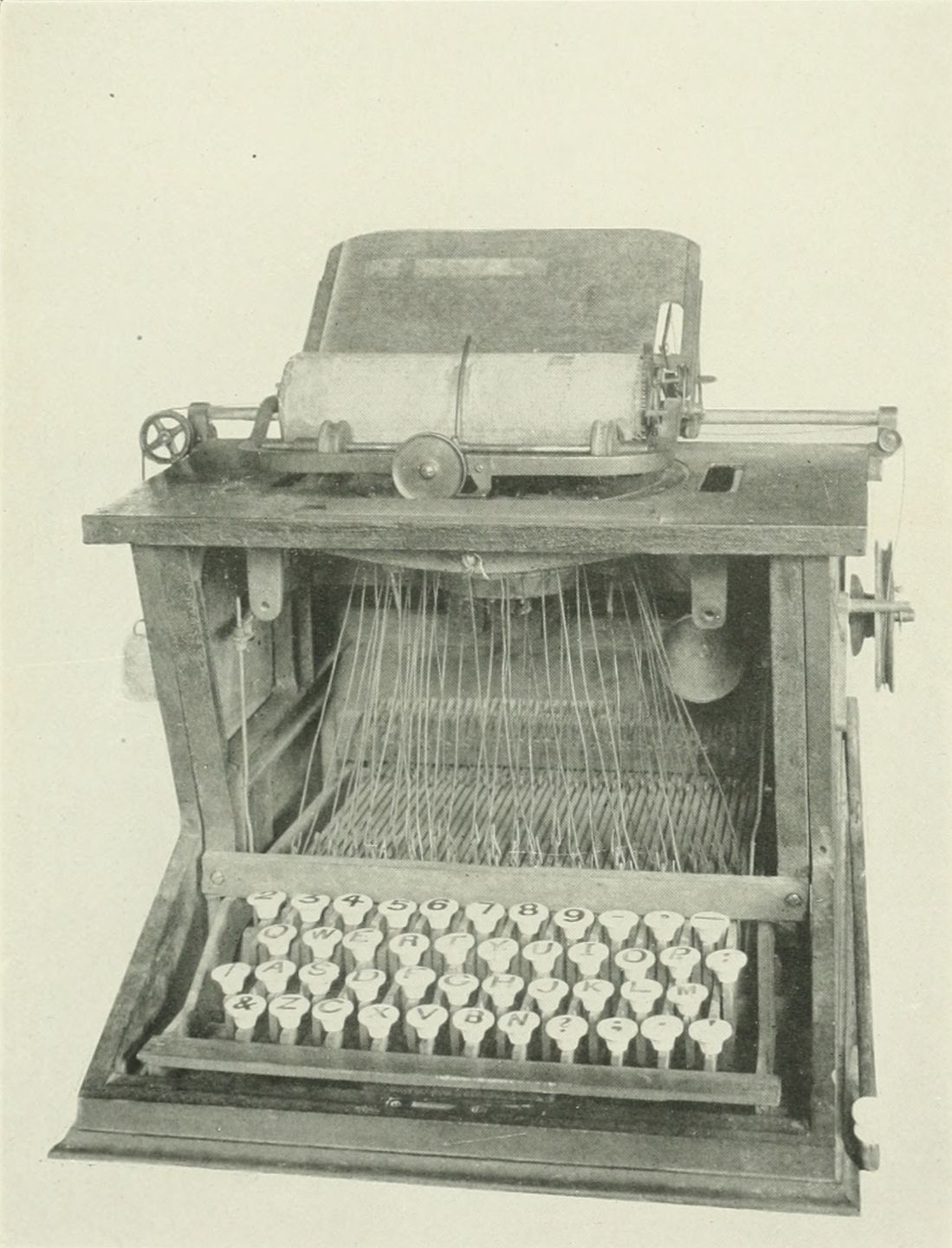
Christopher Latham Sholes typewriter, 1873. George Iles, Public domain, via Wikimedia Commons
Writing as Machine Work
On this day in 1829 — William Austin Burt patented the typographer, an early typewriter that began turning handwriting into machine work.
3 min read
On July 23, 1829, William Austin Burt received U.S. Patent No. 5581X for a machine he called the typographer. It was the first patent for a writing machine issued in America. Burt had built the device in his workshop in Michigan, using wood, metal, and a rotating circular dial with letters arranged around the edge. You selected a character by turning the dial, then pressed a lever to strike it onto paper. It was slow, clunky, and impractical. It was also the beginning of mechanized writing.
Burt did not set out to revolutionize communication. He wanted to solve a personal problem. His handwriting was terrible. He was a surveyor, a job that required legible field notes, and his script was illegible even to himself. Rather than improve his penmanship, he designed a machine that bypassed the need for it. The typographer did not require a trained hand. It required patience and precision. You picked a letter, you pressed a lever, you moved to the next. The process was the same every time, producing uniform characters regardless of who operated the machine.
The design was far from efficient. Handwriting was faster. A skilled clerk could write several sentences in the time it took the typographer to produce one. Burt demonstrated the machine to officials in Washington, hoping for government contracts. They were impressed by the novelty but uninterested in adoption. Why would anyone use a slow machine when trained scribes were plentiful and cheap? Burt returned to Michigan and went back to surveying. The typographer was forgotten.
But the idea persisted. Over the next four decades, dozens of inventors filed patents for writing machines. Each iteration solved some problem the previous designs had created. Christopher Latham Sholes eventually created the first commercially viable typewriter in the 1860s, using a keyboard layout designed to prevent jamming by separating frequently paired letters. That layout, QWERTY, persists today on devices that have no mechanical jams to prevent. Design decisions outlast the constraints that created them.
The typewriter changed the nature of written work. Before its widespread adoption, writing was personal, variable, identifiable by hand. After the typewriter, documents looked identical. The author disappeared into the uniformity of the text. This had legal implications. Typewritten documents were harder to forge but also harder to authenticate. Handwriting experts became obsolete. The signature remained the only handwritten proof of identity on otherwise mechanical pages.
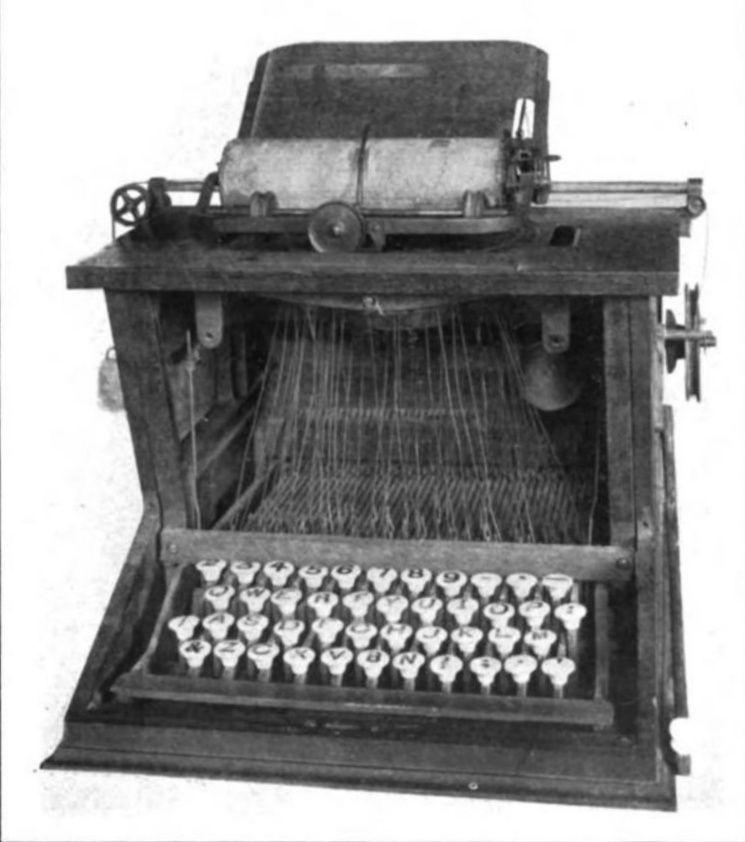
The Sholes and glidden typewriter, the first commercially produced model. George Iles, Public domain, via Wikimedia Commons
More importantly, the typewriter created a new class of worker. The typist, almost always a woman, became essential to office work. Women were hired for typing because their hands were considered more nimble and because they could be paid less than men. The machine became a gateway into the workforce for women who had been excluded from most professional roles. It was not liberation, but it was access. The typewriter did not eliminate gender inequality, but it shifted where the boundaries were drawn.
Writers adapted to the machine. Mark Twain claimed to be the first author to submit a typewritten manuscript to a publisher. He said it was "The Adventures of Tom Sawyer," though later evidence suggests it was "Life on the Mississippi." Regardless, the shift was real. Writing stopped being a solitary act with pen and paper and became something that involved a machine, a ribbon, and the rhythmic clacking of keys. The sound of typing became the sound of thought made visible.
The mechanics influenced the writing itself. Sentences became more direct. Typewriters enforced a grid. Each character occupied the same width, each line the same spacing. Prose became modular, organized into blocks of text that looked like data. The typewriter did not just transcribe thought. It structured it. Just as Jacquard's loom turned fabric into programmable patterns, the typewriter turned language into mechanical output.
Burt's typographer never succeeded commercially. He made his living as a surveyor and inventor of other tools. He developed an improved compass, a solar compass that did not rely on magnetic north, which was more useful in the iron-rich lands of Michigan. That device was widely adopted and made him modestly successful. The typographer was a footnote. But it was the first footnote in a long history of machines designed to turn human thought into standardized text.
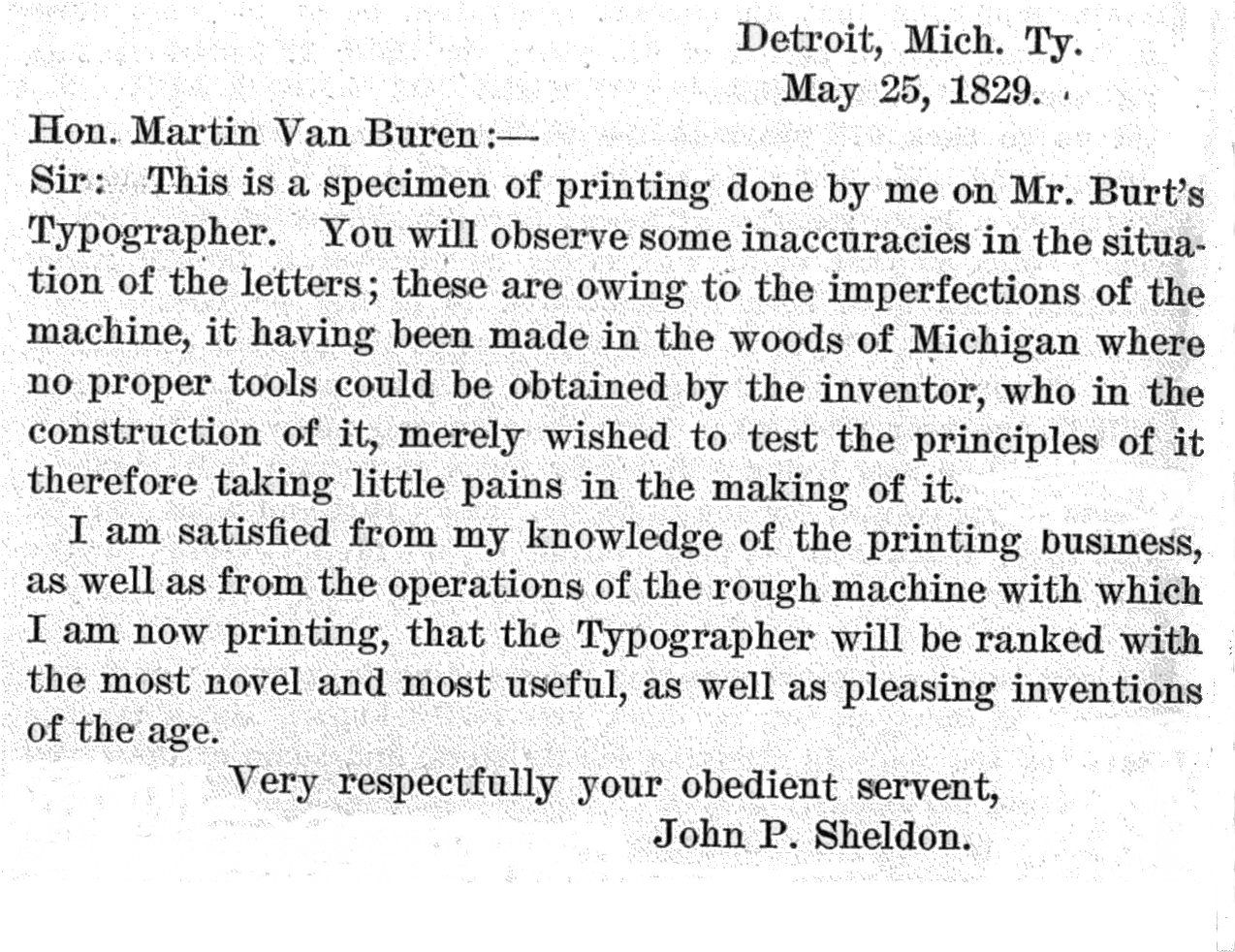
A letter produced on Burt's typographer in 1829, among the earliest typewritten pages. John O. Sheldon, Public domain, via Wikimedia Commons
We still call them keyboards. We still press keys. The mechanism has changed, the materiality is gone, but the concept remains. Writing is no longer about the hand forming letters. It is about selecting characters from a set and assembling them in sequence. Burt did not invent the typewriter, but he patented the idea that writing could be mechanized. That idea changed everything. The hand became optional. The machine took over. We have been pressing keys ever since.
studio / on-this-day / Jul 23