studio / on-this-day / Jun 23
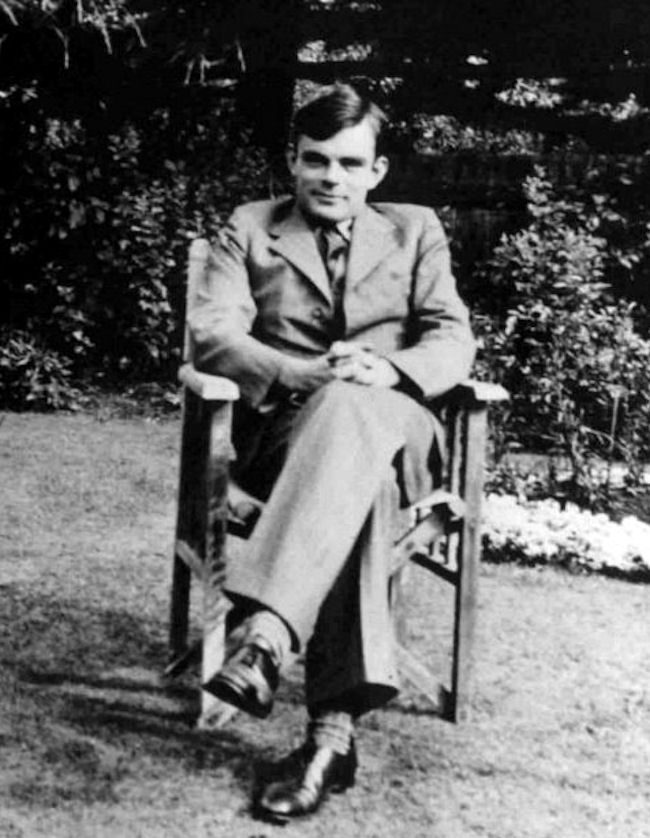
Alan Turing photographed in the 1930s. Public domain, via Wikimedia Commons
The Man Who Taught Machines to Think
On this day in 1912 — Alan Turing was born. He asked "can machines think?" and then built one to prove they could.
3 min read
Alan Mathison Turing was born in London on June 23, 1912, into an upper-middle-class family that valued education and empire service. His father worked for the Indian Civil Service and was often absent. His mother raised Alan and his older brother largely on their own. From an early age, Turing showed an unusual affinity for numbers, patterns, and problems that others found inscrutable. He was awkward socially, brilliant mathematically, and obsessed with understanding how things worked at a fundamental level.
At Cambridge, Turing studied mathematics and became fascinated by a problem posed by David Hilbert: could there be a mechanical procedure to determine whether any given mathematical statement is provable? In 1936, at age 24, Turing published a paper titled "On Computable Numbers" that answered the question. He described a theoretical machine, now called a Turing machine, that could read and write symbols on an infinite tape according to a set of rules. The machine was simple in concept but universal in application. Any computation that could be performed by any machine could, in principle, be performed by a Turing machine. The paper laid the foundation for computer science and introduced the concept of the algorithm as a formal process.
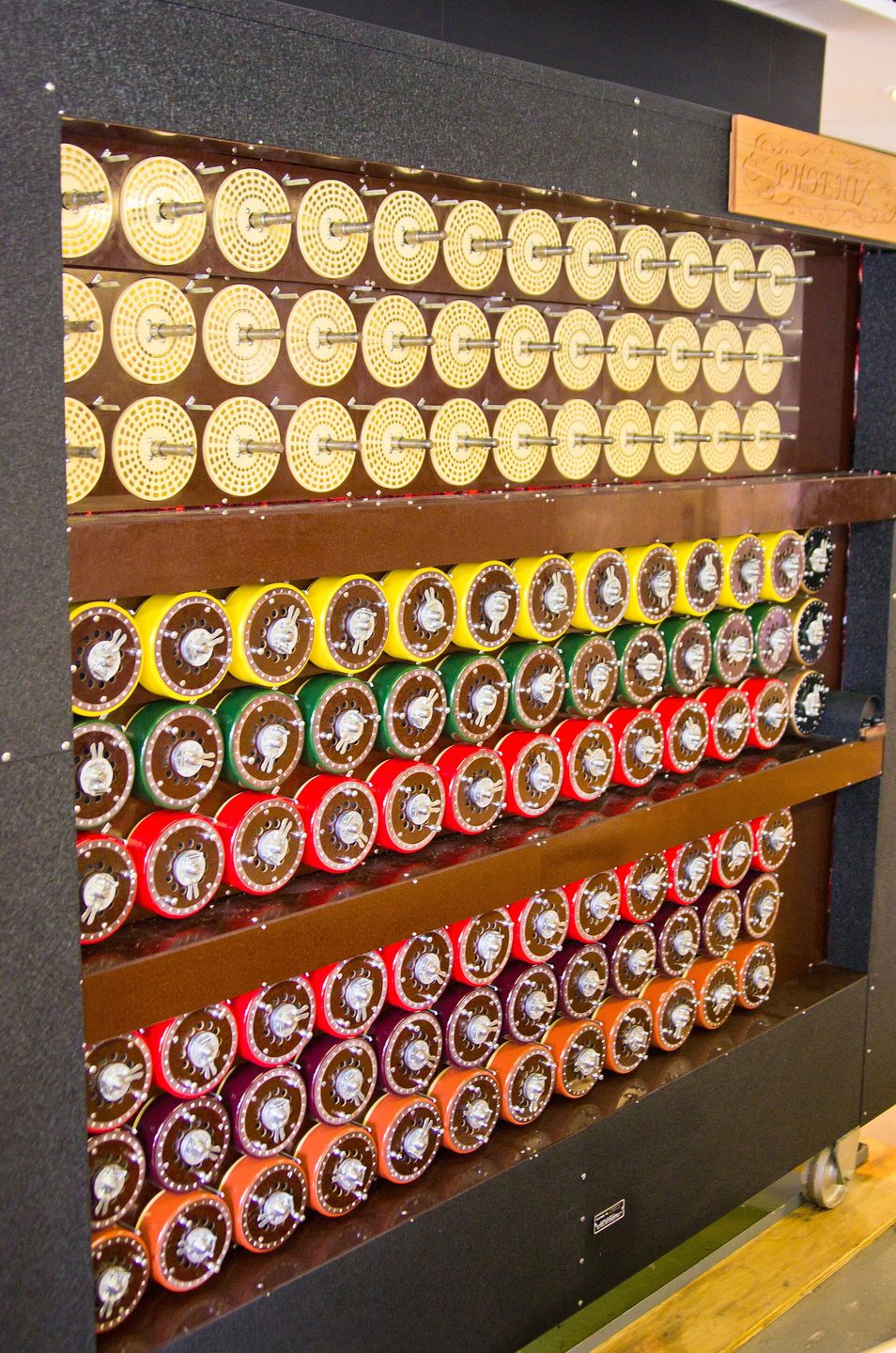
A rebuilt Bombe machine at Bletchley Park — Turing's electromechanical device that cracked Enigma-encrypted messages and shortened World War II. Antoine Taveneaux, CC BY-SA 3.0, via Wikimedia Commons
When World War II began, Turing joined the code-breaking operation at Bletchley Park, where he led the team working to crack the German Enigma cipher. Enigma machines encrypted messages using rotating wheels that changed settings with each keystroke, producing billions of possible configurations. Breaking the code required not just mathematical insight but engineering ingenuity. Turing designed the Bombe, an electromechanical device that tested potential Enigma settings at high speed. The Bombe was not a computer in the modern sense, but it was a machine designed to solve a computational problem. It worked. The intelligence gained from decrypted Enigma messages is estimated to have shortened the war by two years and saved countless lives.
After the war, Turing turned his attention to building an actual computer. He worked on the design of the Automatic Computing Engine at the National Physical Laboratory, but the project was delayed by bureaucracy and funding issues. Meanwhile, the Manchester Baby became the first stored-program computer in 1948. Turing joined the Manchester team and worked on the development of the Manchester Mark 1. In 1950, he published a paper titled "Computing Machinery and Intelligence," which began with the question: Can machines think? He proposed what is now known as the Turing Test, a method for determining whether a machine exhibits intelligent behavior indistinguishable from a human. The paper remains one of the most influential texts in artificial intelligence.
Turing's personal life was less straightforward than his professional one. He was gay at a time when homosexuality was illegal in Britain. In 1952, he was convicted of gross indecency after a brief relationship with a young man. He was given a choice: imprisonment or chemical castration through hormone treatment. He chose the latter. The treatment had severe physical and psychological effects. He continued to work, but his security clearance was revoked, cutting him off from the cryptographic and defense work that had defined much of his career.
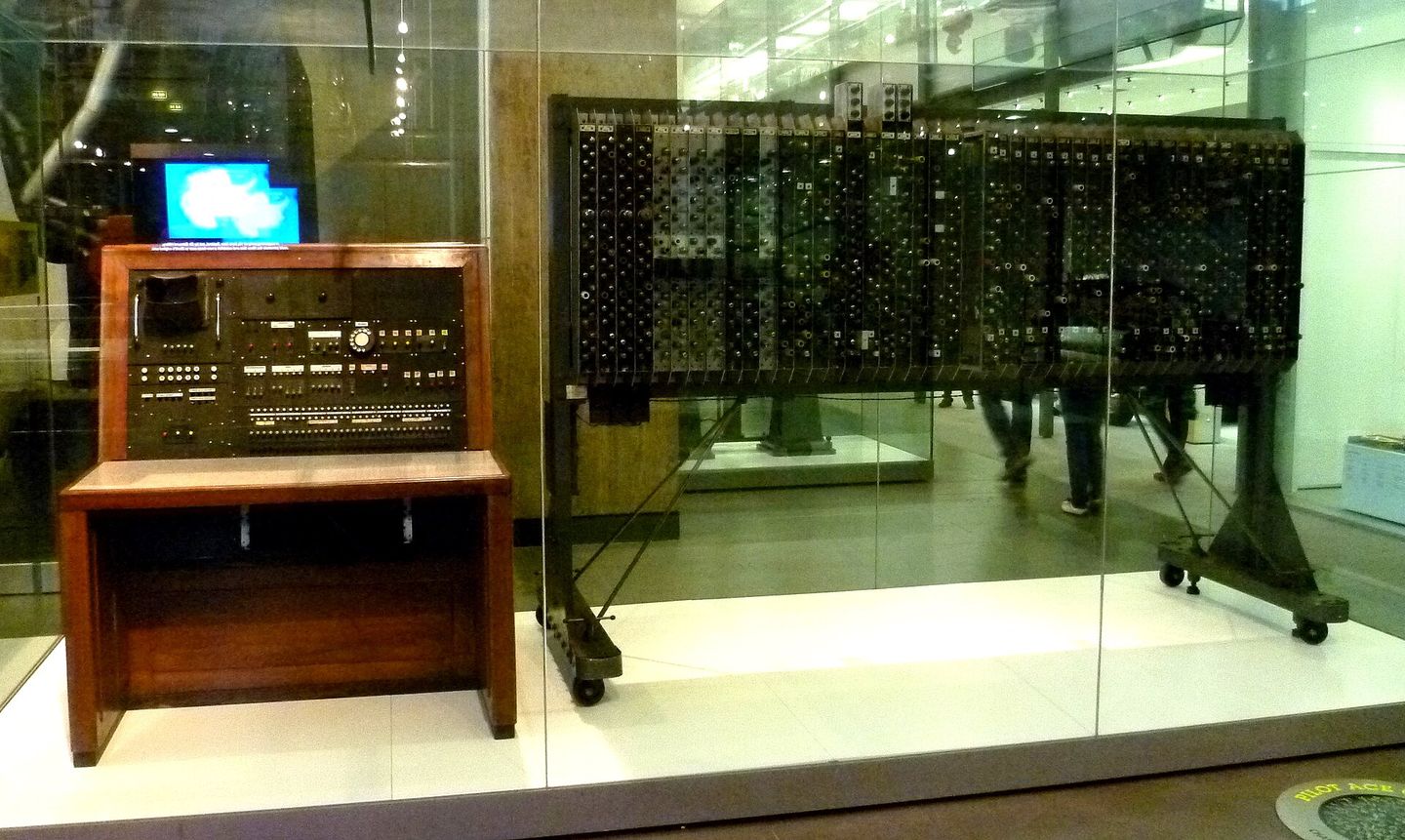
The Pilot ACE at London's Science Museum — the working prototype built from Turing's Automatic Computing Engine design. Philafrenzy, CC BY 2.0, via Wikimedia Commons
On June 7, 1954, Turing was found dead in his home. An autopsy determined that he had died from cyanide poisoning. A half-eaten apple was found near his bed, though it was never tested for cyanide. The inquest ruled his death a suicide. His mother believed it was an accident, that he had been conducting chemistry experiments and carelessly handled the cyanide. The truth is unknowable. What is certain is that Alan Turing, who had saved his country and invented the conceptual framework for the digital age, died alone at 41, persecuted by the state he had served.
In 2009, British Prime Minister Gordon Brown issued a formal apology on behalf of the government. In 2013, Turing received a royal pardon. In 2017, the Turing law posthumously pardoned thousands of men convicted under the same statute. None of it undoes what happened. What remains is the work, the ideas that continue to define how we think about computation, intelligence, and the boundaries between human and machine. Every time you unlock your phone, run a program, or ask whether an AI can think, you are standing in the shadow of a question Turing posed and a future he designed.
studio / on-this-day / Jun 23