studio / on-this-day / Jun 7
Alan Turing, mathematician and father of computer science. Elektrik Fanne, CC BY-SA 4.0, via Wikimedia Commons
The Machine That Could Think
On this day in 1954 — Alan Turing died, the man who cracked Enigma and invented computer science, hounded to death by the state he had saved.
3 min read
Alan Mathison Turing died on June 7, 1954, at the age of 41, in his home in Wilmslow, England. The cause of death was cyanide poisoning. Near his bed was an apple with a bite taken out of it, though it was never tested for poison. The coroner ruled it suicide. Turing's mother insisted it was an accident, that he had been conducting chemistry experiments and had been careless. The truth is unknowable. What is certain is that two years earlier, Turing had been convicted of gross indecency for being gay, subjected to chemical castration as an alternative to prison, and stripped of his security clearance. The man who had helped Britain win World War II was treated as a criminal by the country he had saved.
Turing's wartime work was classified for decades. During the war, he led the team at Bletchley Park that broke the German Enigma cipher. The Enigma machine encrypted messages using a system of rotors and plugboards that generated billions of possible configurations. Each day, the Germans changed the settings. Turing designed a machine called the Bombe, an electromechanical device that could test thousands of configurations per hour, searching for patterns that revealed the day's key. The Bombe did not solve Enigma alone. It required human intuition, linguistic knowledge, and captured codebooks. But it made breaking the cipher practical. Historians estimate that Turing's work shortened the war by two years and saved millions of lives.
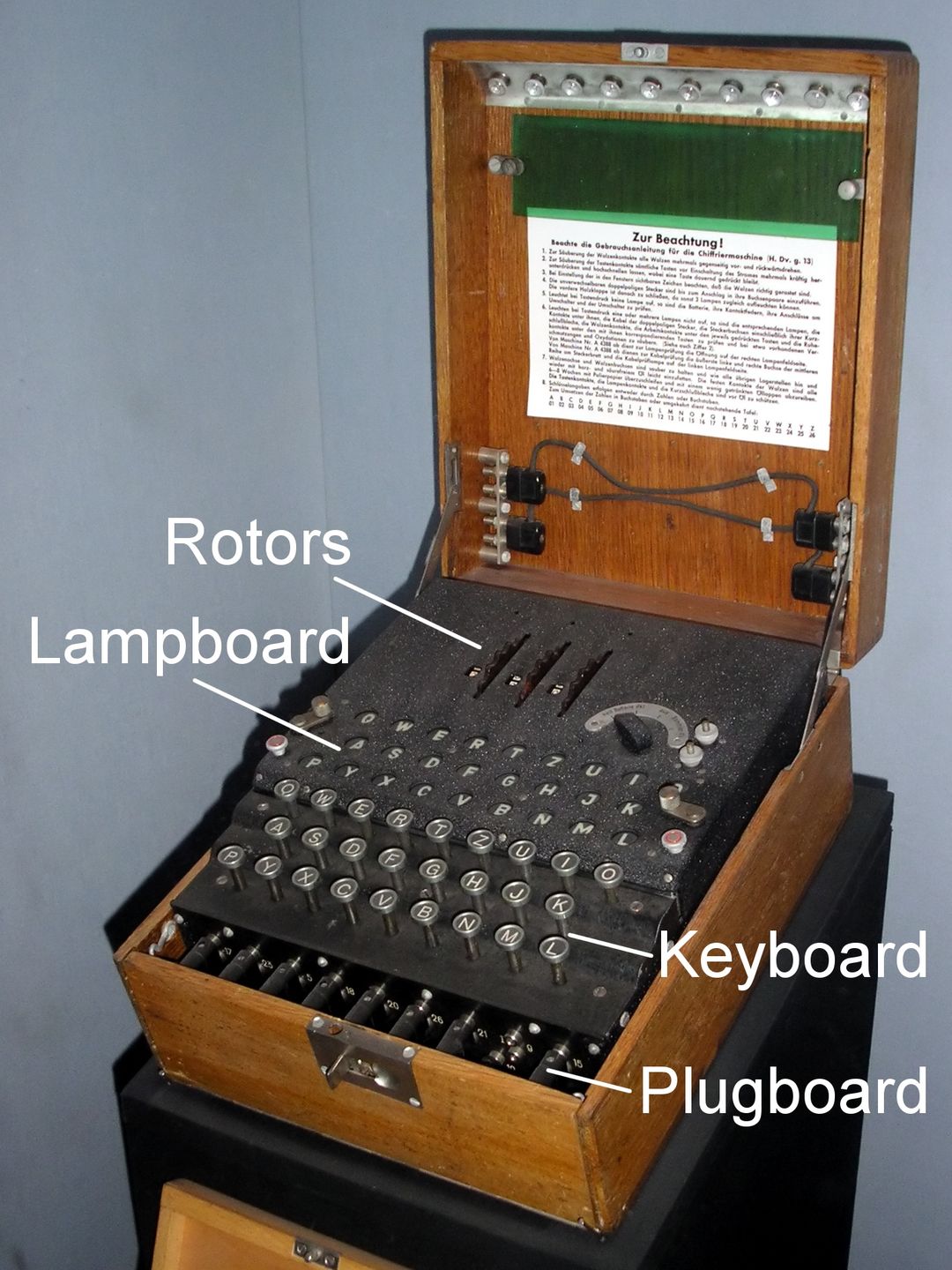
The Enigma machine, used by Nazi Germany to encrypt military communications — broken by Turing and the team at Bletchley Park. Karsten Sperling, http://spiff.de/photo, Public domain, via Wikimedia Commons
Before the war, Turing had already laid the theoretical foundation for all modern computing. In 1936, at age 24, he published a paper titled "On Computable Numbers." In it, he described an imaginary machine that could read and write symbols on an infinite tape according to a set of rules. This machine, now called a Turing machine, could simulate any algorithm. It was a mathematical model of computation itself, proof that certain problems were unsolvable, and a blueprint for the programmable computer. The first stored-program computer, built in 1948, was a physical realization of the Turing machine concept.
After the war, Turing turned his attention to artificial intelligence. In 1950, he published "Computing Machinery and Intelligence," which opened with the question: Can machines think? He proposed a test, now called the Turing Test, in which a human interrogator tries to distinguish between a machine and a human through written conversation. If the interrogator cannot tell the difference, Turing argued, the machine can be said to think. The test was not meant as a definition of intelligence. It was a thought experiment, a way of reframing the question to make it empirically testable. Seventy years later, the test is still debated, still used, still misunderstood.
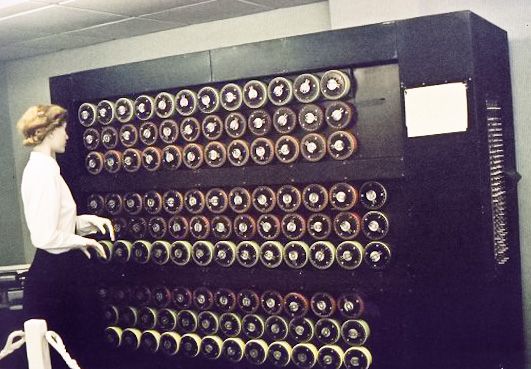
A working reconstruction of Turing's Bombe at Bletchley Park — the electromechanical machine that searched for each day's Enigma settings. User Messybeast on en.wikipedia, CC BY 2.5, via Wikimedia Commons
Turing also worked on morphogenesis, the mathematical study of how patterns form in nature. He developed equations to model how chemical reactions could produce the stripes on a zebra or the spots on a leopard. It was biology approached as computation, life understood as algorithm. The work was largely ignored during his lifetime. Decades later, it became foundational to understanding pattern formation in developmental biology.
In 2013, Queen Elizabeth II granted Turing a royal pardon, a symbolic gesture that acknowledged the injustice of his conviction. In 2021, Turing's face appeared on the £50 note. The recognition came too late for him to see it, but it mattered for what it represented. Turing had been written out of history during his lifetime, his contributions classified, his identity criminalized. The pardon and the currency were Britain's way of saying: we were wrong, and we remember.
Every device that runs software, every algorithm that processes data, every neural network that learns from examples, exists in the conceptual space Turing opened. He did not build the first computer. He proved that such a thing was possible. He did not write the first AI program. He asked whether intelligence could be mechanical. The questions he posed in the 1930s and 1950s are still the questions we ask today. What can be computed? What cannot? When does a machine stop being a tool and start being something else? Turing gave us the language to think about these problems, and then he was gone. The apple, the poison, the silence.
studio / on-this-day / Jun 7