studio / on-this-day / Jun 24
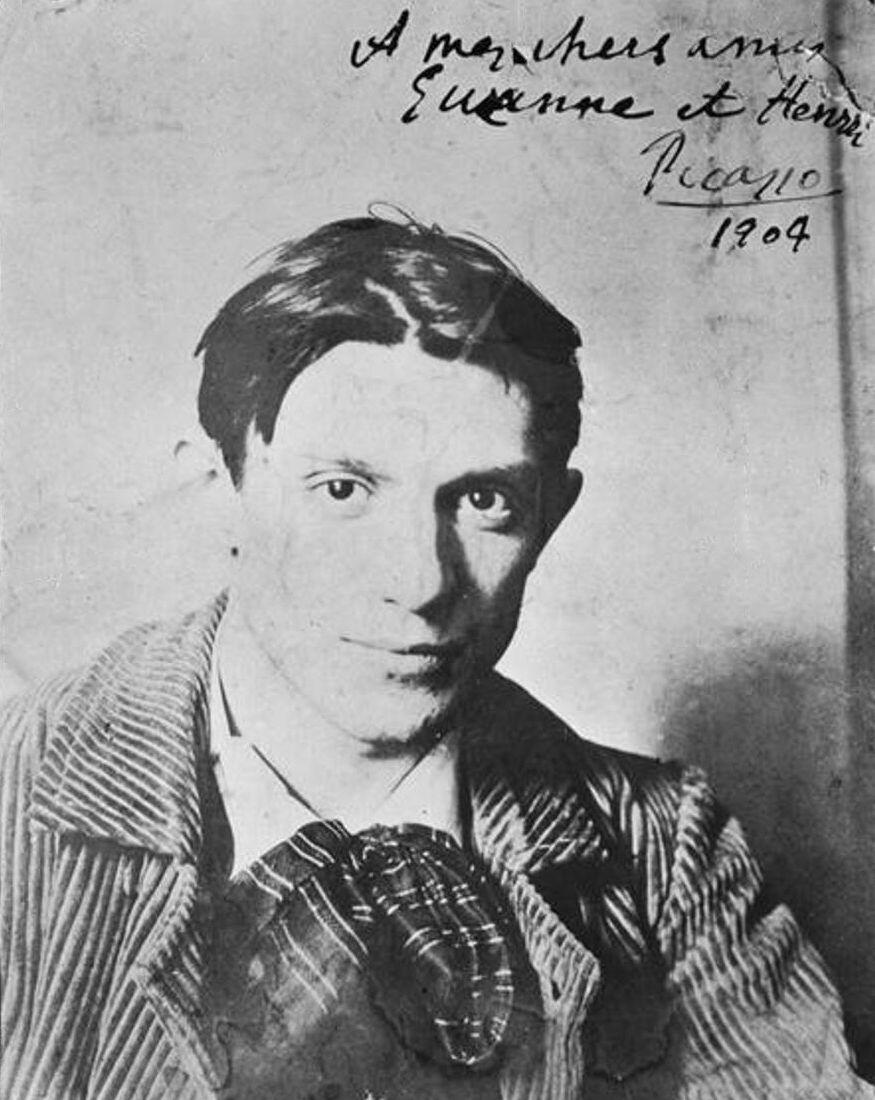
Pablo Picasso, Paris, 1904 — photograph by Ricard Canals i Llambí, taken shortly after his groundbreaking 1901 Vollard exhibition. Ricard Canals i Llambí, Public domain, via Wikimedia Commons
Before the Geometry
On this day in 1901 — a nineteen-year-old Picasso held his first Paris exhibition, still years away from inventing Cubism.
2 min read
On June 24, 1901, a small gallery on rue Laffitte in Paris opened an exhibition of pastels by a young Spanish artist named Pablo Ruiz Picasso. He was 19 years old. The show was organized by dealer Ambroise Vollard, who had previously championed Cézanne and Gauguin. Picasso's work at the time was conventional by the standards of what would come later. Bright colors. Parisian nightlife. Dancers, street scenes, women in hats. The paintings sold moderately well. Critics noticed his technical skill but saw nothing revolutionary. He was talented, but so were many others.
Picasso had arrived in Paris for the first time the year before, traveling with fellow painter Carles Casagemas. The two lived in poverty in Montmartre, sharing a studio and surviving on the occasional sale of a sketch or painting. Casagemas fell in love with a woman who did not return his feelings. In February 1901, in a Paris café, he shot himself in the head. Picasso was in Spain at the time, but the news devastated him. The death marked the beginning of what art historians call the Blue Period, a series of works dominated by somber tones and themes of poverty, isolation, and despair. The pastels shown in the June exhibition predated this shift, but the shift was already forming.
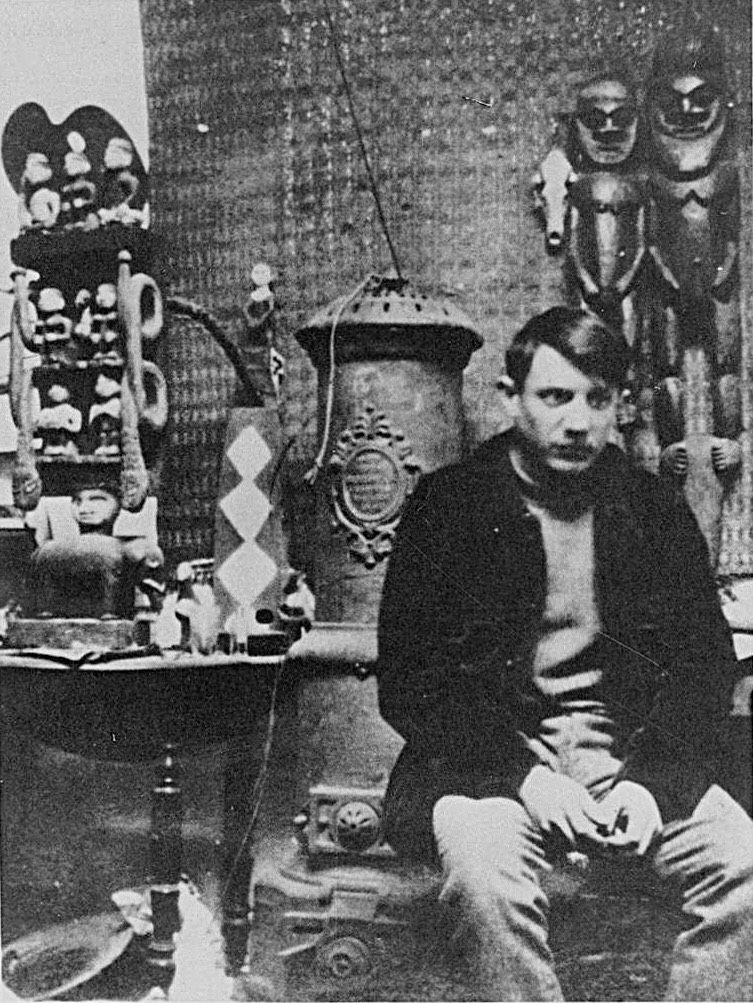
Pablo Picasso in his Montmartre studio, 1908 — between his first exhibition and the invention of Cubism, Picasso was developing the visual language that would reshape modern art. Gelett Burgess, Public domain, via Wikimedia Commons
What makes the 1901 exhibition significant is not the work itself but what it represents: the beginning of a career that would redefine what painting could be. Within a few years, Picasso would abandon traditional perspective and representation. He would collaborate with Georges Braque to develop cubism, fragmenting objects into geometric shapes and presenting multiple viewpoints simultaneously on a single canvas. The move was not aesthetic experimentation for its own sake. It was an attempt to show how we actually perceive things, which is not from one fixed point but from memory, movement, and layered experience.
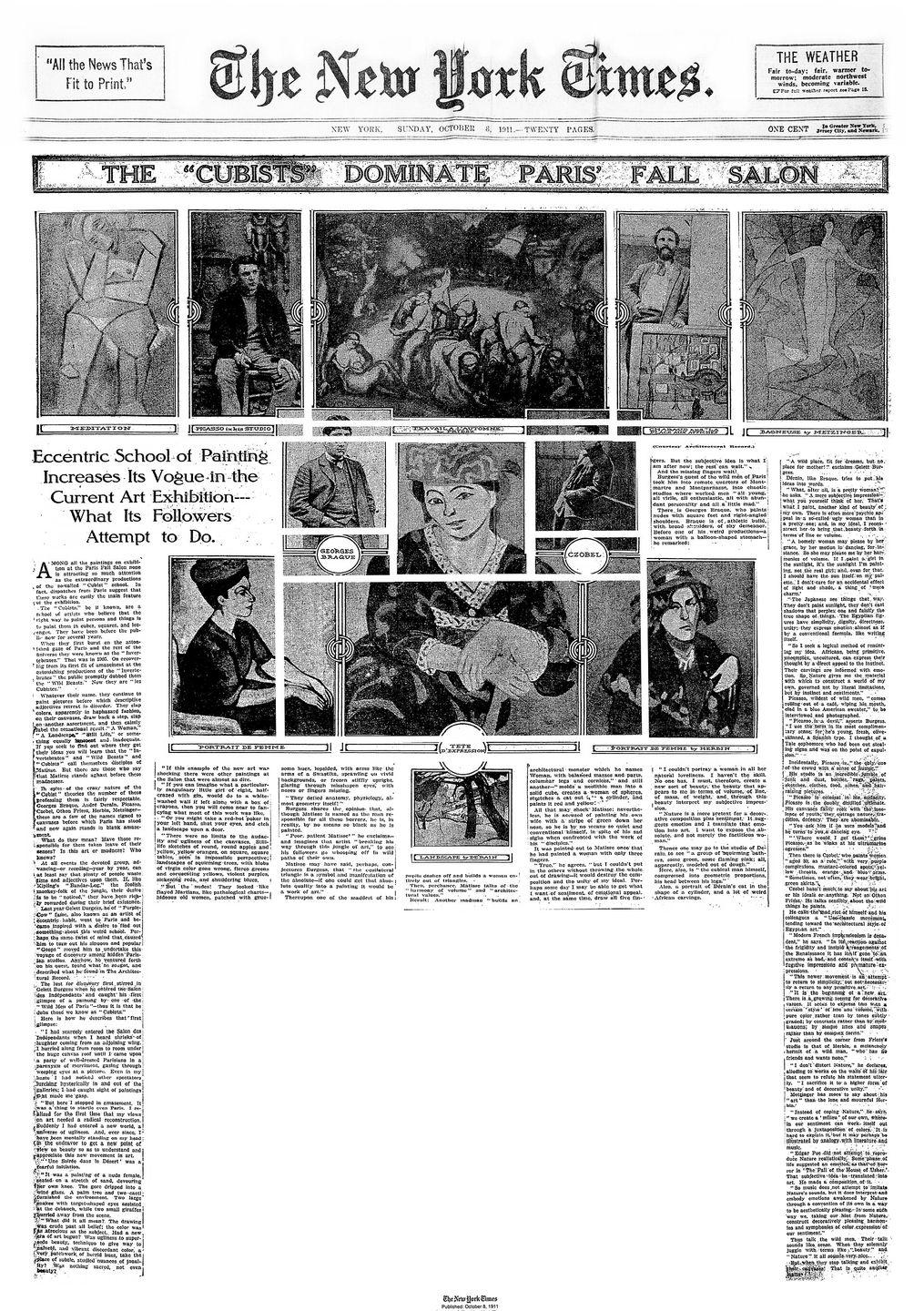
"the cubists dominate Paris' fall salon" — the New York Times, October 8, 1911. a decade after Picasso's first show, the movement he helped invent had become front-page news. Public domain, via Wikimedia Commons
Cubism changed how designers and architects thought about space. The idea that a single object could be shown from multiple angles at once influenced everything from industrial design to typography. The fragmented, layered compositions of early modernist posters and book covers owe a direct debt to cubist principles. So do the spatial experiments in film editing and the collage techniques of graphic design. Picasso was not trying to create a design movement. He was solving a problem about representation. The design implications followed.
Picasso worked until his death in 1973, producing an estimated 50,000 works across painting, sculpture, ceramics, and printmaking. He became synonymous with modern art, both celebrated and criticized for constantly changing styles. But the work shown in Paris in 1901 reveals something useful: even revolutionary careers start somewhere ordinary. The pastels of dancers and street scenes were competent, saleable, and unremarkable. They did not predict what was coming. Genius is not always visible at the beginning. Sometimes it just looks like a 19-year-old trying to pay rent.
studio / on-this-day / Jun 24