studio / on-this-day / Jun 21
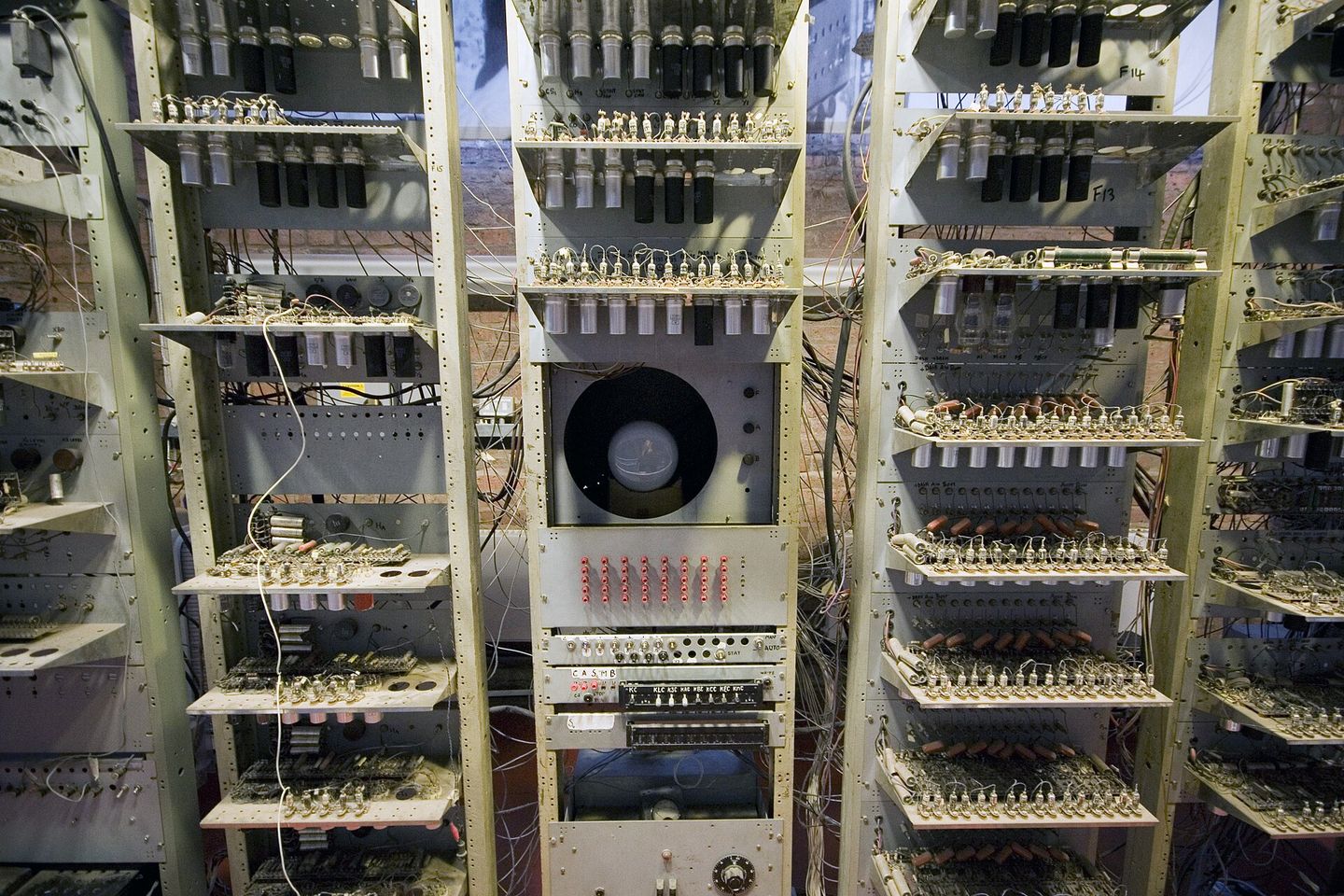
The Manchester Baby (Small-Scale Experimental Machine) — the world's first computer to run a stored program, in June 1948. Parrot of Doom, CC BY-SA 3.0, via Wikimedia Commons
The Machine That Remembered Instructions
On this day in 1948 — the Manchester Baby ran the first stored program, the moment software split off from the hardware it ran on.
3 min read
On June 21, 1948, in a laboratory at the University of Manchester, a machine smaller than a room but larger than a desk executed a program stored in its own electronic memory. The machine was officially called the Small-Scale Experimental Machine. Everyone called it the Baby. It was the first computer to run a stored program, and with that single run, it changed the architecture of computation forever. Before the Baby, programs were wired into machines. After the Baby, programs became data.
The concept had been described years earlier by mathematician Alan Turing, who proposed a theoretical machine that could read instructions from a tape and modify its own behavior accordingly. The Manchester team, led by Freddie Williams and Tom Kilburn, built the first physical implementation of that idea. The Baby had no keyboard, no monitor, no storage beyond its 32 words of memory, each word only 32 bits. It could perform seven types of operations, all basic arithmetic and logic. The first program it ran was written to find the highest factor of a number. It took 52 minutes to complete. The answer was correct.
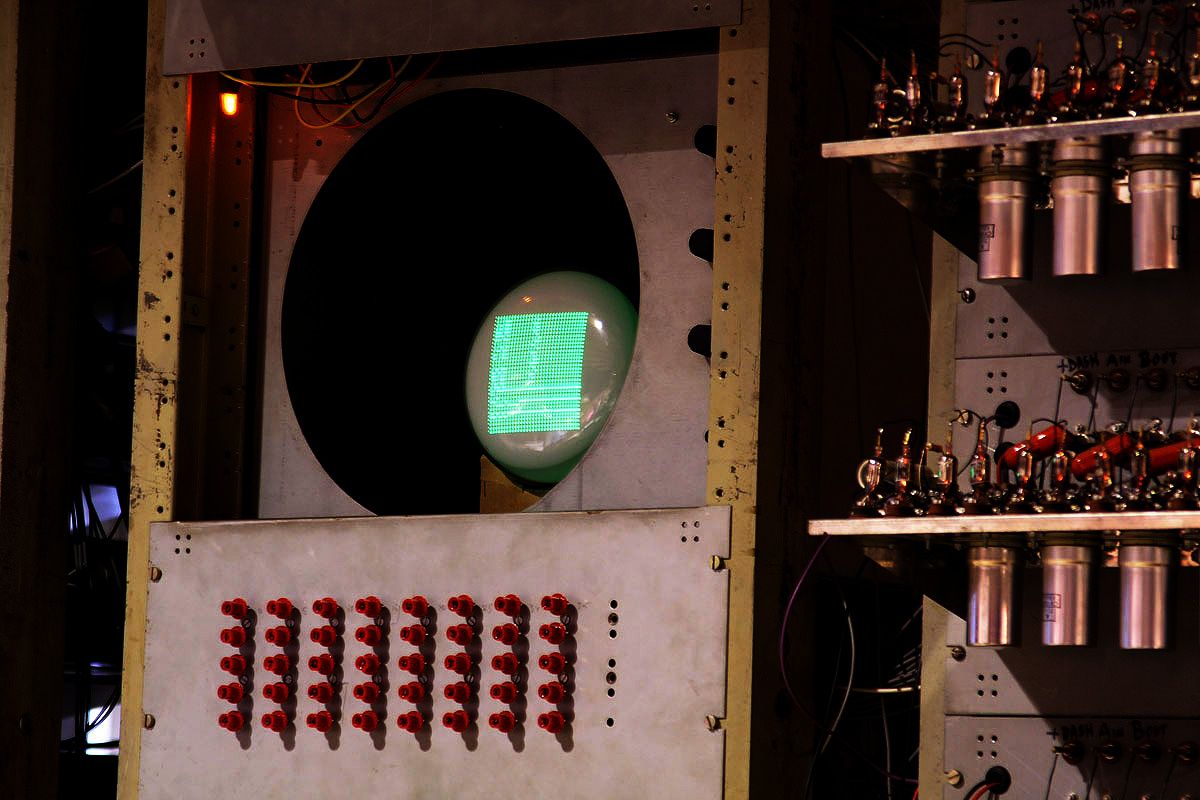
A cathode ray tube (Williams tube) — the type of memory used in the Manchester Baby to store its program and data as electronic dots on a screen. Ben.Green at English Wikipedia, Public domain, via Wikimedia Commons
The real breakthrough was not the machine's speed or power. It was the Williams-Kilburn tube, a cathode ray tube used as random-access memory. Data was stored as patterns of electrical charge on the face of the tube, visible as dots on a screen. The memory was volatile, erasing itself when the power was turned off, and it was prone to errors from electrical noise. But it worked. It allowed the machine to store both the program and the data it operated on in the same memory space, treating instructions as just another type of data. This was the stored-program architecture, and it became the foundation of every general-purpose computer built since.
The implications were profound. If instructions could be stored in memory, they could be modified by the machine itself. Programs could rewrite themselves. Loops, conditionals, and subroutines became possible. A single machine could run any program, limited only by memory and time. The distinction between hardware and software became real. You no longer needed to physically rewire a machine to change what it did. You just loaded a different program.
The Baby was never intended for production. It was a proof of concept, a test bed for ideas that would be refined in later machines like the Manchester Mark 1 and eventually commercialized as the Ferranti Mark 1, the first commercially available general-purpose computer. The Baby itself was dismantled after it served its purpose. A working replica was built in 1998 and is on display at the Museum of Science and Industry in Manchester. It runs the same programs the original ran, slowly, with the same glowing cathode ray tubes and the same clicking relays.
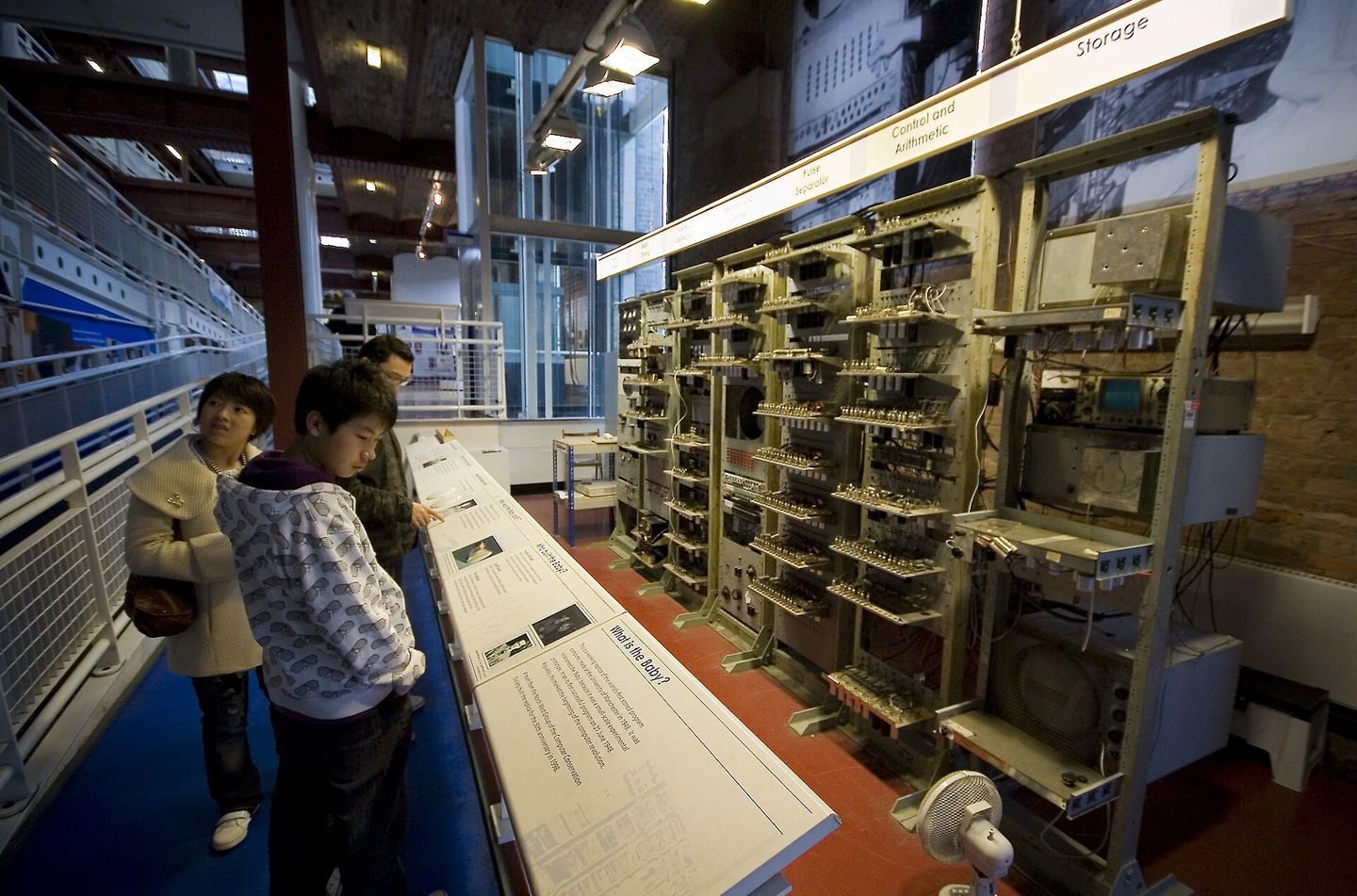
The 1998 working replica of the Manchester Baby, on display at the Museum of Science and Industry in Manchester — racks of valves and Williams tubes filling the whole frame. Parrot of Doom, CC BY-SA 3.0, via Wikimedia Commons
Tom Kilburn, who wrote the first stored program, later said that the significance of the Baby was not immediately obvious. To him, it was an engineering challenge, a way to test the Williams tube memory. The idea that this architecture would become universal, that every smartphone and server and supercomputer would follow the same basic design, was not something he anticipated. He was solving a specific problem. The world changed as a side effect.
The stored-program concept is so foundational to modern computing that it is easy to take for granted. But it was not inevitable. Other architectures were possible. Some were explored. The stored-program model won because it was flexible, because it allowed machines to be reprogrammed without rebuilding them, because it made software possible. The Baby ran for 52 minutes on June 21, 1948, and in that time, it demonstrated that computation could be abstracted from the machine performing it. The program was the point. The hardware was just a vessel. Everything since has been elaboration.
studio / on-this-day / Jun 21