studio / on-this-day / Jun 19
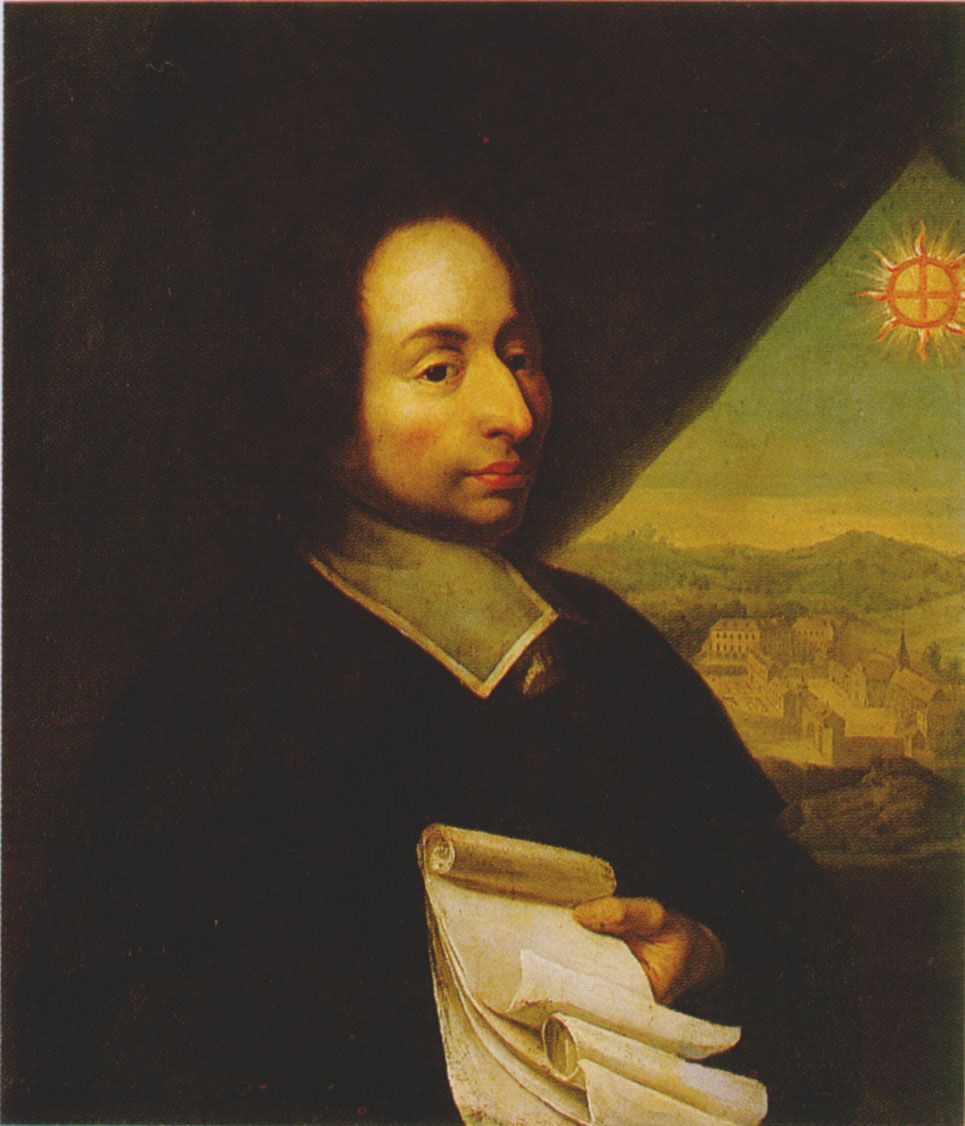
Blaise Pascal, mathematician and philosopher. Public domain, via Wikimedia Commons
The Calculator and the Wager
On this day in 1623 — Blaise Pascal was born, a mathematician and physicist who also warned that the heart has reasons reason cannot follow.
3 min read
Blaise Pascal was born in Clermont-Ferrand, France, on June 19, 1623, into a family that valued intellect above almost everything. His father, Étienne, was a mathematician and tax collector who educated his children at home. Blaise's mother died when he was three. His father never remarried. Instead, he focused on cultivating the mind of his son, who showed an unsettling aptitude for mathematics before he could read.
At age 12, Pascal discovered several of Euclid's geometric propositions on his own, without access to the texts. At 16, he wrote a treatise on conic sections that René Descartes refused to believe had been written by someone so young. At 19, to help his father with the tedious arithmetic required for tax calculations, Pascal invented the Pascaline, a mechanical calculator that could add and subtract using a system of gears and wheels. It was one of the first mechanical computers, a device that performed logic through physical design. He built more than 50 prototypes. Only a few survive.
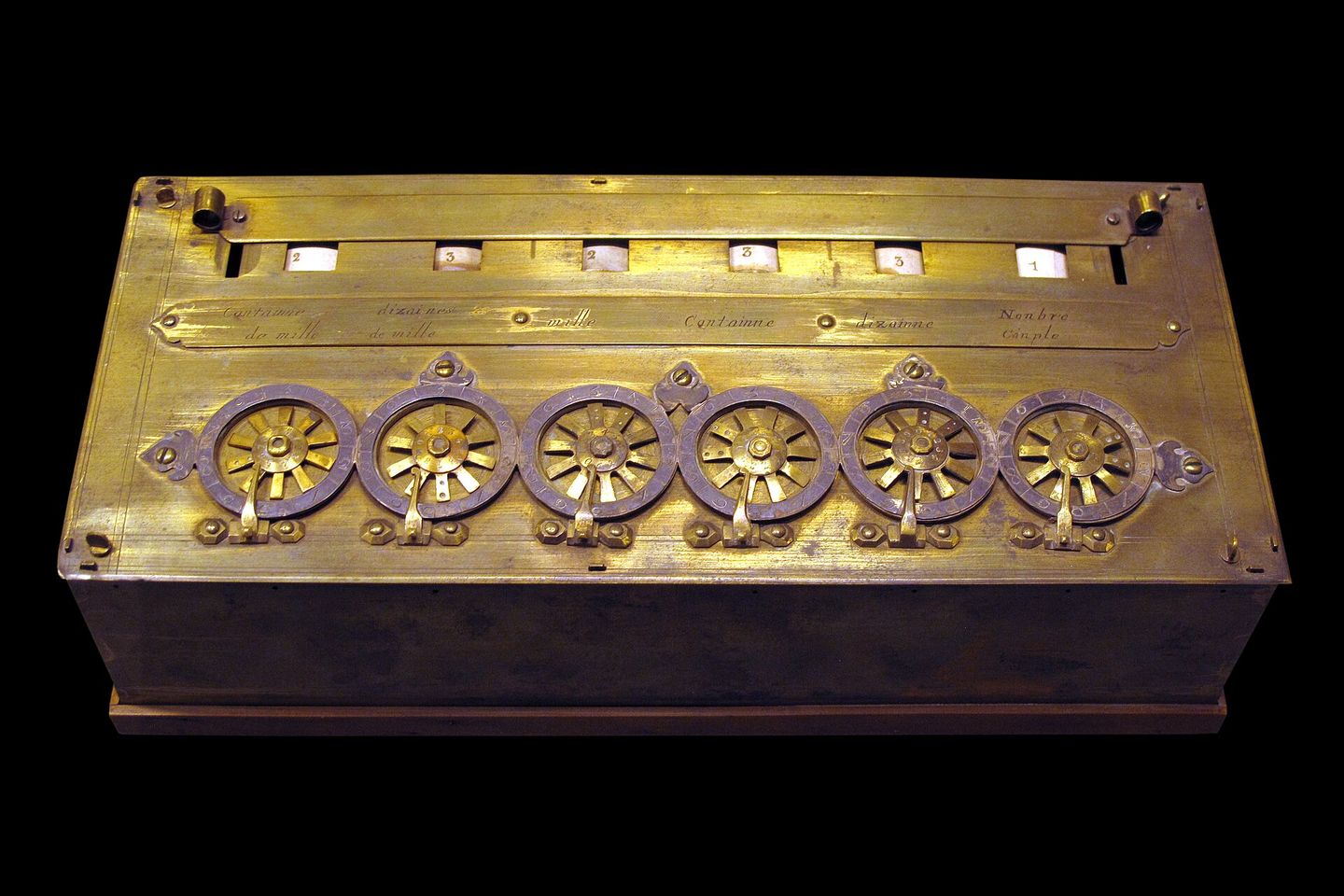
The Pascaline, Pascal's mechanical calculator, c. 1642, Conservatoire National des Arts et métiers, Paris. Rama, CC BY-SA 3.0 fr, via Wikimedia Commons
Pascal's early work in mathematics and physics was rigorous and foundational. He corresponded with Pierre de Fermat on problems of probability, laying the groundwork for what would become probability theory. He conducted experiments on atmospheric pressure using barometers, proving that air has weight and that pressure decreases with altitude. His experiments on fluids and pressure led to what is now called Pascal's law, a principle underlying hydraulic systems from car brakes to industrial presses. He saw the world as a set of interlocking systems that could be described with precision.
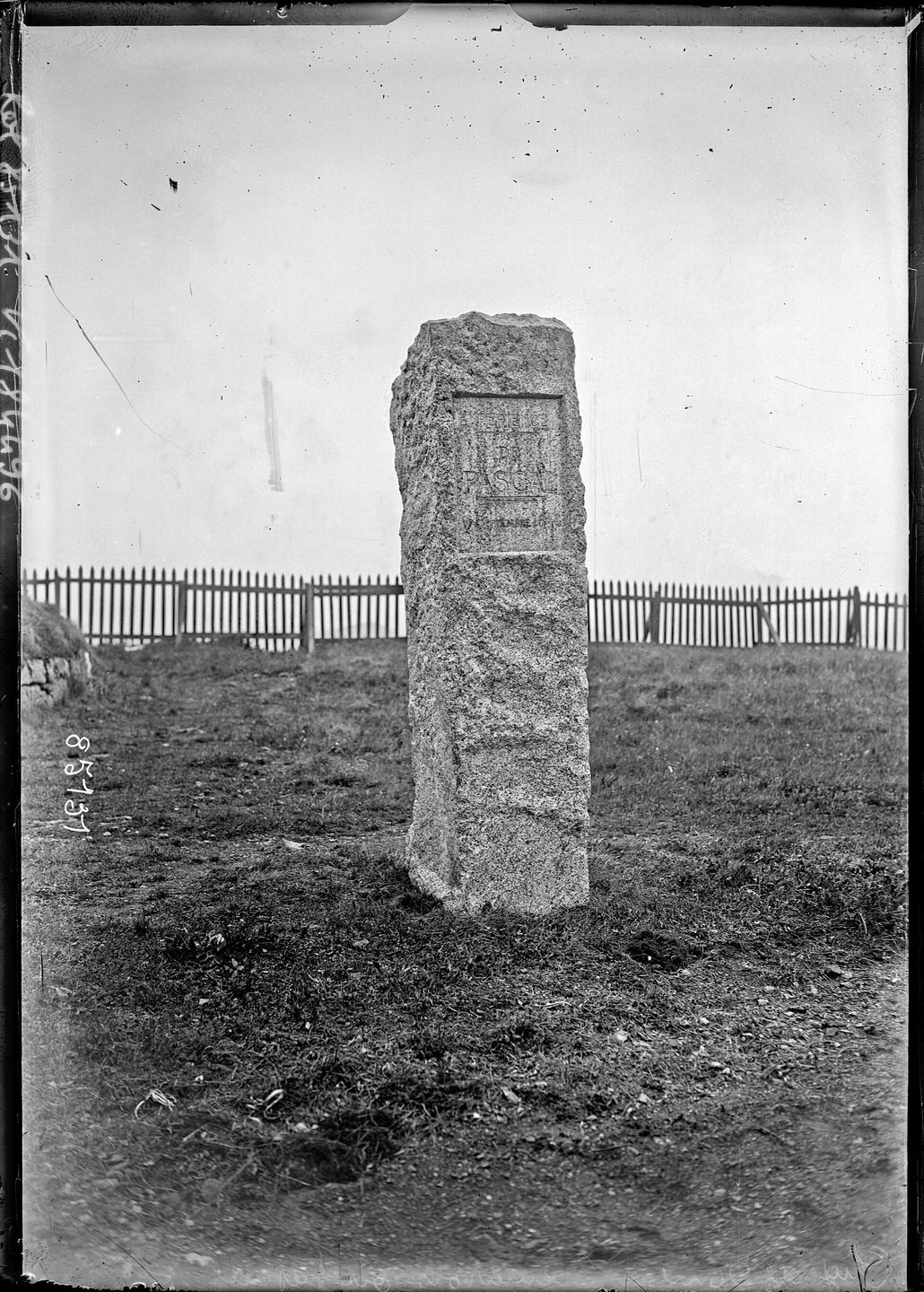
The Puy de dôme, where Pascal's barometer experiment on atmospheric pressure was carried out. Agence Rol. Agence photographique (commanditaire), Public domain, via Wikimedia Commons
Then, on the night of November 23, 1654, something happened. Pascal had a religious experience so intense that he sewed a written account of it into the lining of his coat and carried it with him for the rest of his life. The document, discovered after his death, described an encounter with what he called the God of Abraham, Isaac, and Jacob, not the God of philosophers and scholars. From that point forward, Pascal turned away from pure mathematics and toward theology and philosophy. He entered the Jansenist community at Port-Royal and began writing what would become the Pensées, a fragmentary, unfinished collection of thoughts on faith, doubt, and human nature.
It is in the Pensées that Pascal advanced what is now known as Pascal's Wager, an argument for belief in God framed as a decision under uncertainty. If God exists and you believe, you gain infinite reward. If God does not exist and you believe, you lose nothing of consequence. If God exists and you do not believe, you lose everything. Therefore, belief is the rational choice. The argument is not a proof. It is a design pattern for decision-making when the stakes are infinite and the evidence is incomplete. It treats faith as an engineering problem.
Pascal was chronically ill for most of his adult life, suffering from intense headaches, insomnia, and digestive problems. He worked through the pain with an almost manic intensity. In 1658, while suffering from a toothache, he distracted himself by solving problems related to the cycloid, a curve traced by a point on the rim of a rolling wheel. His solutions were elegant and complete. He published them under a pseudonym, challenging other mathematicians to match his results. Few could. His health continued to deteriorate. He died on August 19, 1662, at the age of 39. An autopsy revealed severe damage to his stomach and brain, likely the result of a chronic illness that had plagued him since childhood.
What Pascal left behind was a body of work that refused to stay in one category. He designed machines and wrestled with the infinite. He formalized probability and wrote about grace. He believed that reason could take you only so far, and that beyond reason lay something else, something the heart recognized but the mind could not prove. He spent his short life building tools to think with, and then used those tools to argue that some things cannot be thought, only felt. His legacy lives in every calculator, every probability table, every hydraulic press, and in every decision made in the face of uncertainty. The machines continue. The questions remain.
studio / on-this-day / Jun 19