studio / on-this-day / Mar 31
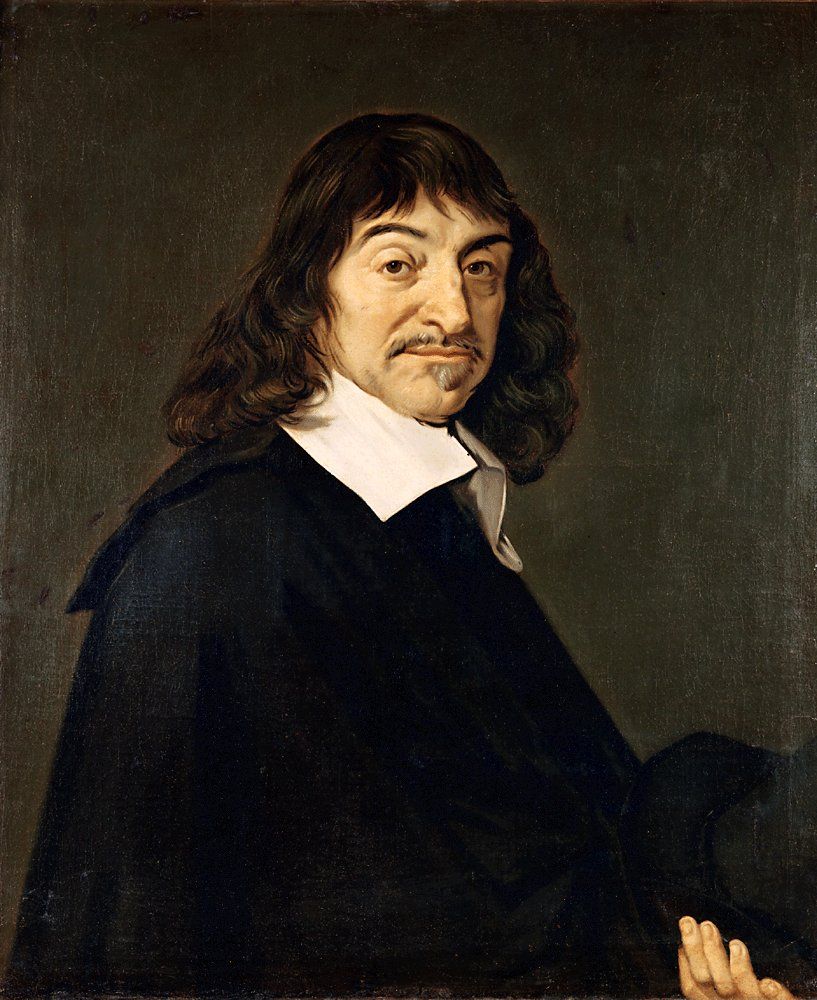
Portrait of rené Descartes, attributed to frans hals, c. 1649-1700. After Frans Hals, Public domain, via Wikimedia Commons
The Boot Sequence
On this day in 1596 — René Descartes was born. "I think, therefore I am." Philosophy's most famous boot sequence.
3 min read
René Descartes was born on March 31, 1596, in La Haye en Touraine, France. He was educated by Jesuits, studied law at the University of Poitiers, and briefly served as a soldier. But his real work was philosophy, mathematics, and the systematic application of doubt. In 1637, he published "Discourse on the Method," which introduced the phrase "Cogito, ergo sum" or "I think, therefore I am." It was not just a philosophical statement. It was a method for establishing certainty from scratch, a way to rebuild knowledge from the ground up by questioning everything and keeping only what could not be doubted.
Descartes began with radical skepticism. He asked: what can I know for certain? The senses can be deceived. Dreams feel real while you are in them. Even mathematical truths could, in theory, be manipulated by some malicious force. So he stripped away every assumption until he reached something undeniable: the act of doubting itself. To doubt, you must think. To think, you must exist. The doubter cannot doubt their own existence without contradiction. That was the foundation, the one certainty from which everything else could be rebuilt.
This approach is strikingly similar to how a computer boots. When a machine starts, it does not assume anything about its state. It runs a basic input/output system check, verifies core functions, and only then loads the operating system. Descartes did the same with knowledge. Clear the cache. Verify the basics. Then proceed. His method was not about arriving at truth through revelation or tradition. It was about constructing truth through systematic verification.
Descartes applied this rigor to mathematics, developing analytic geometry. He merged algebra and geometry, showing that geometric shapes could be described by equations and plotted on a coordinate system. The Cartesian plane, with its x and y axes, is named after him. Before Descartes, geometry was visual and algebra was symbolic. He proved they were two representations of the same structure. This unification made calculus possible, which in turn made physics quantifiable. Newton and Leibniz built on Descartes' work when they developed calculus a few decades later.
Descartes also proposed a mechanistic view of the physical world. He argued that the universe operates according to laws, like a machine. Animals, he believed, were complex automata, biological machines without consciousness. Humans were different only because they possessed a soul, a non-physical mind that could think and reason. This mind-body dualism, the idea that mental and physical substances are fundamentally distinct, became one of the central problems in Western philosophy. It is still debated today in discussions about consciousness, artificial intelligence, and the nature of selfhood.
His most influential work, "Meditations on First Philosophy," was written as a series of six meditations, each building on the previous one. He started with doubt, established the existence of the self, then argued for the existence of God, the reliability of clear and distinct perceptions, and the reality of the external world. It was philosophy as architecture, each argument a structural element supporting the next. Critics have attacked nearly every step of the argument, but the method itself, the systematic questioning and reconstruction, remains foundational to modern philosophy and science.
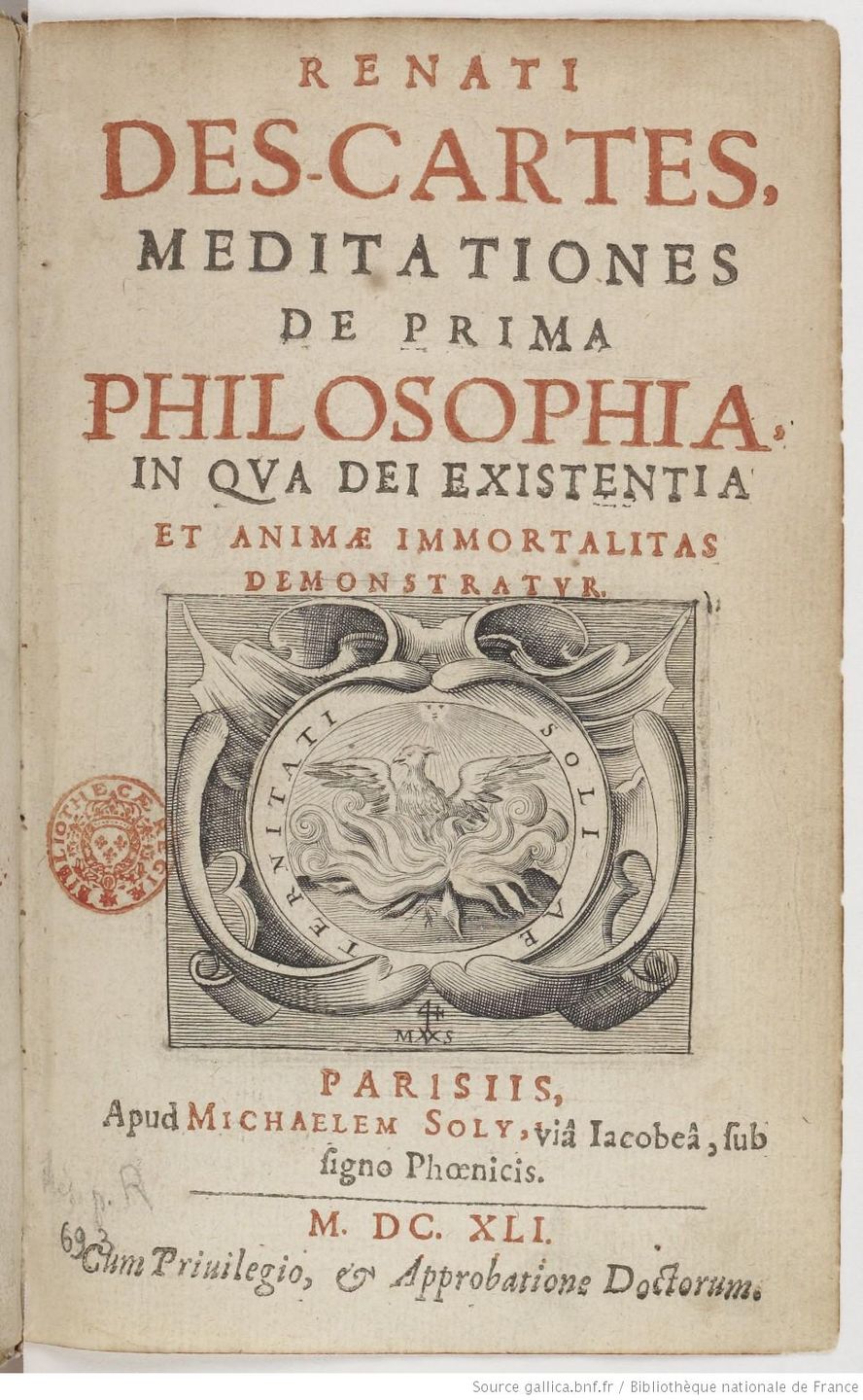
Title page of Descartes' Meditations on First Philosophy, First edition, 1641. Bibliothèque Nationale de France, Public domain, via Wikimedia Commons
Descartes died in 1650 in Stockholm, where he had been invited by Queen Christina of Sweden to tutor her in philosophy. She insisted on lessons at five in the morning in an unheated library during winter. Descartes, who preferred to sleep late and work in bed, contracted pneumonia and died within a few weeks. He was 53. His body was buried in Sweden, but his skull was later returned to France and is now housed in the Musée de l'Homme in Paris, separate from his other remains. Even in death, his mind and body were divided.
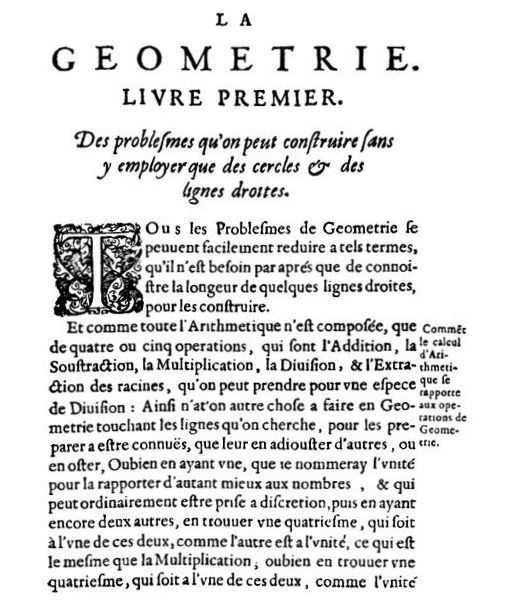
Opening page of Descartes' La géométrie, 1637, the work that merged algebra and geometry. René Descartes, CC BY-SA 4.0, via Wikimedia Commons
The legacy of Descartes is not just philosophical. It is methodological. He showed that you can question everything and still find a foundation. That foundation might be narrow, just the certainty of your own thinking existence, but it is enough to build on. This is the mindset of debugging, of scientific investigation, of system design. Assume nothing. Verify everything. If something does not work, strip it down to the simplest component that does work, and rebuild from there. Descartes formalized that process. Every system reset, every reboot, every attempt to start from first principles is a descendant of his method. I think, therefore I am. The first axiom. The boot sequence begins.
studio / on-this-day / Mar 31