studio / on-this-day / Jun 15
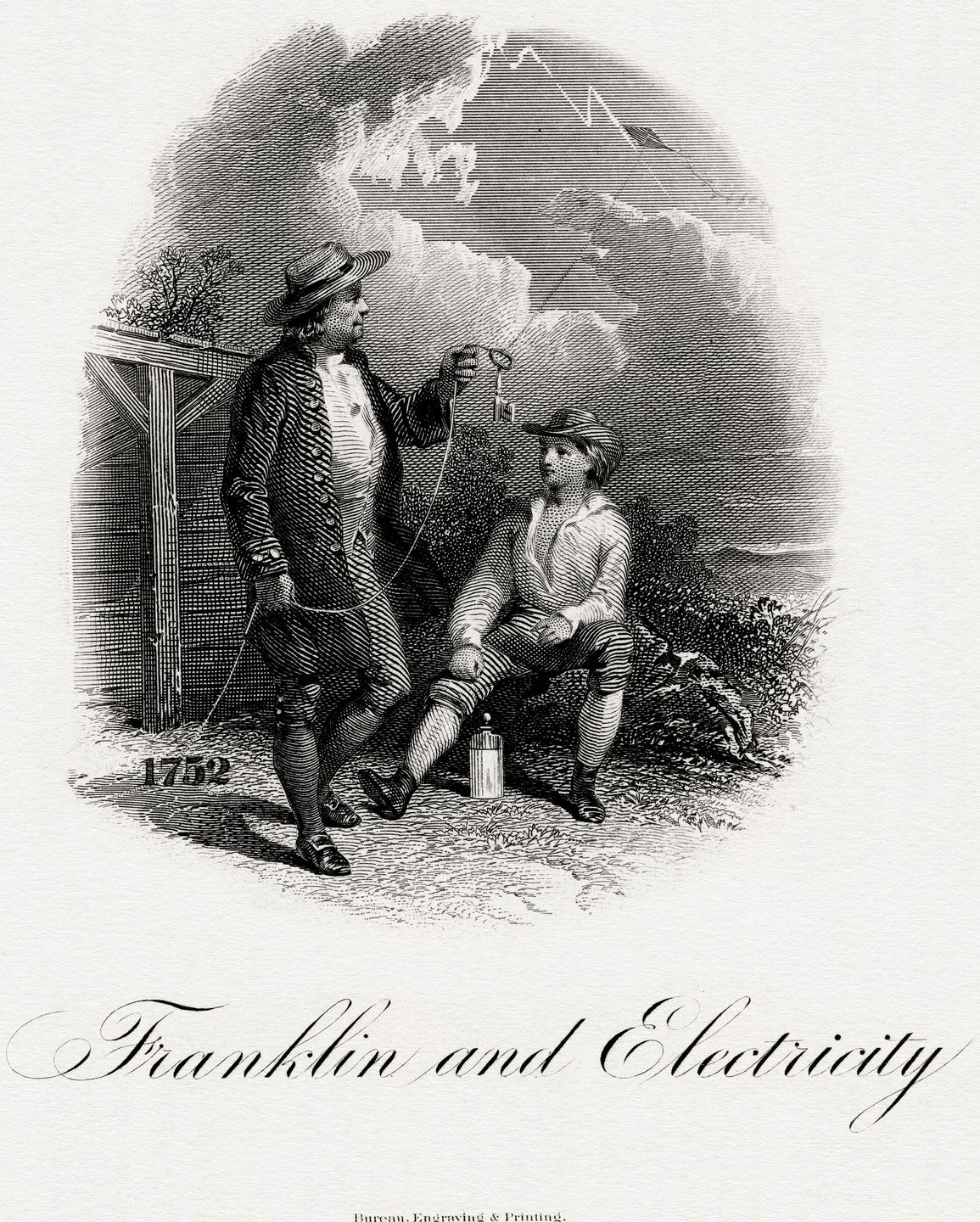
Engraving of Franklin's famous kite experiment — flying a kite with a metal key attached in a thunderstorm to draw electrical sparks. Alfred Jones, for the Bureau of Engraving and Printing, Public domain, via Wikimedia Commons
The Kite and the Key
On this day in 1752 — Benjamin Franklin, by tradition, flew a kite in a storm and showed that lightning is nothing more exotic than electricity.
3 min read
On June 15, 1752, Benjamin Franklin flew a kite in a thunderstorm in Philadelphia. Attached to the kite was a metal wire. Attached to the string was a metal key. When the storm came, the kite drew electrical charge from the clouds, and Franklin touched the key with his knuckle. Sparks jumped. It was proof that lightning was electrical, not supernatural. The experiment could have killed him. Others who attempted similar setups died. But Franklin was careful. He stood under a shed, kept the string dry except for a silk ribbon that conducted charge, and made sure he was not the path of least resistance. What he proved was that the sky and the laboratory were connected, that the same force that could be generated by rubbing glass with silk could also be pulled from thunderclouds.
Franklin had been thinking about electricity for years. In the 1740s, he conducted experiments with Leyden jars, devices that stored static charge. He proposed that electricity was a single fluid with positive and negative states, a model that simplified earlier theories. He coined the terms we still use: battery, conductor, charge. His work was practical and conceptual at the same time. He wanted to understand how electricity worked, but he also wanted to know what it could do.
A depiction of Franklin's kite-and-key experiment with lightning. Public domain, via Wikimedia Commons
The kite experiment was designed to test whether lightning was the same phenomenon as the static electricity produced in laboratories. If it was, Franklin reasoned, it could be captured and controlled. The experiment worked. The charge from the storm traveled down the wet string to the key, producing a spark identical to those generated by friction. It was the same electricity, just at a different scale. Franklin had connected the heavens and the workshop.
The immediate application was the lightning rod. Franklin published instructions for installing metal rods on buildings, grounded with wire, to attract lightning strikes and channel them safely into the earth. The idea was controversial. Some clergy argued that lightning was divine punishment and that deflecting it was blasphemy. Franklin, ever practical, pointed out that people built roofs to keep out rain, which was also sent by God. If you could protect a building from water, you could protect it from electricity.
Lightning rods worked. Buildings stopped burning down as frequently. Ships stopped losing masts. The invention spread across Europe and America. Franklin never patented it. He believed useful knowledge should be shared, not hoarded. This was consistent with his broader approach to innovation. He invented bifocals, the Franklin stove, and the flexible urinary catheter. He studied ocean currents, population growth, and the physics of evaporation. He founded libraries, fire departments, and universities. The kite experiment is what he is remembered for, but it was part of a much larger effort to understand and improve the world.
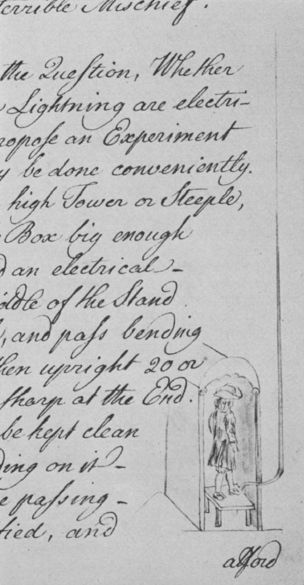
Franklin's sentry-box experiment — a grounded iron rod proposed to draw charge from passing storm clouds, the test that preceded the kite. Public domain, via Wikimedia Commons
Franklin's work on electricity influenced later scientists. His terminology, positive and negative, is still used. His concept of electrical grounding became fundamental to electrical engineering. Michael Faraday and James Clerk Maxwell built on his insights to develop the mathematical framework for electromagnetism. The lightning rod, in various forms, remains the primary method for protecting structures from lightning damage.
What Franklin demonstrated was that nature could be studied experimentally, that phenomena once attributed to gods or fate could be understood through careful observation and testing. The kite and the key were tools, simple ones, but they were enough to ask a question and get an answer. Lightning was not wrath. It was charge. And charge could be redirected. The sky was not beyond reach. It was just another system, waiting to be mapped.
Franklin continued experimenting for the rest of his life. Even in his seventies, he was designing improvements to ship hulls, studying the Gulf Stream, and debating scientific questions with correspondents across the world. He approached everything with the same combination of curiosity, pragmatism, and skepticism. He tested ideas rather than assuming them. He built tools rather than waiting for someone else to solve the problem. The kite was not the point. The point was that a man with a question, a piece of string, and a willingness to stand in a storm could change how we understand the world.
studio / on-this-day / Jun 15