studio / on-this-day / Aug 29
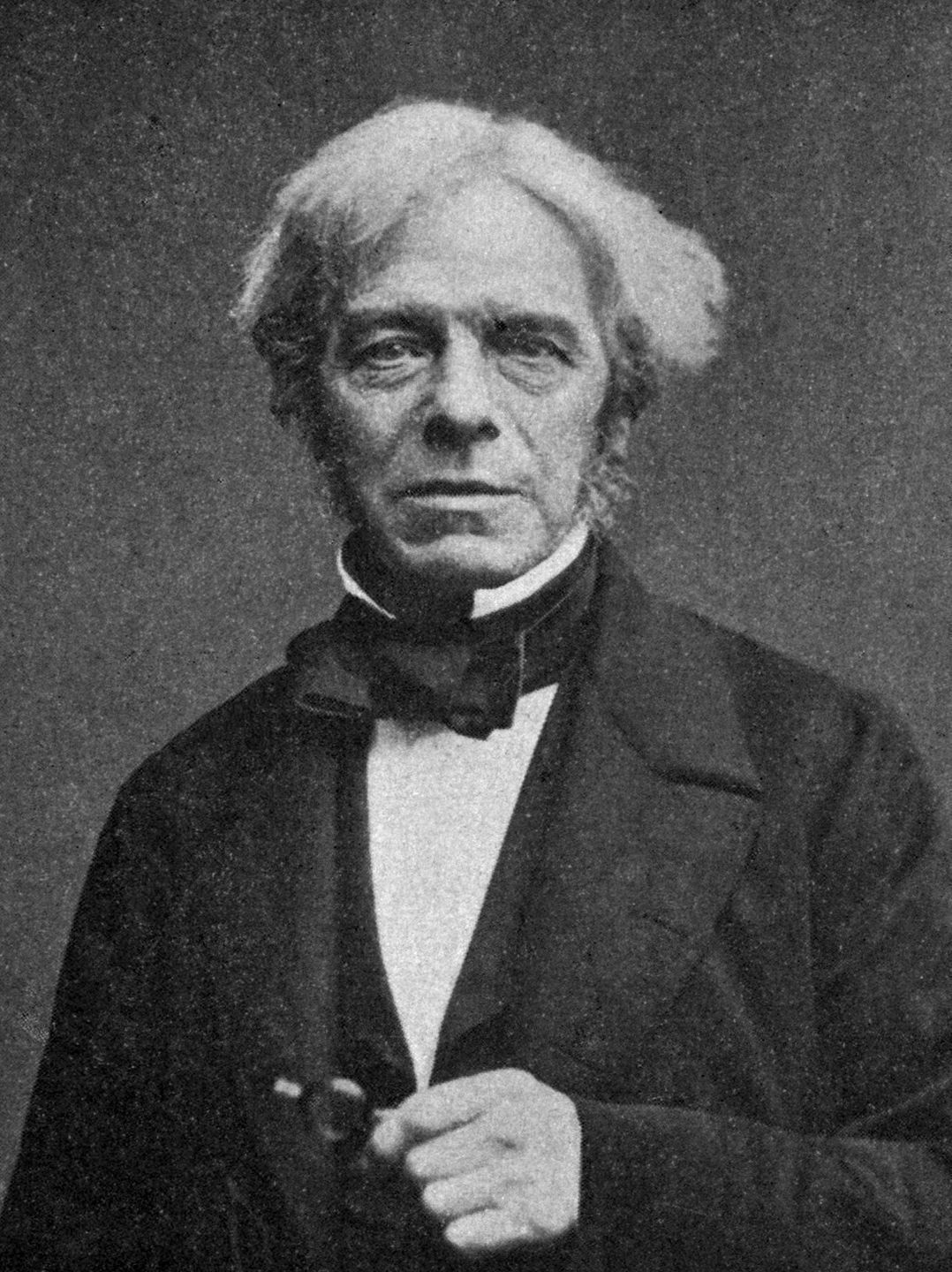
Michael Faraday, the self-taught bookbinder who became the father of electromagnetism. Probably albumen carte-de-visite by John Watkins, Public domain, via Wikimedia Commons
The Loop That Lit the World
On this day in 1831 — Michael Faraday discovered electromagnetic induction, the single loop of wire behind every electric motor since.
3 min read
On August 29, 1831, Michael Faraday wound two coils of wire around opposite sides of an iron ring, connected one to a battery and one to a galvanometer, and found that when he switched the current on in the first coil, the galvanometer in the second coil briefly jumped. When he switched it off, it jumped again. No wire connected the two circuits. Something invisible was passing between them. He called what he had found electromagnetic induction, and it is the operating principle behind every electric generator, every transformer, and every induction motor that has run since.
Faraday had come to this moment through an unusual path. Born in a poor south London family, apprenticed to a bookbinder at thirteen, he had educated himself largely by reading the books that passed through his hands. He attended lectures by Humphry Davy at the Royal Institution, took careful notes, bound them as a gift, and sent them to Davy asking for a job. Davy reportedly said that Faraday had shown him the best evidence he had seen that one could teach himself from books. He was hired in 1813 and never left.
The ring experiment of 1831 was followed quickly by more. Faraday showed that moving a magnet in and out of a coil of wire produced a sustained current, not just a momentary blip. Change the magnetic field through a loop, and you produce electricity. Hold the magnet still, nothing happens. The thing that mattered was change, the rate of flux through the loop over time. This was a completely new idea: that electricity and magnetism were not separate phenomena but aspects of a single underlying reality, linked by motion and change.
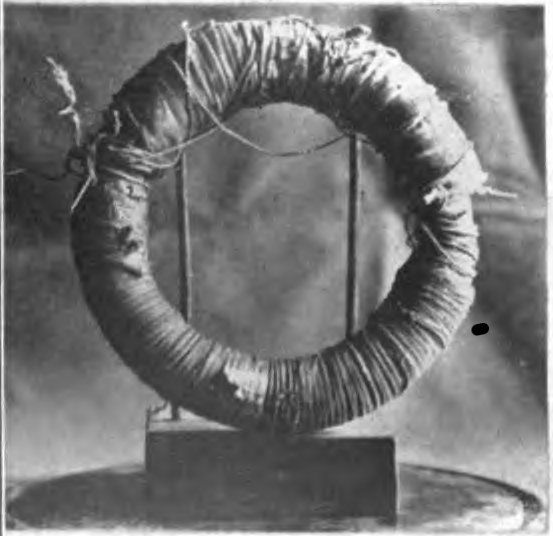
The iron induction ring Faraday wound with two coils of wire, the apparatus he used on August 29, 1831. Public domain, via Wikimedia Commons
He built the first electric generator from this principle, a copper disk spinning between the poles of a magnet, producing a continuous current. It was crude and the output was tiny, but the architecture was exactly right. Every power station built since operates on the same fundamental geometry: a changing magnetic field, a conducting loop, and a current that appears as if from nowhere. The entire electrical grid, the infrastructure that powers every building, every screen, every machine in the modern world, is an elaboration of what Faraday did in his laboratory in the autumn of 1831.
Faraday was not a mathematician. He thought almost entirely in terms of physical pictures: field lines, tubes of force, the geometry of electromagnetic space. James Clerk Maxwell, who came after him, would take those physical intuitions and encode them in the equations that govern all of classical electromagnetism. But Faraday's conceptual contribution was original and deep. The idea of a field, of space having physical properties that could store and transmit energy, was his. It took decades for the physics community to fully accept how radical this was.
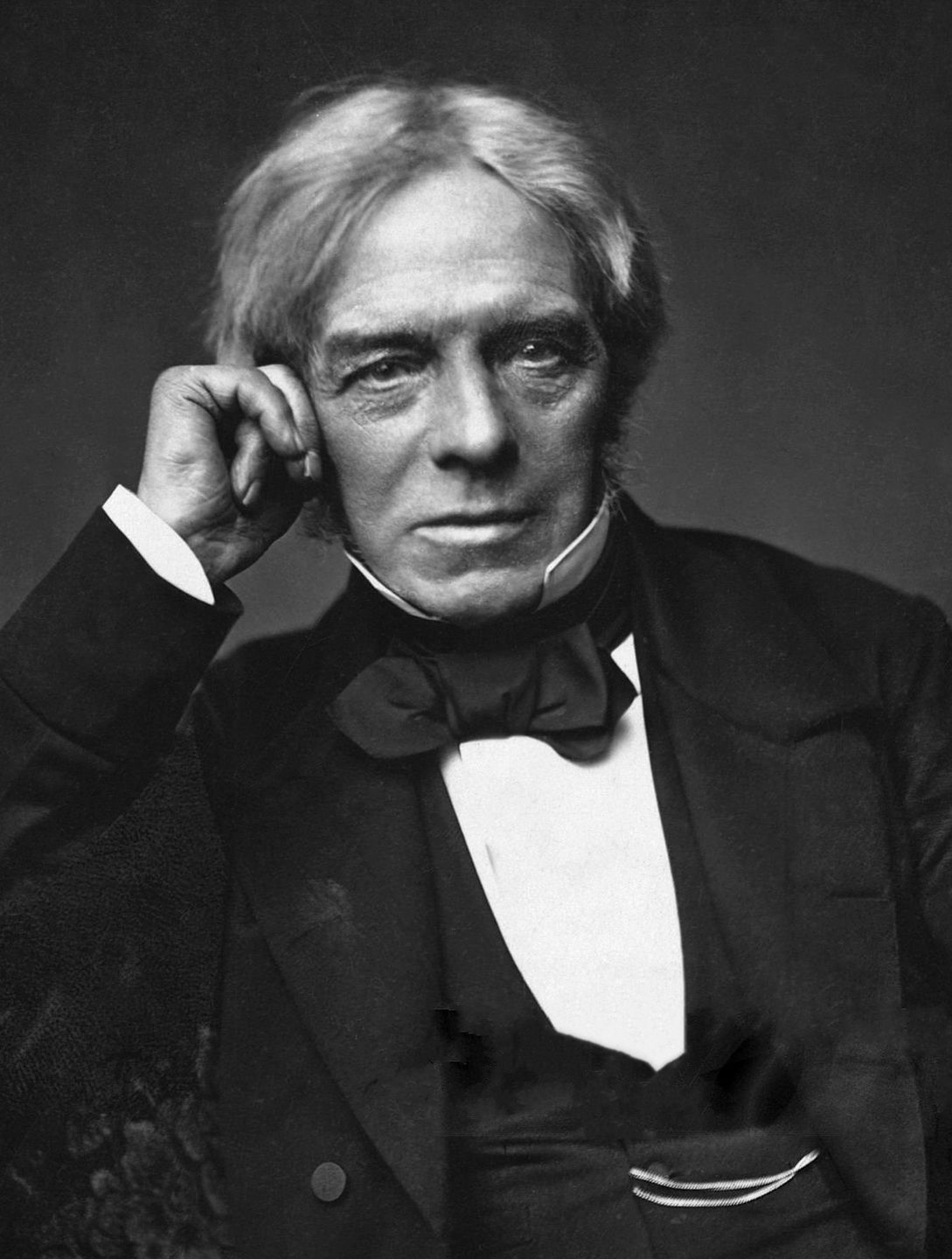
Michael Faraday at the Royal Institution, where he discovered electromagnetic induction on August 29, 1831, and continued working until memory loss made it impossible. Public domain, via Wikimedia Commons
His later work on the relationship between magnetism and light, the Faraday effect discovered in 1845, further unified the two phenomena and pointed toward the electromagnetic theory of light that Maxwell would formalize. He kept working well into his sixties, until memory loss made it impossible. He declined a knighthood and refused burial in Westminster Abbey, requesting instead a simple grave near his wife in London.
The bookbinder's apprentice who taught himself physics from borrowed volumes eventually had his face on the British twenty-pound note. But the more meaningful monument is less visible: it is the quiet hum of every motor, the grid that moves power from generation to use, the transformer that steps voltage up and down across thousands of miles of wire. Nikola Tesla's alternating current systems, which would eventually power that grid, were built directly on Faraday's foundations. He did not know what he was starting. Most foundational discoveries don't.
studio / on-this-day / Aug 29