studio / on-this-day / Jun 13
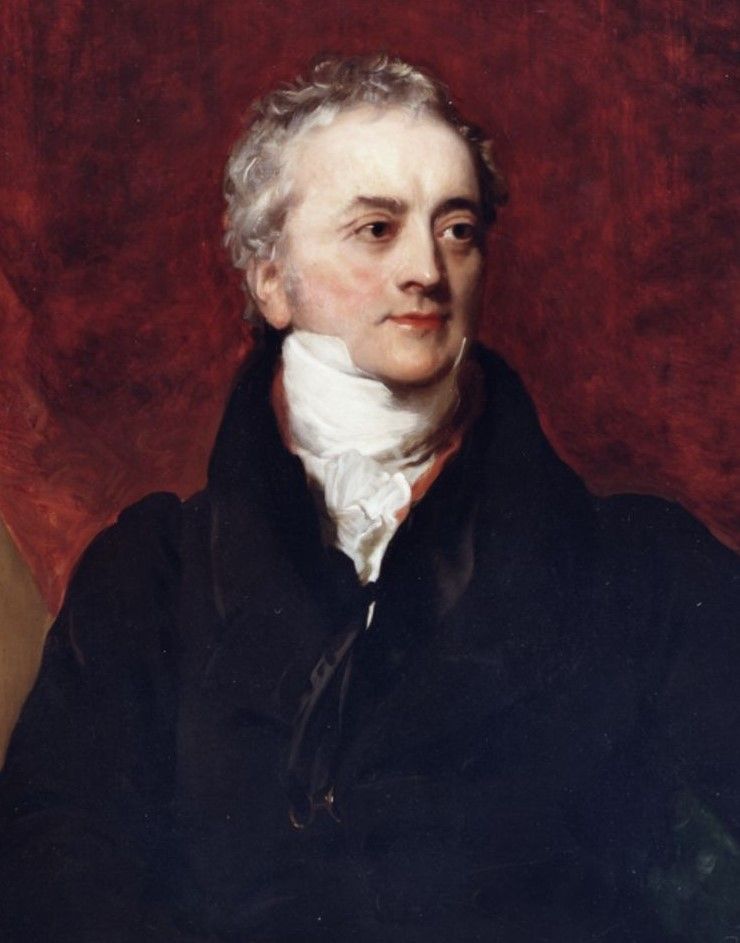
Thomas Young, polymath, physician, and physicist, painted by henry briggs. Henry Perronet Briggs, CC BY-SA 4.0, via Wikimedia Commons
The Polymath's Stone
On this day in 1773 — Thomas Young was born, a polymath who showed light behaves as a wave and helped crack the script of the Rosetta Stone.
3 min read
Thomas Young was born on June 13, 1773, in Somerset, England, the eldest of ten children in a Quaker family. By the age of two, he could read fluently. By fourteen, he had taught himself Latin, Greek, French, Italian, Hebrew, Arabic, Persian, and Syriac. He studied medicine at Edinburgh, Göttingen, and Cambridge, but he was never primarily a doctor. He was a problem solver who happened to have a medical degree. What interested him was not specialization but the connections between fields, the patterns that appeared when you looked at disparate subjects from the same angle.
In 1801, Young performed an experiment that changed how scientists understood light. He shone light through two narrow slits onto a screen. If light were made of particles, as Isaac Newton had proposed, the screen should show two bright lines. Instead, Young saw a pattern of alternating light and dark bands. The explanation was interference: light behaves like a wave, and when two waves overlap, they can reinforce or cancel each other out. The experiment was elegant, simple, and deeply counterintuitive. It took decades for the scientific community to accept it, but eventually they did. Young had proven that light was a wave, not a particle. Later physicists would complicate the picture again, discovering that light behaves as both wave and particle depending on how you measure it. But Young was the first to demonstrate the wave nature experimentally.
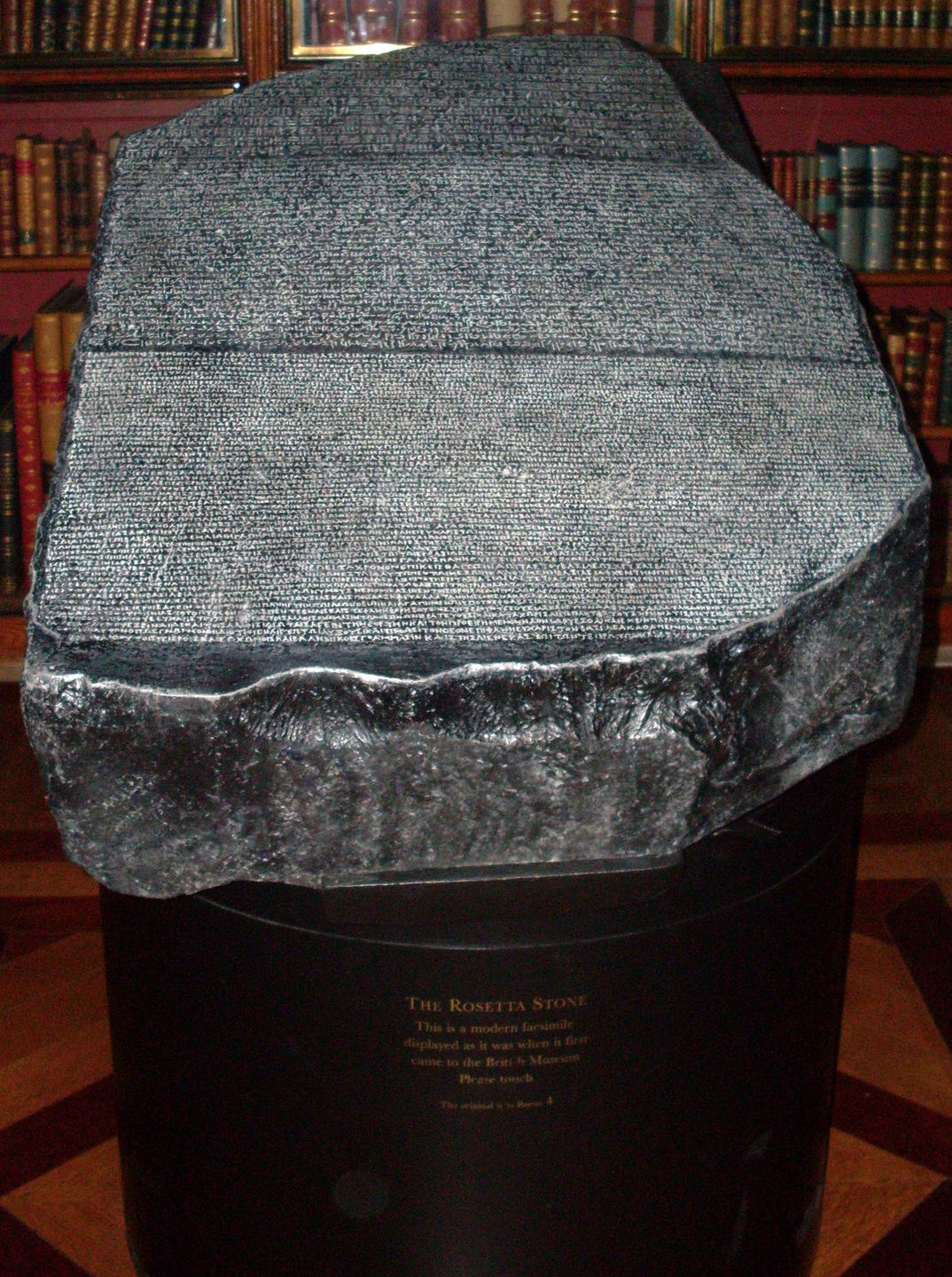
A copy of the Rosetta Stone — the ancient Egyptian decree inscribed in hieroglyphics, Demotic script, and Greek, which Young began to decode. CC BY-SA 3.0, via Wikimedia Commons
Young also contributed to the understanding of human vision. He proposed that the eye contains three types of receptors, each sensitive to a different range of wavelengths, and that all colors we perceive result from combinations of these three signals. This trichromatic theory, developed further by Hermann von Helmholtz, became the foundation of modern color science. It explains not only how we see color but also how screens display it, using red, green, and blue pixels to recreate the full spectrum.
In 1814, Young turned his attention to a different kind of problem. The Rosetta Stone, discovered by French soldiers in Egypt in 1799, was a slab of black basalt inscribed with the same text in three scripts: Greek, Demotic, and hieroglyphics. The Greek was readable, but the hieroglyphics had been undeciphered for over a thousand years. Young began by comparing the Greek text with the hieroglyphic symbols, looking for repeated patterns. He identified the cartouches, oval shapes that enclosed groups of symbols, and hypothesized that they represented royal names. By matching the sounds of the Greek names to the hieroglyphic symbols, he began to decode the phonetic values of individual signs. He did not complete the translation, but his work laid the groundwork. Jean-François Champollion, building on Young's insights, published a full decipherment in 1822.
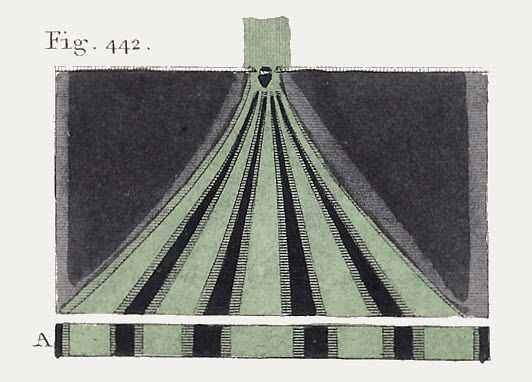
Young's own 1807 diagram of two overlapping wave sources, the interference pattern at the heart of his double-slit experiment. Thomas Young (Life time: 1773-1829), Public domain, via Wikimedia Commons
Young also worked on the theory of elasticity, developing the concept now known as Young's modulus, a measure of a material's stiffness. He studied the mechanics of the human voice, the tides, life insurance calculations, and the measurement of distances using diffraction. He was appointed superintendent of the Nautical Almanac, where he improved the accuracy of astronomical tables. He contributed to the design of the achromatic lens, reducing chromatic aberration in telescopes. He had no single field. He worked wherever the problem was interesting.
Young died in 1829 at the age of 55. His contemporaries struggled to categorize him. He had made major contributions to physics, medicine, linguistics, and engineering, but he had not founded a school or trained disciples. His work on light was overshadowed during his lifetime by competing theories. His work on hieroglyphics was completed by someone else. His name does not appear on many equations or laws, though Young's modulus is an exception. He was too broad to be easily remembered, too interdisciplinary for a discipline-obsessed age.
But what Young demonstrated was that the tools of one field can unlock the problems of another. He used wave mechanics to understand light and vision. He used pattern recognition to decode language. He used mathematics to describe materials. The problems changed, but the approach remained the same: observe carefully, identify structures, test hypotheses, refine understanding. Today, we call this interdisciplinary thinking, but Young just called it thinking. He saw no reason to stop at the edges of a discipline when the question kept going.
studio / on-this-day / Jun 13