studio / on-this-day / May 16
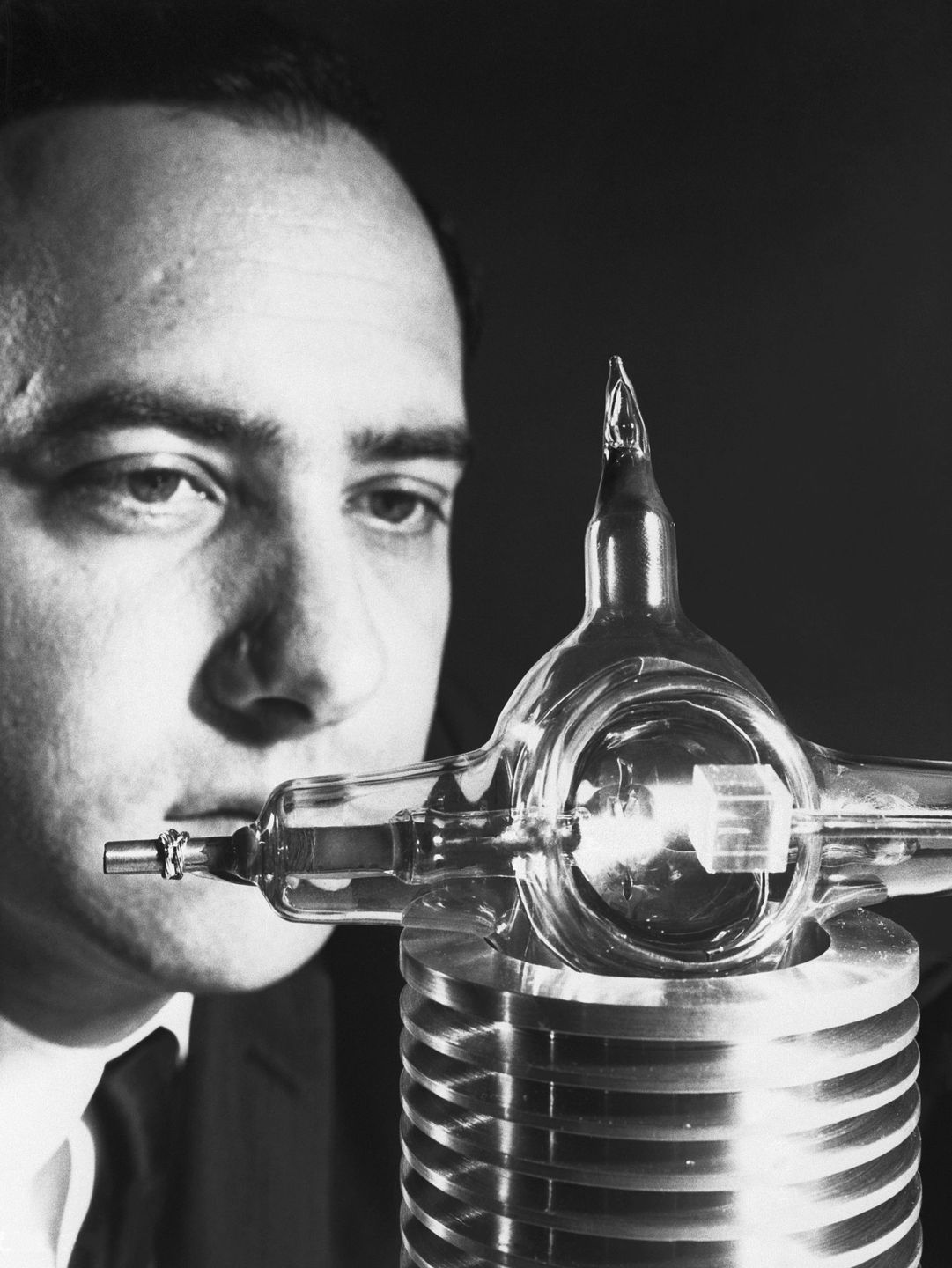
Dr. theodore h. Maiman with his laser device in New York, 1960. Public domain, via Wikimedia Commons
Coherent Light
On this day in 1960 — Theodore Maiman fired up the first working laser, a beam of coherent light that would end up in surgery and stereos alike.
3 min read
Theodore Maiman didn't believe it would work. In his laboratory at Hughes Research in Malibu, he had spent months trying to build something most physicists thought was impossible: a device that could amplify light into a single, concentrated beam. Every textbook said it couldn't be done. His own colleagues were skeptical. Even his funding was running out. But on May 16, 1960, Maiman fired a photographer's flash lamp at a synthetic ruby crystal, and for the first time in history, coherent light emerged.
What made laser light different from every other light source was its purity. Ordinary light scatters in all directions, a chaotic mix of wavelengths bouncing off in random phases. But the light from Maiman's ruby laser traveled in lockstep, every photon vibrating in perfect synchronization, every wave aligned. It was light with discipline, light that could be aimed, focused, and controlled with astonishing precision. It was light as a tool.
The word laser is an acronym: Light Amplification by Stimulated Emission of Radiation. The theory had been around since Einstein described stimulated emission in 1917, but turning theory into hardware took decades. Maiman's breakthrough was recognizing that a ruby crystal, doped with chromium atoms, could serve as the gain medium. When the flash lamp excited the chromium atoms, they released photons in a cascade, bouncing between mirrors at each end of the ruby rod until the beam became intense enough to escape. The whole device was small enough to hold in one hand.
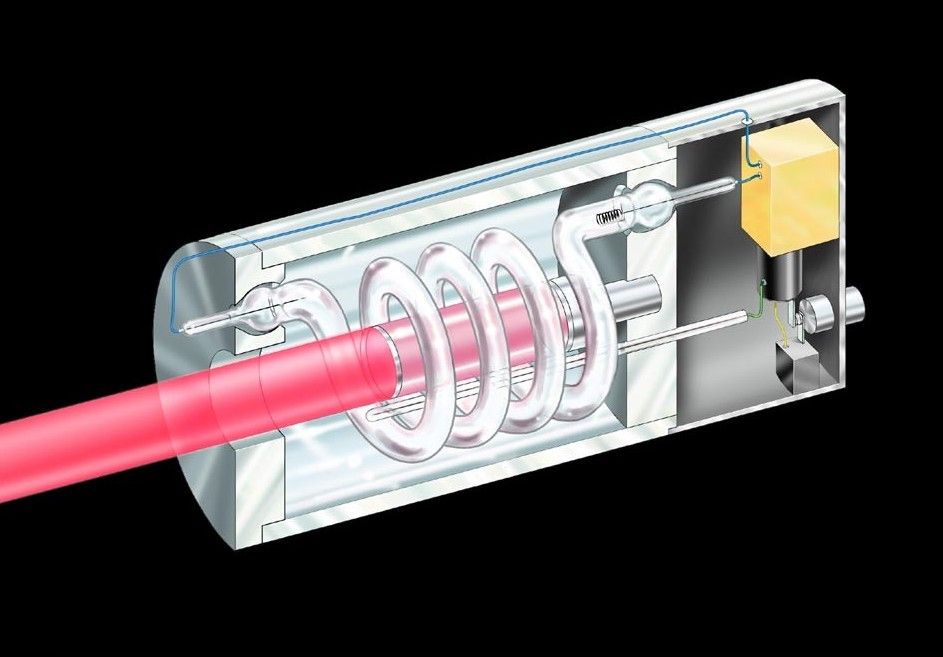
Diagram of a ruby laser from llnl document "laser programs, the first 25 years." US gov, Public domain, via Wikimedia Commons
Hughes Aircraft announced the invention at a press conference in Manhattan on July 7, 1960. The New York Times ran the story on page 36. The headline described it as a "light beam so intense it could vaporize any substance on earth." That wasn't quite true, but it captured the public imagination. Science fiction writers had been imagining death rays for decades. Now they had a real one, sort of.
What no one anticipated was how ordinary the laser would become. Within a decade, lasers were cutting steel in factories. Within two decades, they were scanning barcodes at grocery checkouts. Within three decades, they were reading data from compact discs, etching circuits onto silicon wafers, and correcting vision in eye surgery. The laser became invisible by becoming ubiquitous, the same way Alan Turing's computer faded into the background once every pocket held one.
Maiman's laser was a design object as much as a scientific instrument. It had to balance optical physics, materials science, and engineering constraints. The ruby had to be grown to exact specifications. The mirrors had to be aligned within microns. The flash lamp had to fire at precisely the right moment. Every component mattered because the system only worked when everything synchronized. It was a machine for making light behave like a tool instead of a phenomenon.
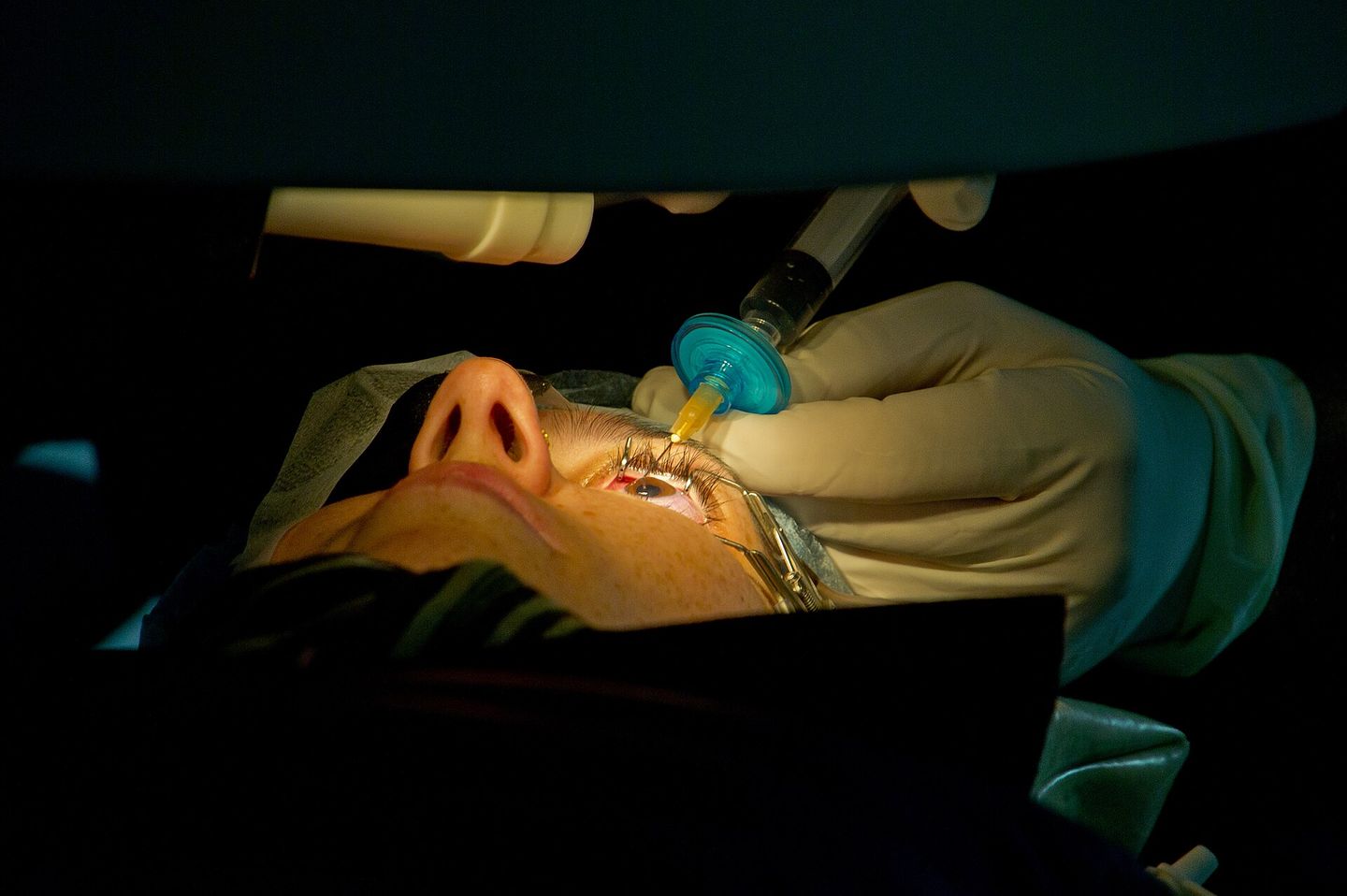
A laser used in lasik eye surgery, one of the everyday medical uses Maiman's invention made possible. Peretz Partensky from San Francisco, USA, CC BY 2.0, via Wikimedia Commons
Today, lasers cut, weld, measure, communicate, and heal. They transmit data through fiber optic cables at the speed of light. They guide missiles and level construction sites. They play music from spinning discs and etch nanoscale patterns onto computer chips. The technology Maiman built in 1960 became foundational to nearly every field that requires precision. Surgery, manufacturing, telecommunications, entertainment, research: all of them depend on coherent light.
Maiman spent the rest of his career fighting patent battles and trying to commercialize his invention. He never became wealthy from the laser, though it generated billions in revenue for others. He died in 2007, by which time lasers were so commonplace that most people never thought about them. The ruby rod from his first laser is now in the Smithsonian, a relic of the moment when light became something you could design.
studio / on-this-day / May 16