studio / on-this-day / May 11
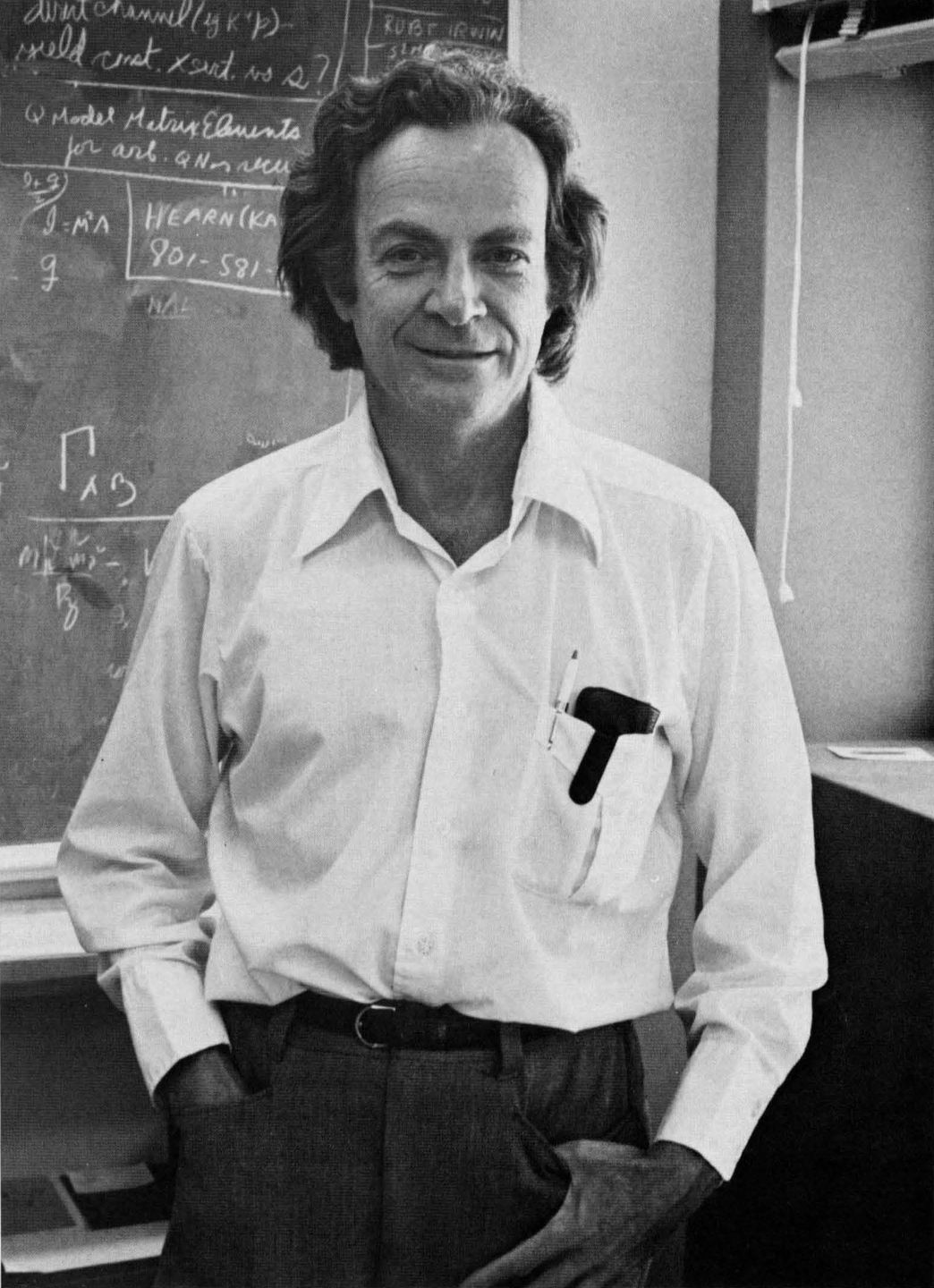
Richard Feynman, physicist and Nobel laureate, photographed in 1988. Public domain, via Wikimedia Commons
Quantum Mechanics as Jazz
On this day in 1918 — Richard Feynman was born, a physicist and bongo-playing safecracker who made quantum mechanics feel like improvisation.
3 min read
Richard Feynman was born on May 11, 1918, in Queens, New York. He became one of the most influential physicists of the 20th century, winning the Nobel Prize in 1965 for his work on quantum electrodynamics. But he was also a bongo player, a safe cracker, an artist, and a storyteller. He approached physics not as a solemn discipline but as a playground for curiosity. His lectures were performances. His diagrams were visual poetry. He made the impossibly abstract feel intuitive.
Feynman's most famous contribution is the Feynman diagram, a simple visual method for representing particle interactions. Before Feynman, quantum calculations required pages of dense mathematics. Feynman turned them into sketches: lines for particles, vertices for interactions, time flowing in one direction. The diagrams were not just illustrations. They were a new language for thinking about physics. They allowed physicists to see patterns that equations obscured. A complex interaction became a picture you could draw on a napkin.
He worked on the Manhattan Project during World War II, calculating the behavior of nuclear reactions at Los Alamos. He was 24. While there, he earned a reputation for picking locks on secure filing cabinets, not to steal secrets but to prove he could. He left notes inside the safes: "Guess who." It was play, but it was also philosophy. Feynman believed that systems, whether physical or social, revealed themselves when you tested their boundaries. A locked safe was a problem to solve, like a particle interaction.
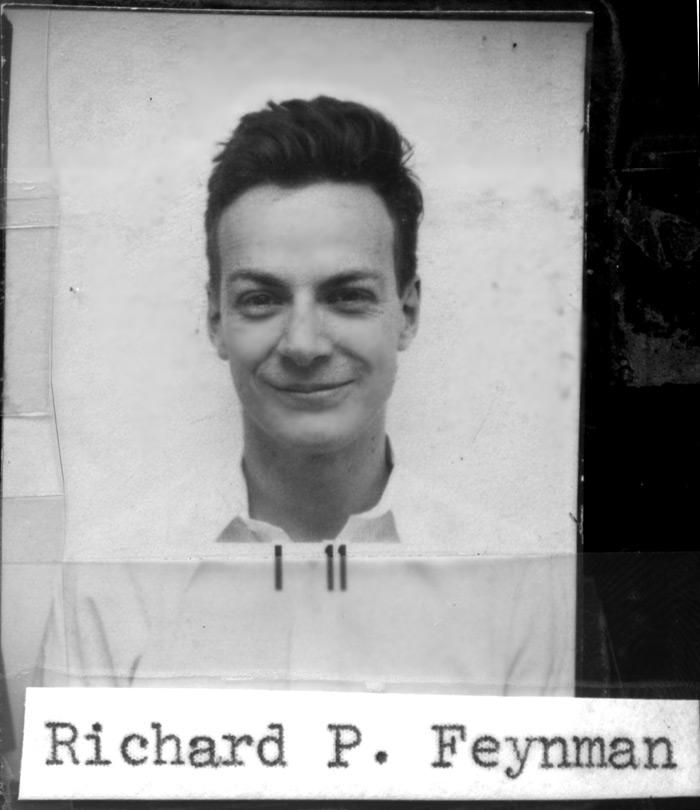
Feynman's Los Alamos security badge, worn while he worked on the Manhattan Project at age 24. United States Army, Public domain, via Wikimedia Commons
After the war, Feynman taught at Caltech, where his lectures became legendary. He did not lecture. He performed. He walked students through problems from first principles, asking questions, making mistakes on purpose, thinking out loud. His course on undergraduate physics was recorded and published as "The Feynman Lectures on Physics," one of the most widely read physics texts ever written. He made quantum mechanics, relativity, and thermodynamics accessible not by simplifying them but by teaching how to think about them.
Feynman's approach to problem-solving was improvisational. He did not follow standard methods. He invented his own. When asked how he thought about physics, he said he visualized interactions as if they were physical objects moving in space. He did not work through formal proofs. He played with ideas until they made intuitive sense. This was closer to jazz than classical music. Structure existed, but so did improvisation, risk, and spontaneity.
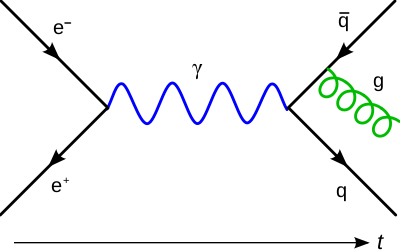
A Feynman diagram showing gluon radiation, the visual language Feynman invented to represent quantum interactions. Joel Holdsworth (Joelholdsworth), Public domain, via Wikimedia Commons
He was also skeptical of authority and unimpressed by credentials. He served on the commission investigating the Challenger space shuttle disaster in 1986. During a televised hearing, he demonstrated that the O-ring seals failed in cold temperatures by dropping one into a glass of ice water. It was a simple experiment, performed live, that contradicted NASA's official explanations. The diagram, the safe, the O-ring: Feynman's method was always to simplify until the truth became undeniable.
Feynman died in 1988 from cancer. His last words, reportedly, were: "I'd hate to die twice. It's so boring." Even at the end, he treated life as an experiment worth running until the data stopped coming in. He left behind not just discoveries but a way of working: stay curious, question assumptions, and never take a system at face value. If something seems complicated, it is probably because you do not understand it yet. Keep looking.
Quantum mechanics is still taught using Feynman diagrams. Physicists still read his lectures. The safe-cracking stories are still told. He proved that rigor and playfulness are not opposites. They are complements. The best work happens when you take the problem seriously and yourself lightly.
studio / on-this-day / May 11