studio / on-this-day / Apr 15
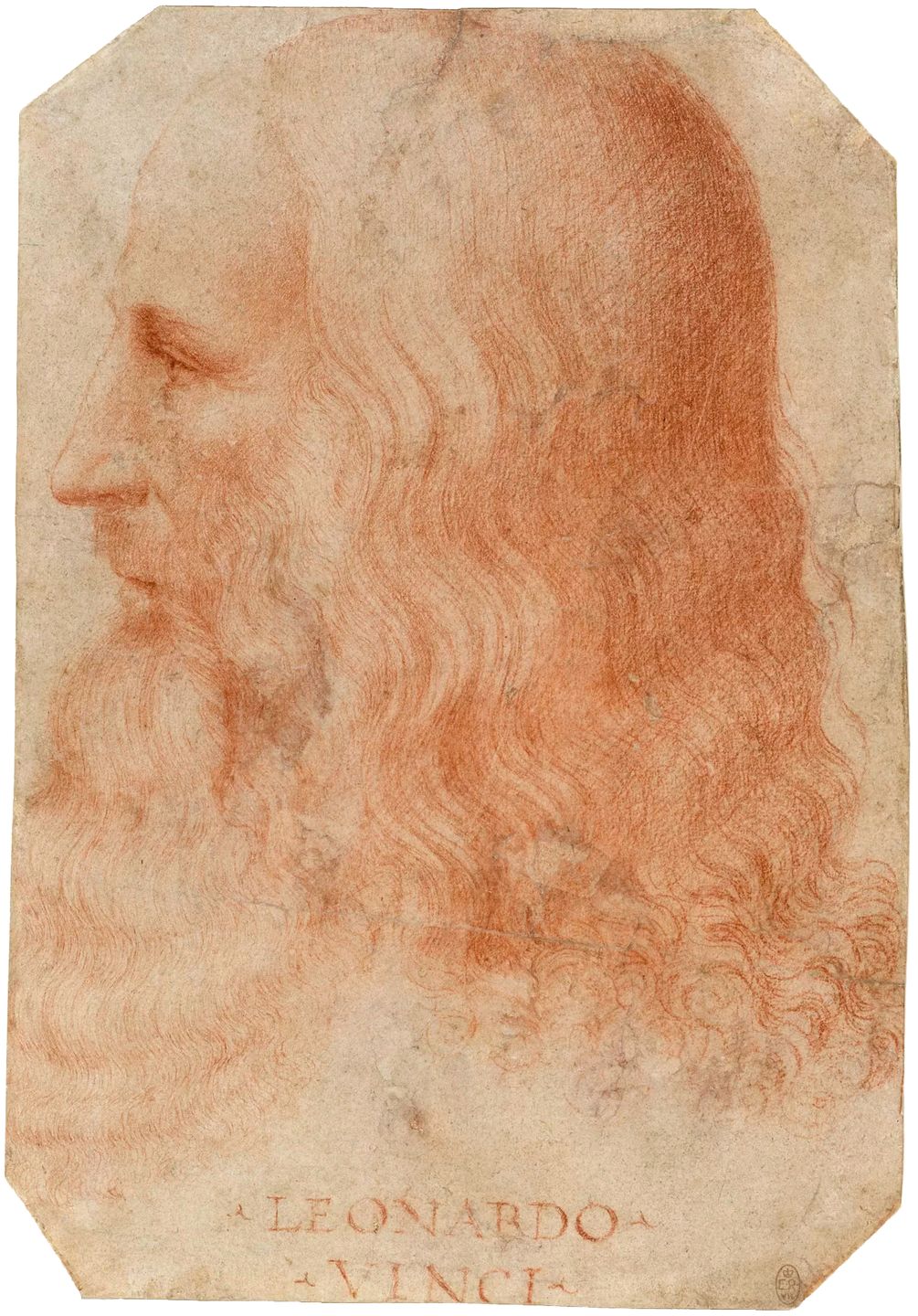
Portrait of Leonardo da Vinci painted by his student and companion francesco melzi, one of the few contemporary likenesses of the Renaissance master. Attributed to Francesco Melzi, Public domain, via Wikimedia Commons
The Original Systems Thinker
On this day in 1452 — Leonardo da Vinci was born, painter, anatomist, and engineer, arguably the original systems thinker.
3 min read
Leonardo da Vinci was born on April 15, 1452, in the small town of Vinci, near Florence, Italy. He was illegitimate, the son of a notary and a peasant woman, which meant he couldn't follow his father's profession or attend university. So he became an apprentice instead, learning to paint, sculpt, and build in the workshop of Andrea del Verrocchio. It was there, surrounded by artists and engineers, that Leonardo developed the habit that defined his life: seeing connections between things that others kept separate.
Leonardo didn't distinguish between art and science. To him, they were the same discipline. Painting required understanding anatomy, light, perspective, and materials. Engineering required understanding forces, motion, and the behavior of fluids. Everything was connected. His notebooks are filled with sketches that jump from mechanical devices to human muscles to water turbulence to architectural plans, all on the same page. He didn't organize his thoughts by subject. He organized them by curiosity.
He painted fewer than 20 works in his lifetime, but several are among the most famous images in history. The Mona Lisa, The Last Supper, The Vitruvian Man. Each was a technical achievement as much as an artistic one. The Mona Lisa's sfumato technique, using layers of translucent paint to create soft transitions, required understanding optics and chemistry. The Last Supper used one-point perspective so precisely that viewers feel they are in the room. The Vitruvian Man combined geometry, anatomy, and proportion into a single diagram that is still used to teach design principles.
But Leonardo spent more time on his notebooks than his paintings. Over 7,000 pages survive, filled with sketches, observations, and ideas. He designed flying machines, submarines, helicopters, parachutes, and tanks, centuries before the technology existed to build them. He studied bird flight, water flow, and human anatomy with obsessive detail. He dissected over 30 corpses to understand how muscles, bones, and organs work together. He drew the human heart with such accuracy that his diagrams are still used in medical education.
Most of his inventions were never built. Many wouldn't have worked. His helicopter design lacked a power source. His tank was too heavy to move. His flying machines didn't account for control surfaces. But that wasn't the point. Leonardo was thinking through systems, sketching possibilities, testing ideas on paper. He wasn't trying to build the perfect machine. He was trying to understand how things could work, how forces interacted, how design decisions cascaded through a system.
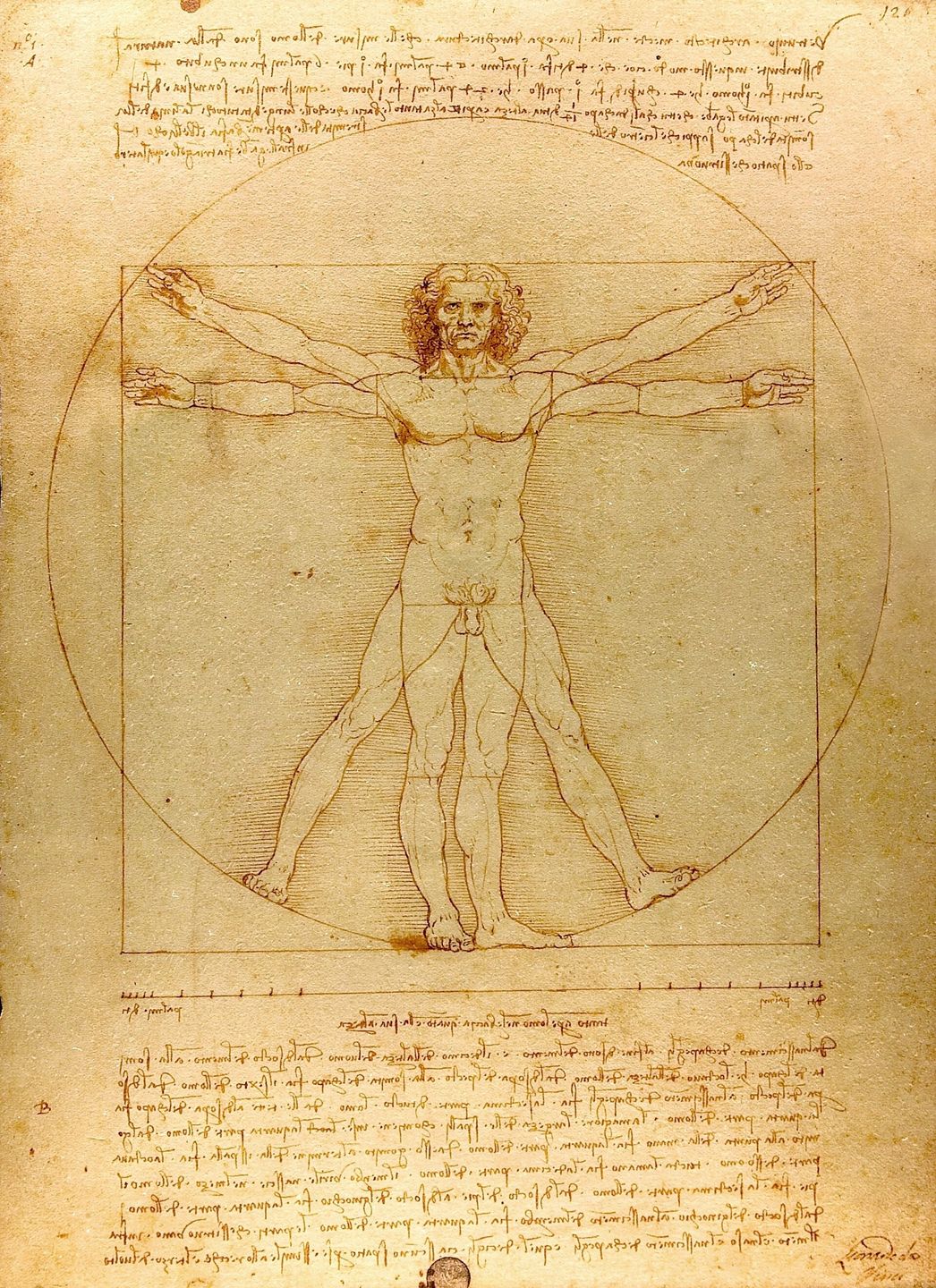
The Vitruvian Man (c. 1490) — Leonardo's synthesis of geometry, anatomy, and proportion into a single diagram. It remains one of the most recognized images in design history. Leonardo da Vinci, Public domain, via Wikimedia Commons
Leonardo wrote in mirror script, right to left, possibly because he was left-handed and didn't want to smudge the ink. His notebooks were private, not intended for publication. He kept them for himself, a personal archive of observations and experiments. After his death, they were scattered, sold, and lost. Some were rediscovered centuries later. Others are still missing. What survives is fragmentary, incomplete, and astonishing.
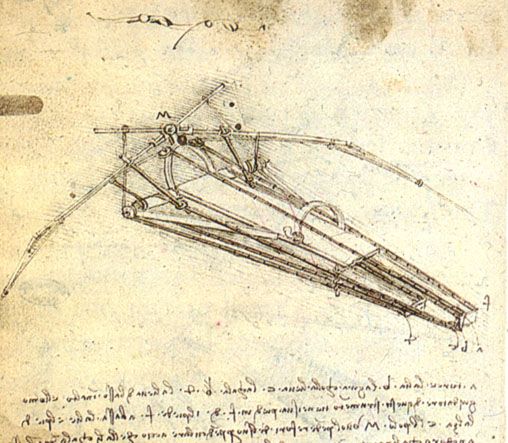
Design for a flying machine — one of Leonardo's many sketches of human flight, drawn centuries before the technology to build it existed. Leonardo da Vinci, Public domain, via Wikimedia Commons
He worked slowly and left many projects unfinished. Patrons complained that he spent too much time experimenting and not enough time delivering. He would start a painting, then abandon it to study anatomy or design a canal system. He moved between cities, working for dukes, kings, and popes, never settling, never quite fitting into the structures others built for him. He died in France in 1519, in the service of King Francis I, having spent his last years organizing his notes and sketching designs for a royal palace that was never built.
What makes Leonardo the original systems thinker is not that he mastered multiple disciplines. It's that he refused to see them as separate. Art informed engineering. Anatomy informed painting. Observation informed invention. He didn't just draw what he saw. He drew to understand how it worked. Every sketch was a theory, every painting an experiment. He treated the world as a design problem, not a collection of facts to memorize but a system to decode.
Today, we call people like Leonardo polymaths or Renaissance men, as if being interested in everything is rare. But Leonardo would have found the specialization we celebrate strange. To him, curiosity wasn't a trait. It was the default. You couldn't understand light without understanding the eye. You couldn't paint a face without understanding the skull beneath it. You couldn't design a machine without understanding the forces it would encounter. Everything connected. Systems thinking wasn't a methodology for Leonardo. It was just thinking.
studio / on-this-day / Apr 15