studio / on-this-day / Apr 12
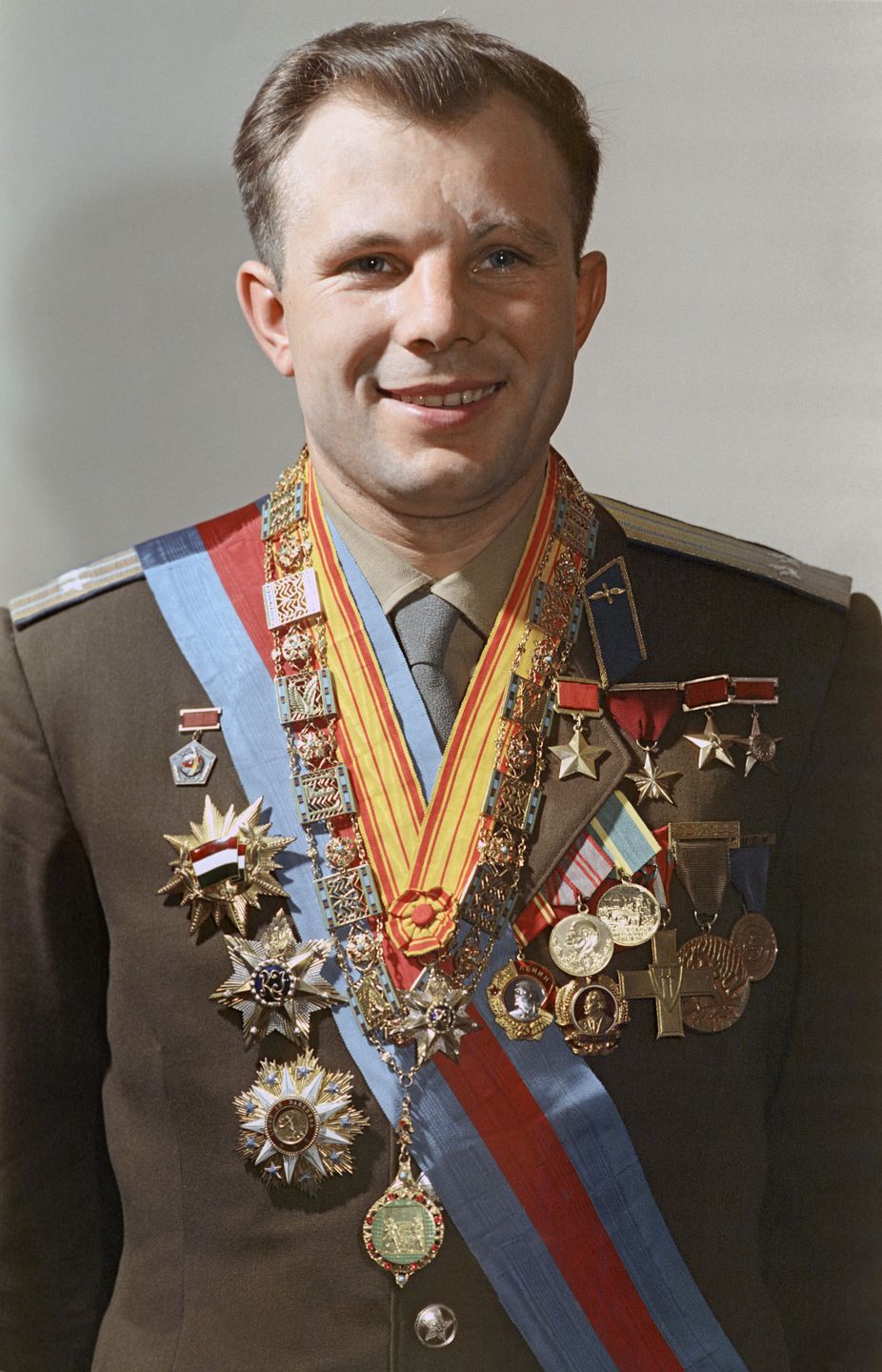
Yuri Gagarin, the first human in Space, wearing his medals and military awards after his historic 108-minute flight on April 12, 1961. Александр Моклецов / СовИнформБюро, CC BY 4.0, via Wikimedia Commons
108 Minutes
On this day in 1961 — Yuri Gagarin became the first human in space, and a single 108-minute orbit made the whole planet feel small.
3 min read
On April 12, 1961, Yuri Gagarin climbed into Vostok 1, a spherical capsule barely large enough for one person, and became the first human to leave Earth. The flight lasted 108 minutes, a single orbit that carried him from Kazakhstan over Siberia, the Pacific, South America, and Africa before landing back in the Soviet Union. He reached a maximum altitude of 203 miles, experienced weightlessness for the first time, and saw the planet from a perspective no human had ever witnessed. When he returned, he was no longer just a Soviet pilot. He was proof that humans could survive in space.
Gagarin was 27 years old, the son of a carpenter and a milkmaid. He had been selected from thousands of candidates based on his test scores, physical fitness, and psychological resilience. He was also short, which helped. The Vostok capsule was cramped, and height was a disqualifying factor. The night before launch, Gagarin wrote a farewell letter to his wife, not sure if he would return. The odds of survival were uncertain. No one had done this before. The spacecraft was automated because nobody knew if a human could function in zero gravity. Gagarin's role was mostly observational, though he had an override key in case something went wrong.
The launch was public but tightly controlled. The Soviet government didn't announce it until Gagarin was already in orbit, a precaution in case the mission failed. When Vostok 1 lifted off from Baikonur Cosmodrome, Gagarin reportedly said "Poyekhali!", Russian for "Let's go!" It became one of the most famous phrases in spaceflight history, a mix of excitement and fatalism compressed into two syllables. The rocket worked. The capsule separated. Gagarin floated, weightless, watching the Earth spin below him.
He later described what he saw: the planet's curvature, the thin blue line of the atmosphere, the transition from day to night. He noted the colors, the clouds, the way the horizon glowed. He ate from tubes, tested his ability to write in zero gravity, and monitored instruments. Everything functioned as expected until reentry, when the service module failed to separate cleanly from the descent module. The capsule spun violently for several minutes before the modules finally broke apart. Gagarin endured intense g-forces, but the heat shield held. At 7,000 meters, he ejected from the capsule and parachuted separately to the ground, landing in a field near the Volga River.
A farmer and her granddaughter watched him land, still in his orange flight suit and white helmet. He told them not to be alarmed, that he was a Soviet citizen like them and had just come from space. They didn't believe him at first. Then the state news agency announced it, and the world knew. The Space Race had a new leader. The Soviets had put a human in orbit before the Americans, a propaganda victory that reverberated globally.
Gagarin became an international celebrity overnight. He toured the world, met heads of state, and became the face of Soviet achievement. He never flew to space again. The Soviet government considered him too valuable to risk. He trained other cosmonauts, gave speeches, and represented the USSR at diplomatic events. In 1968, he died in a jet crash during a routine training flight. He was 34. The circumstances were never fully explained. Conspiracy theories persisted for decades, but the most likely cause was pilot error or mechanical failure during bad weather.
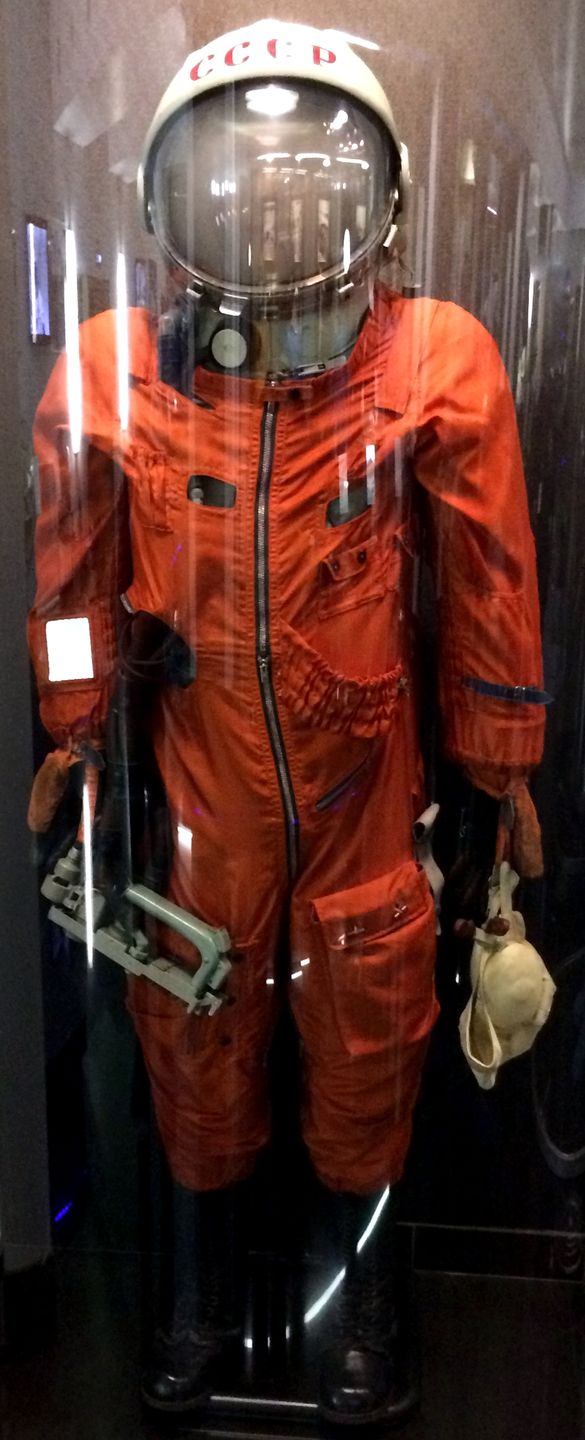
Yuri Gagarin in his Vostok Space suit shortly before the April 12, 1961 launch. He was 27 years old, the son of a carpenter, selected partly because of his small stature — the capsule barely fit one person. Ivtorov, CC BY-SA 4.0, via Wikimedia Commons
What Gagarin accomplished in 108 minutes was more than a technical feat. It was a shift in perspective. For all of human history, Earth was the entire universe. Gagarin left it, looked back, and saw it as an object, a sphere hanging in space. He proved that humans could survive beyond the atmosphere, that the species was not bound to the surface. His flight made the Apollo program possible, the International Space Station conceivable, and space exploration inevitable.
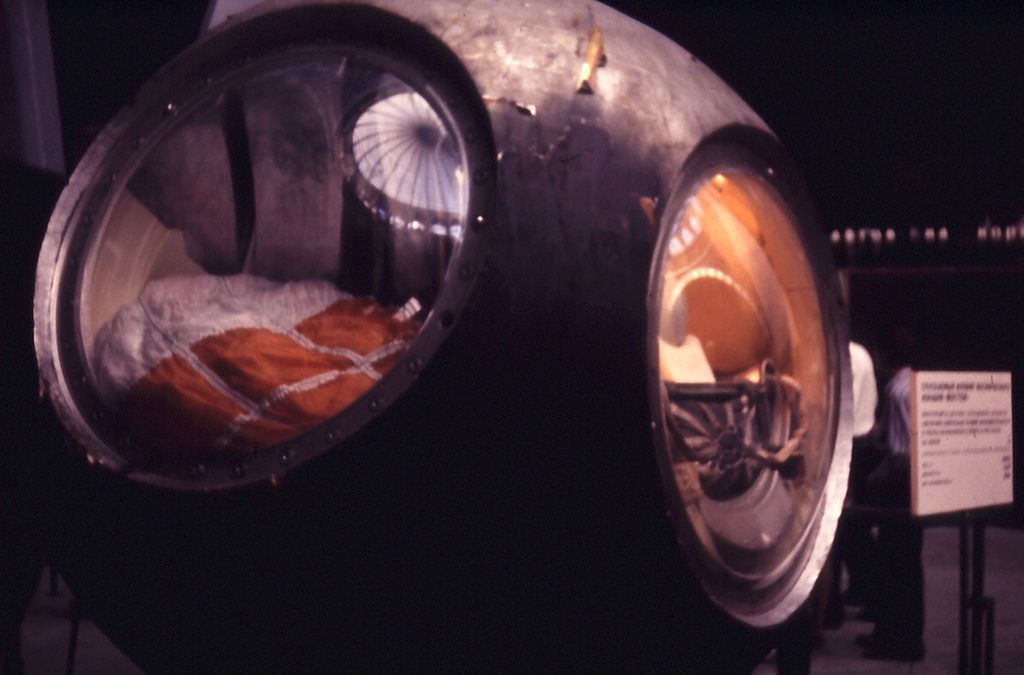
The spherical Vostok 1 descent capsule that carried Gagarin through a single orbit, its surface scorched by reentry, now on display at the cosmonautics museum in Moscow. Allan Lee (StormyDog) from Auckland, New Zealand, CC BY 2.0, via Wikimedia Commons
Every astronaut since has followed the path Gagarin opened. The technology has improved, but the experience he described remains consistent. Earth looks fragile from orbit. Borders disappear. The atmosphere is shockingly thin. The silence is absolute. Gagarin's 108 minutes didn't just make him the first human in space. They made Earth smaller, space closer, and the future a place we could actually go.
studio / on-this-day / Apr 12