studio / on-this-day / Mar 29
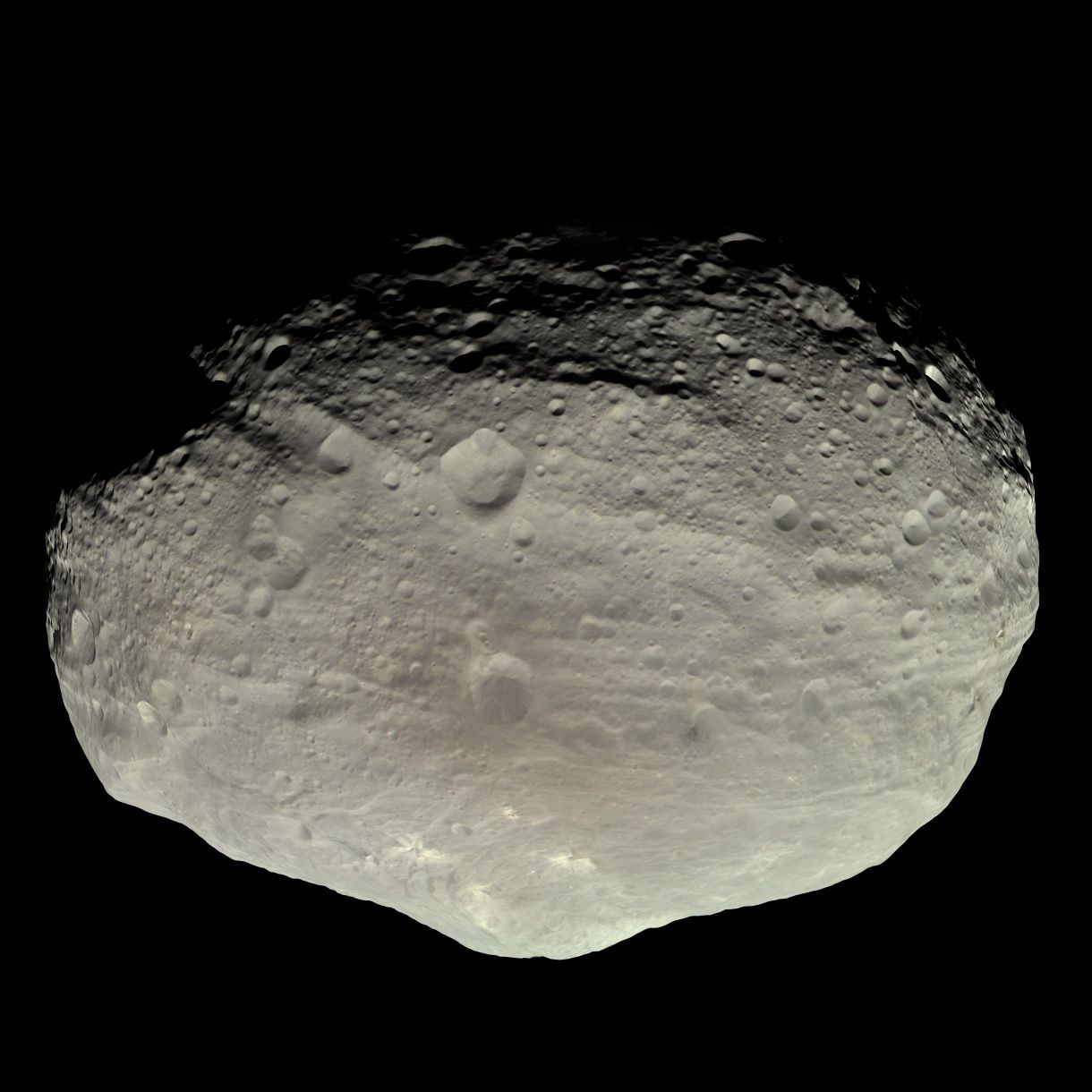
Asteroid Vesta in natural color, photographed by NASA's Dawn spacecraft in 2011. NASA / JPL / MPS / DLR / IDA / Björn Jónsson, Public domain, via Wikimedia Commons
The Debris Field
On this day in 1807 — Vesta, the fourth asteroid found, was discovered, and the tidy solar system turned out to be far more crowded than expected.
3 min read
On March 29, 1807, German astronomer Heinrich Wilhelm Matthias Olbers discovered Vesta, the fourth asteroid to be identified. He was observing from his private observatory in Bremen when he noticed a faint point of light that moved against the background stars. It was located in the asteroid belt, the region between Mars and Jupiter where a planet should have formed but did not. Vesta was the brightest of the asteroids discovered so far, visible to the naked eye under dark skies. It was also the last major asteroid to be found for nearly four decades.
The discovery of asteroids was accidental. Astronomers had been searching for a missing planet. In 1766, Johann Daniel Titius proposed a mathematical pattern that seemed to predict the distances of planets from the sun. When Uranus was discovered in 1781, it fit the pattern perfectly. But there was a gap between Mars and Jupiter where the formula suggested a planet should exist. Astronomers began searching for it. On January 1, 1801, Giuseppe Piazzi found Ceres, a small object in the predicted orbit. It was hailed as the missing planet. But within a few years, three more objects were found in similar orbits: Pallas, Juno, and Vesta. They were too small to be planets. They were something else.
William Herschel, who had discovered Uranus, proposed calling them asteroids, from the Greek for "star-like," because they appeared as points of light in telescopes rather than disks. The name stuck. By the mid-19th century, hundreds of asteroids had been cataloged. By the 21st century, the count exceeded a million. The asteroid belt is not a failed planet. It is the remnants of a planetary formation process that never completed, disrupted by Jupiter's gravitational influence. The material that should have coalesced into a single body instead remained fragmented.
Vesta is unusual among asteroids. It is large, about 326 miles in diameter, and it has a differentiated interior with a metallic core, a rocky mantle, and a basaltic crust. This suggests that early in its history, Vesta was hot enough for its interior to melt and separate into layers, much like Earth. It is effectively a protoplanet, a planetary embryo that never grew. Its surface is ancient, scarred by impacts, and it has a massive crater near its south pole caused by a collision so violent it ejected material into space. Some of that material has fallen to Earth as meteorites, making Vesta one of the few asteroids whose fragments we can study directly.
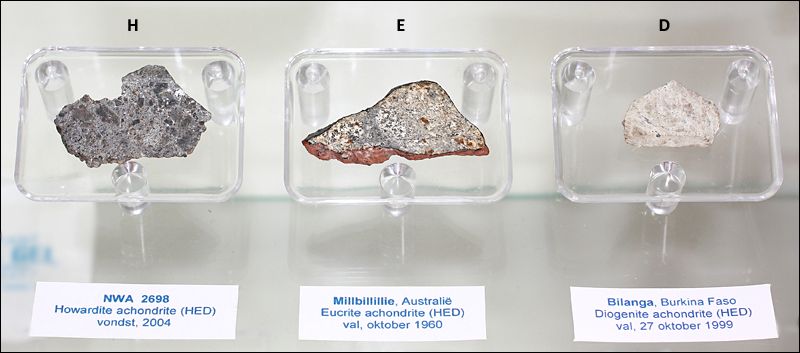
Hed meteorites — howardites, eucrites, and diogenites — fragments of Vesta that fell to Earth. Marcoaliaslama, CC BY 3.0, via Wikimedia Commons
In 2011, NASA's Dawn spacecraft entered orbit around Vesta, the first spacecraft to orbit an object in the asteroid belt. It spent over a year mapping the surface, measuring composition, and studying the geology. The data revealed that Vesta's surface is more complex than expected, with mountains, valleys, and evidence of ancient volcanic activity. The mission confirmed that Vesta is geologically more similar to rocky planets than to typical asteroids. It is a bridge between the two, a body that began forming into a planet but stopped partway through the process.
The existence of asteroids complicates the tidy model of the solar system. Planets, moons, and the sun are large, regular, and predictable. Asteroids are small, irregular, and chaotic. They orbit in swarms. They collide. They fragment. Some are solid rock. Some are rubble piles held together by gravity. Some contain water ice. Some are rich in metal. They are leftovers, the construction debris from the solar system's formation 4.6 billion years ago. Studying them is like studying a construction site after the building is finished, trying to reconstruct the process from what was discarded.
Asteroids also pose a threat. Earth's history is marked by impacts. The asteroid that killed the dinosaurs 66 million years ago was about six miles wide. Smaller impacts occur more frequently, causing regional devastation. Tracking near-Earth asteroids has become a priority for space agencies. The goal is to identify potentially hazardous objects decades in advance and develop methods to deflect them. In 2022, NASA's DART mission successfully altered the orbit of an asteroid by crashing a spacecraft into it, proving that kinetic impact is a viable deflection strategy.
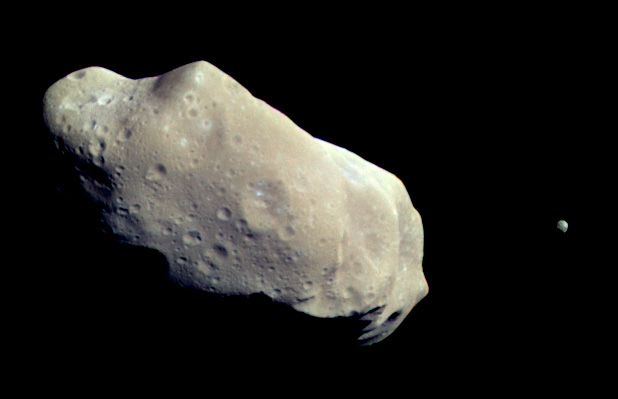
Asteroid 243 ida, a typical main belt asteroid, photographed by the galileo spacecraft in 1993. 243_ida.jpg: NASA/JPL derivative work: Chzz ►, Public domain, via Wikimedia Commons
What Vesta and the asteroid belt represent is incompleteness. The solar system is not a finished design. It is a dynamic system still shaped by collisions, migrations, and gravitational interactions. The planets are stable now, but they were not always in their current orbits. Jupiter and Saturn migrated inward and then outward, scattering smaller bodies across the solar system. The asteroid belt is evidence of that chaos. It is a reminder that every system, no matter how orderly it appears, contains traces of the disorder that created it.
studio / on-this-day / Mar 29