studio / on-this-day / Mar 26
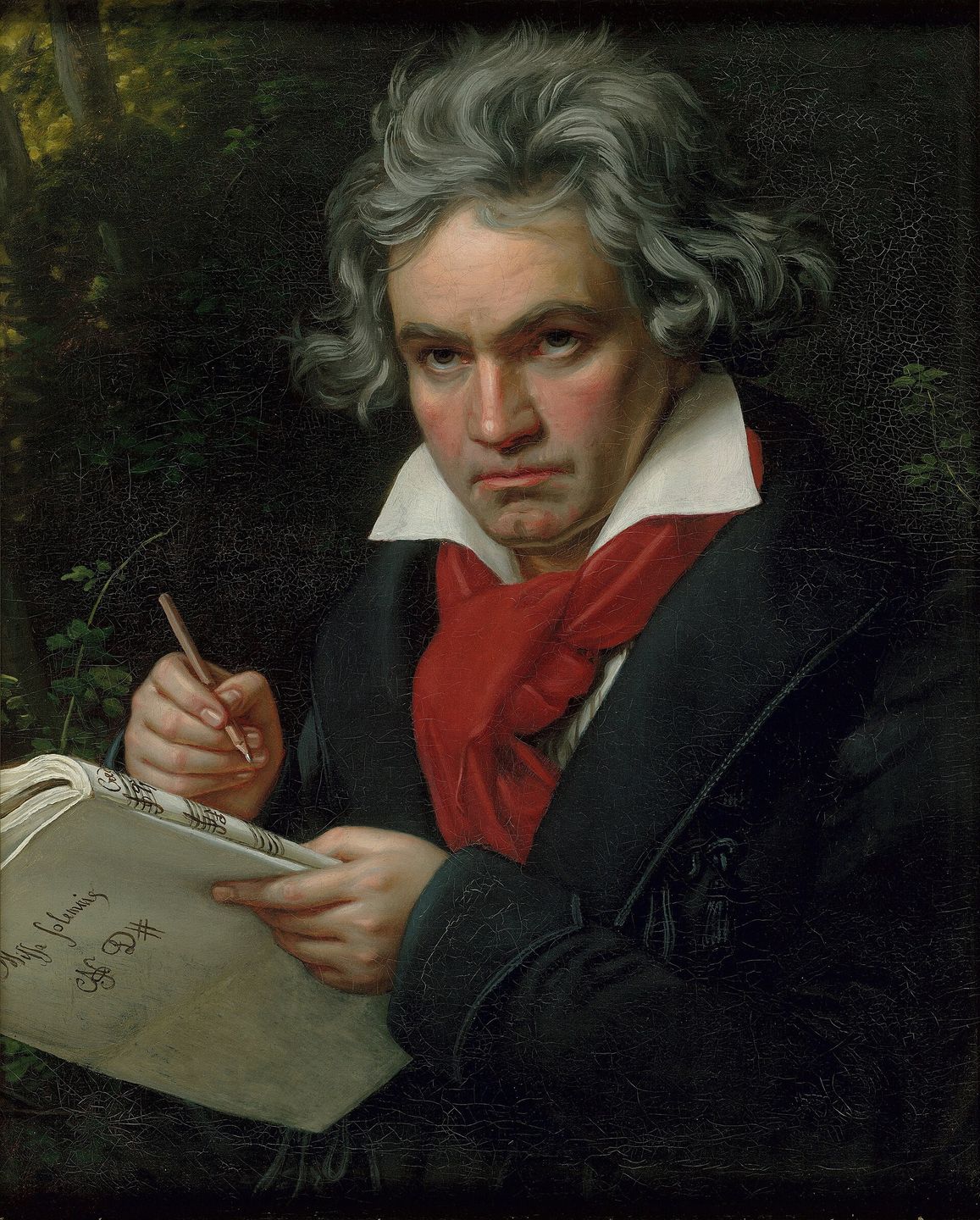
Portrait of Beethoven with the manuscript of the missa solemnis, by joseph karl stieler, 1820. Joseph Karl Stieler, Public domain, via Wikimedia Commons
Silence as Signal
On this day in 1827 — Ludwig van Beethoven died, having composed some of his greatest music while completely unable to hear a note of it.
3 min read
Ludwig van Beethoven died in Vienna on March 26, 1827, during a thunderstorm. He was 56 years old and had been completely deaf for over a decade. His last major work, the Ninth Symphony, premiered three years earlier. He could not hear it. He stood on stage, keeping time with the conductor, but the sounds he had written existed only in his memory and imagination. When the performance ended, he remained facing the orchestra until a singer turned him around to see the audience applauding. He saw their hands but heard nothing. The disconnect between what he created and what he could perceive defined the final third of his life.
Beethoven began losing his hearing in his late twenties. The cause is unclear, possibly lead poisoning or an autoimmune disorder. By 1801, he was avoiding social situations because he could not follow conversations. By 1814, he needed written communication to interact with others. By 1818, he was profoundly deaf. For a composer, this should have been catastrophic. Hearing is the primary feedback loop. You play a note, you hear it, you adjust. Without that loop, composition becomes abstract, disconnected from the physical reality of sound. Beethoven adapted by relying on memory, inner hearing, and the physical vibrations of the piano transmitted through his bones.
The music he wrote after losing his hearing is some of the most complex and emotionally intense in the Western canon. The late string quartets, composed between 1822 and 1826, push the boundaries of harmonic structure and thematic development. They are difficult to perform and difficult to listen to, not because they are poorly written, but because they demand complete attention. There are no easy resolutions, no predictable cadences. The music moves through dissonance and resolution in ways that feel inevitable only in retrospect. It is music written by someone who no longer needed to please an audience because he could not hear their reactions.
Beethoven's deafness forced him to internalize sound as a structural problem. He thought in terms of patterns, relationships, and transformations rather than timbres and textures. The result is music that feels more like architecture than performance. Just as Bach's fugues are structured explorations of a theme, Beethoven's late works are systematic investigations of how far a musical idea can be developed without losing coherence. The constraint of deafness did not diminish his creativity. It redirected it.
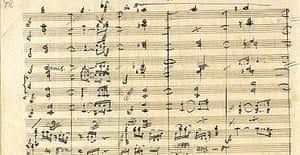
A page from Beethoven's autograph manuscript of the Ninth Symphony — the music he knew only as ink on paper. Ludwig van Beethoven, Public domain, via Wikimedia Commons
Beethoven kept conversation books, notebooks where visitors would write their side of a dialogue and he would respond aloud or in writing. Over 400 of these books survive. They are records of a life conducted in fragments, one-sided exchanges where only the written portions remain. The books contain mundane details about meals and rent, but also philosophical reflections, arguments with publishers, and sketches for compositions. They are a strange archive, a conversation preserved on one side only, like reading a script with half the dialogue missing.
The Ninth Symphony, Beethoven's last completed symphony, ends with a choral setting of Friedrich Schiller's "Ode to Joy." It was the first time a major symphony had included voices. The decision was radical, breaking the boundary between instrumental and vocal music. The finale builds to a massive, affirmative statement of human unity, sung by a chorus and soloists over a full orchestra. Beethoven never heard it performed. He knew it only as notation on paper, patterns of ink that represented sound he could no longer perceive. The music existed entirely in his mind.
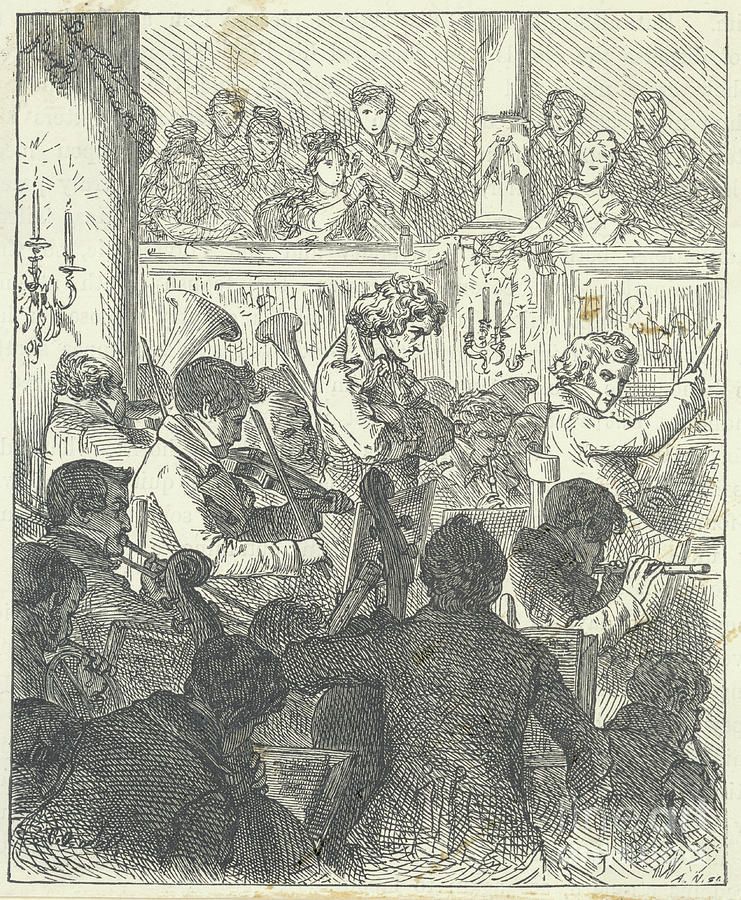
The premiere of Beethoven's Symphony no. 9, 1824 — the first Symphony to include a choral finale. Carl Offterdinger, Public domain, via Wikimedia Commons
What Beethoven proved is that music is not just sound. It is structure, pattern, and relationship. It can be conceived, manipulated, and perfected without acoustic feedback. This insight resonates beyond music. Design, engineering, and systems thinking all involve working with abstractions that may not have immediate physical manifestations. The blueprint is not the building. The code is not the program. The score is not the performance. But all three are complete in their own right. Beethoven composed in silence because he had no other choice. That constraint revealed something fundamental: creation is an internal process. The external form is just the output.
studio / on-this-day / Mar 26