studio / on-this-day / Mar 25
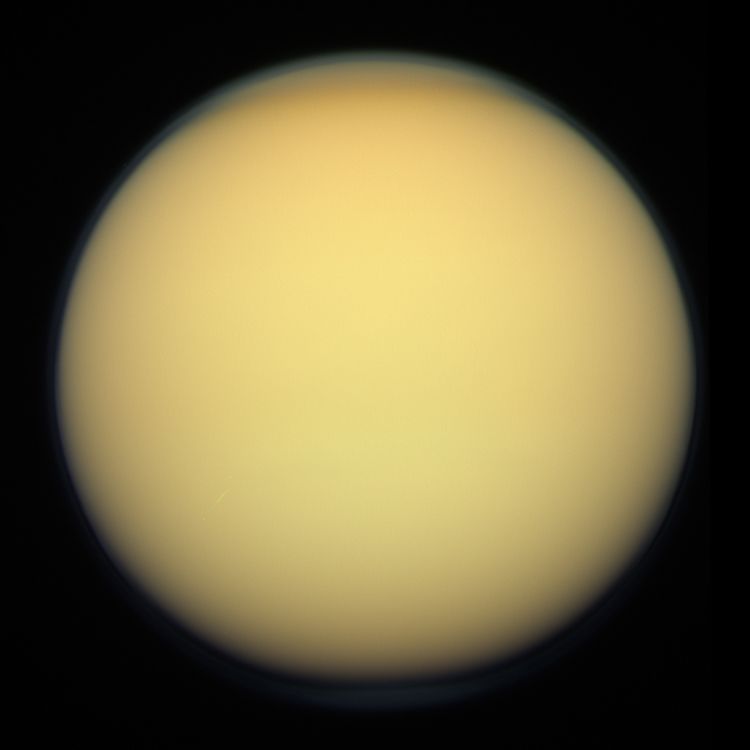
Titan in true color — Saturn's largest moon, discovered by Christiaan Huygens on March 25, 1655. NASA/JPL-Caltech/SSI/Kevin M. Gill, CC BY 2.0, via Wikimedia Commons
The Moon Builder
On this day in 1655 — Christiaan Huygens spotted Titan, Saturn's largest moon, through a telescope he had ground and assembled himself.
3 min read
On March 25, 1655, Christiaan Huygens pointed a telescope at Saturn and noticed a faint point of light near the planet. He tracked it over several nights and confirmed that it was orbiting. It was a moon, the sixth known satellite in the solar system and the first to be discovered around Saturn. He named it Titan, after the mythological race of giants. The discovery was significant not just for what Huygens found, but for how he found it. He had ground the lenses himself, designed the optical system, and built the telescope by hand. His tools were as important as his observations.
Huygens was born in The Hague in 1629, into a wealthy and intellectually connected family. His father was a diplomat and poet. His tutors included René Descartes. He studied law and mathematics at Leiden University but quickly shifted his focus to physics and astronomy. By his twenties, he was designing and building optical instruments that surpassed anything available commercially. His telescopes used longer focal lengths and better lens grinding techniques, which reduced chromatic aberration and produced clearer images. Seeing farther required making better lenses, and making better lenses required understanding light.
Huygens's work on optics led him to study the nature of light itself. He proposed that light was a wave, not a particle, and developed a theory of wave propagation that explained reflection, refraction, and diffraction. His wave theory competed with Newton's particle theory for nearly two centuries until quantum mechanics revealed that light behaves as both. But in the 17th century, Huygens's wave model was a radical departure from the prevailing mechanical explanations. He treated light as a disturbance moving through a medium, similar to ripples on water. The mathematics worked, even if the physical mechanism remained unclear.
Huygens also invented the pendulum clock, the first timepiece accurate enough for scientific use. Before his design, clocks were unreliable, drifting by minutes per day. Huygens realized that a pendulum's period depends only on its length, not the amplitude of its swing. This property, called isochronism, made pendulums ideal for regulating clockwork. His clock, built in 1656, was accurate to within seconds per day. Suddenly, experiments that required precise timing became possible. Navigation improved. Astronomy became more exact. The pendulum clock was infrastructure for precision.
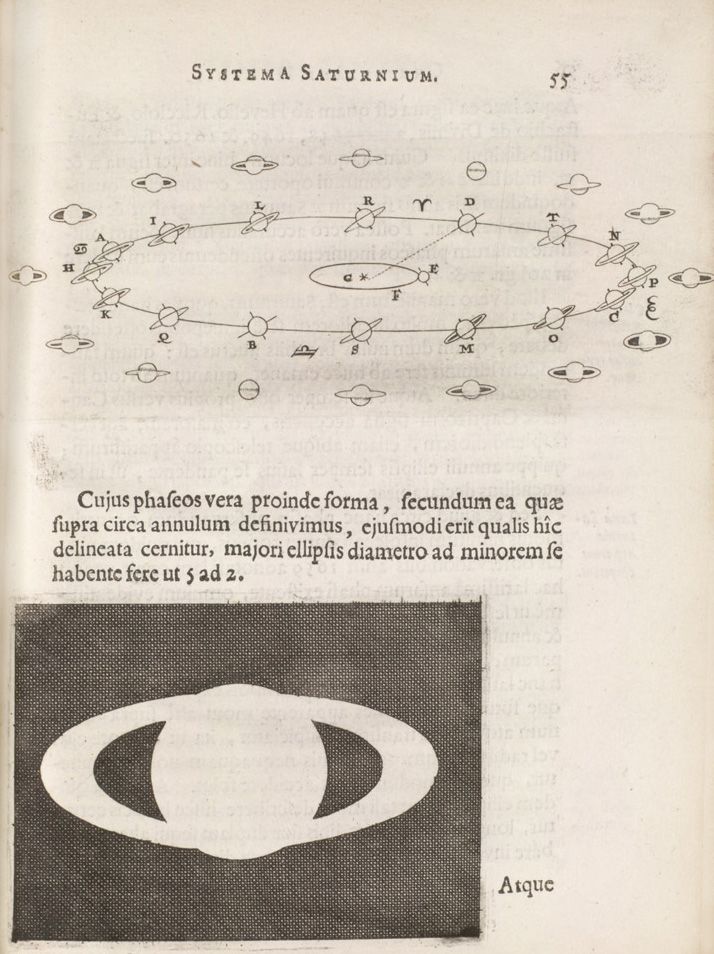
Huygens's diagram of Saturn's rings from systema saturnium (1659), showing the ring geometry as it appears from Earth through the year. Christiaan Huygens, Public domain, via Wikimedia Commons
The discovery of Titan was part of a larger effort to understand Saturn's rings. When Galileo first observed Saturn in 1610, he saw what looked like three objects: a central disk and two smaller bodies on either side. His telescope was not powerful enough to resolve the rings. Huygens, with his superior optics, correctly identified them as a flat disk encircling the planet. He published his findings in an anagram to establish priority without revealing his methods, a common practice at the time. Later, he published the full explanation, including diagrams that showed the ring's geometry as it appeared from Earth at different times of year.
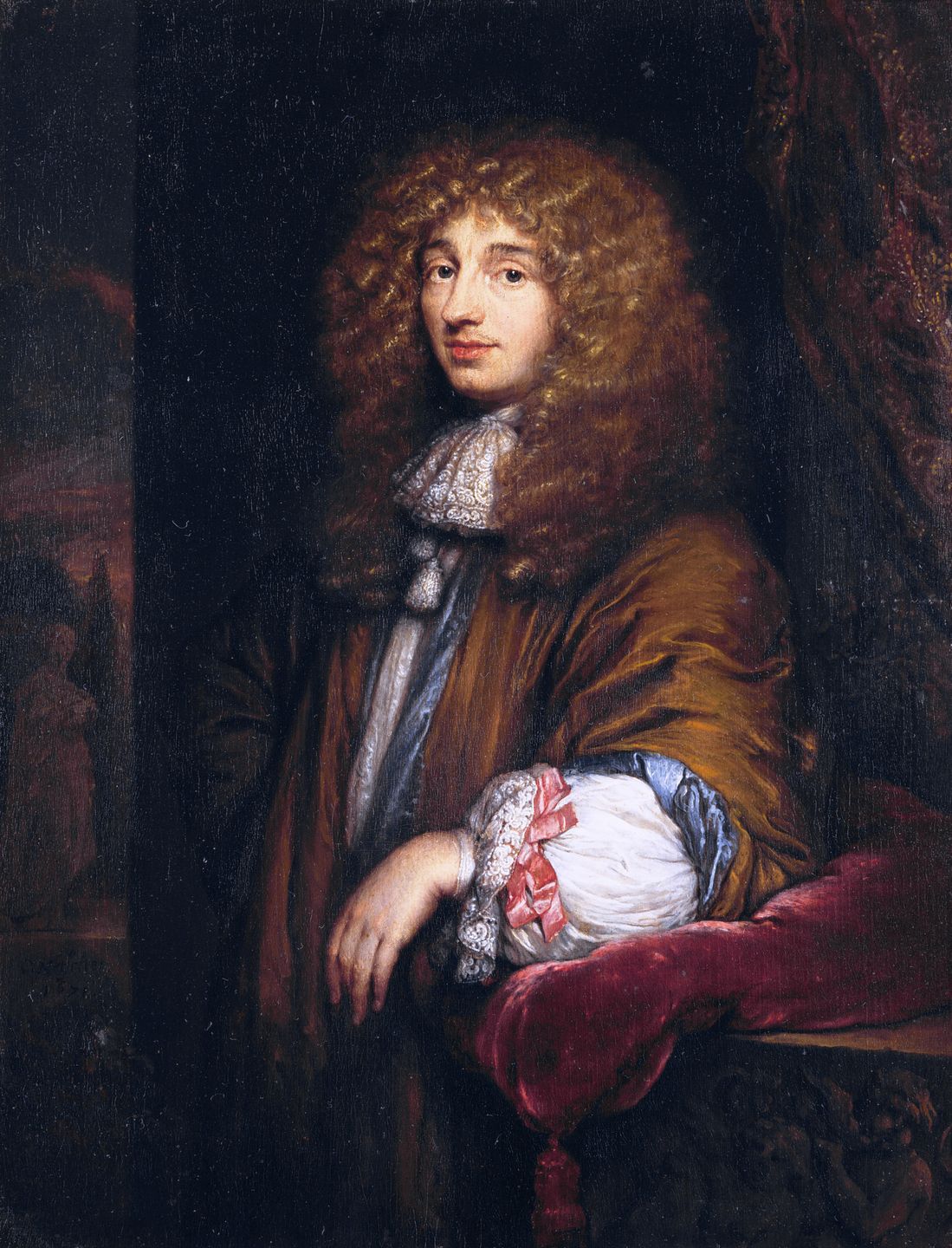
Christiaan Huygens, Dutch physicist, astronomer, and inventor of the pendulum clock. Caspar Netscher, Public domain, via Wikimedia Commons
Huygens died in 1695, leaving behind contributions to physics, astronomy, mathematics, and horology. His wave theory of light influenced later physicists. His telescopes set new standards for optical design. His pendulum clocks remained the most accurate timekeepers for over two centuries. And Titan, the moon he discovered, became one of the most studied objects in the solar system. In 2005, the European Space Agency's Huygens probe landed on Titan's surface, the first landing in the outer solar system. It transmitted data for 90 minutes before its battery died, revealing lakes of liquid methane, organic chemistry, and an atmosphere thicker than Earth's.
What makes Huygens exemplary is not just the breadth of his work, but his insistence on building the tools needed to do it. He did not wait for better telescopes. He made them. He did not assume light was what others said it was. He developed his own theory. He did not accept that clocks could not be precise. He designed one that was. The pattern is consistent: identify the limitation, design a solution, build it. This is the engineering mindset applied to natural philosophy. Discovery requires observation, but observation requires instruments, and instruments require design.
studio / on-this-day / Mar 25