studio / on-this-day / Mar 27
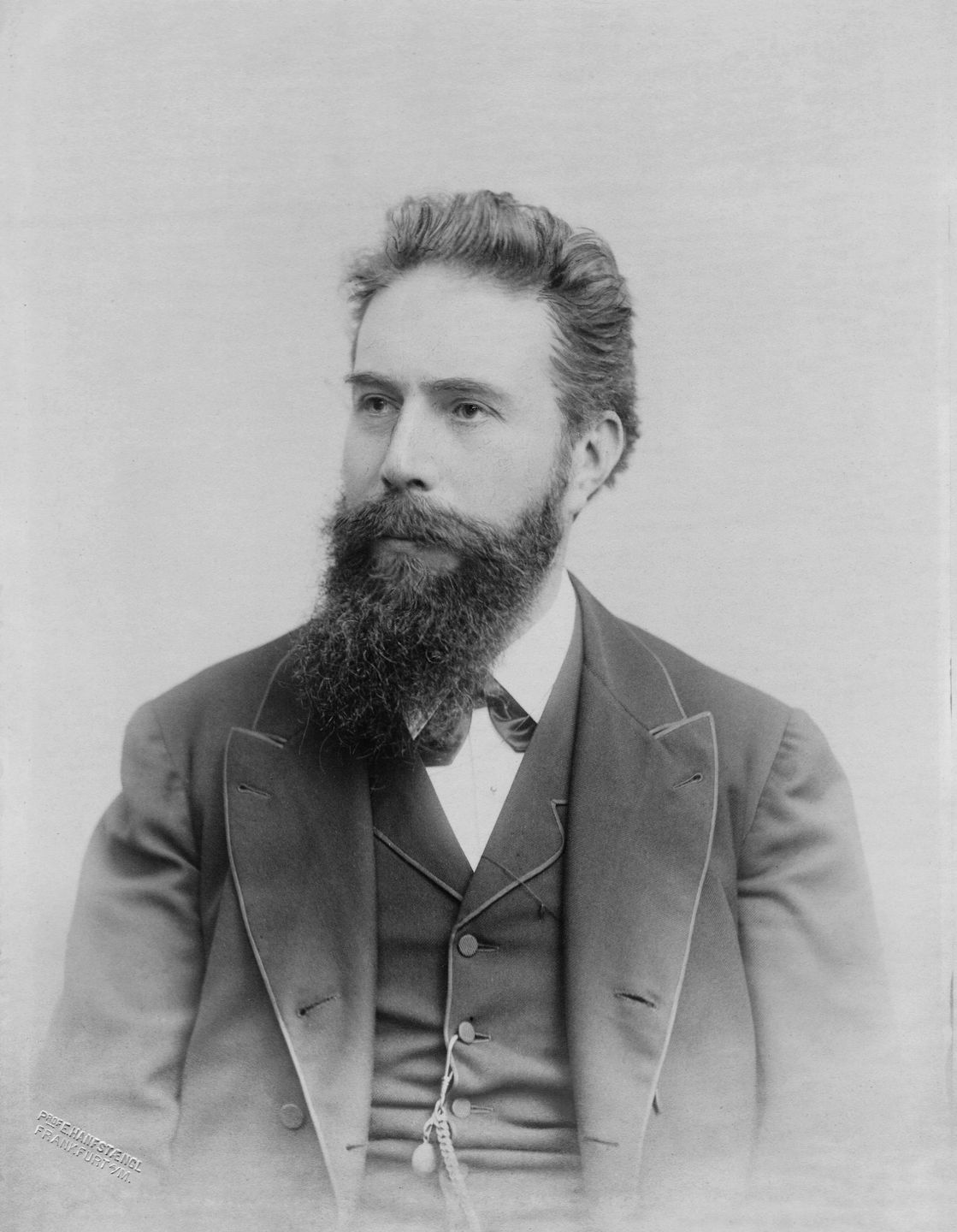
Wilhelm röntgen, physicist and discoverer of x-Rays, c. 1888-1900. Erwin Hanfstaengl, Public domain, via Wikimedia Commons
Seeing Through
On this day in 1845 — Wilhelm Röntgen was born, and would discover X-rays and let people, for the first time, see straight through solid flesh.
3 min read
Wilhelm Conrad Röntgen was born on March 27, 1845, in Lennep, Prussia. He studied mechanical engineering at the Swiss Federal Institute of Technology in Zurich and eventually became a professor of physics at the University of Würzburg. His work was methodical, not visionary. He investigated cathode rays, electromagnetic fields, and the specific heat of gases. None of it suggested he would stumble upon one of the most transformative discoveries in medical history. But on November 8, 1895, while experimenting with cathode ray tubes in a darkened laboratory, he noticed something impossible: a fluorescent screen across the room was glowing, even though it was shielded from the cathode rays. Something invisible was passing through solid objects.
Röntgen spent the next seven weeks investigating the phenomenon in secret. He placed various materials between the cathode tube and the fluorescent screen: wood, metal, thick books. The glow persisted. He placed his hand in front of the screen and saw the shadow of his bones. The flesh was nearly transparent, but the bones and a ring on his finger were clearly visible. He had discovered a form of electromagnetic radiation that could penetrate matter. He called it "X-radiation" because its nature was unknown. The name stuck.
On December 28, 1895, Röntgen published his findings in a paper titled "On a New Kind of Rays." He included an image: the x-ray of his wife's hand, showing her bones and wedding ring. The image was unsettling. It was the first time anyone had seen the inside of a living human body without surgery. The reaction was immediate and global. Within weeks, physicists and physicians around the world were replicating Röntgen's experiments. Within months, x-rays were being used to locate bullets, diagnose fractures, and examine internal organs. Medicine would never be the same.
The discovery was accidental, but the investigation was rigorous. Röntgen did not rush to publish. He verified his results, eliminated alternative explanations, and documented the properties of x-rays systematically. They traveled in straight lines. They were not deflected by magnetic fields. They ionized air. They exposed photographic plates. He described what they did before he understood what they were. This is experimental discipline: observe the effect, then search for the cause.
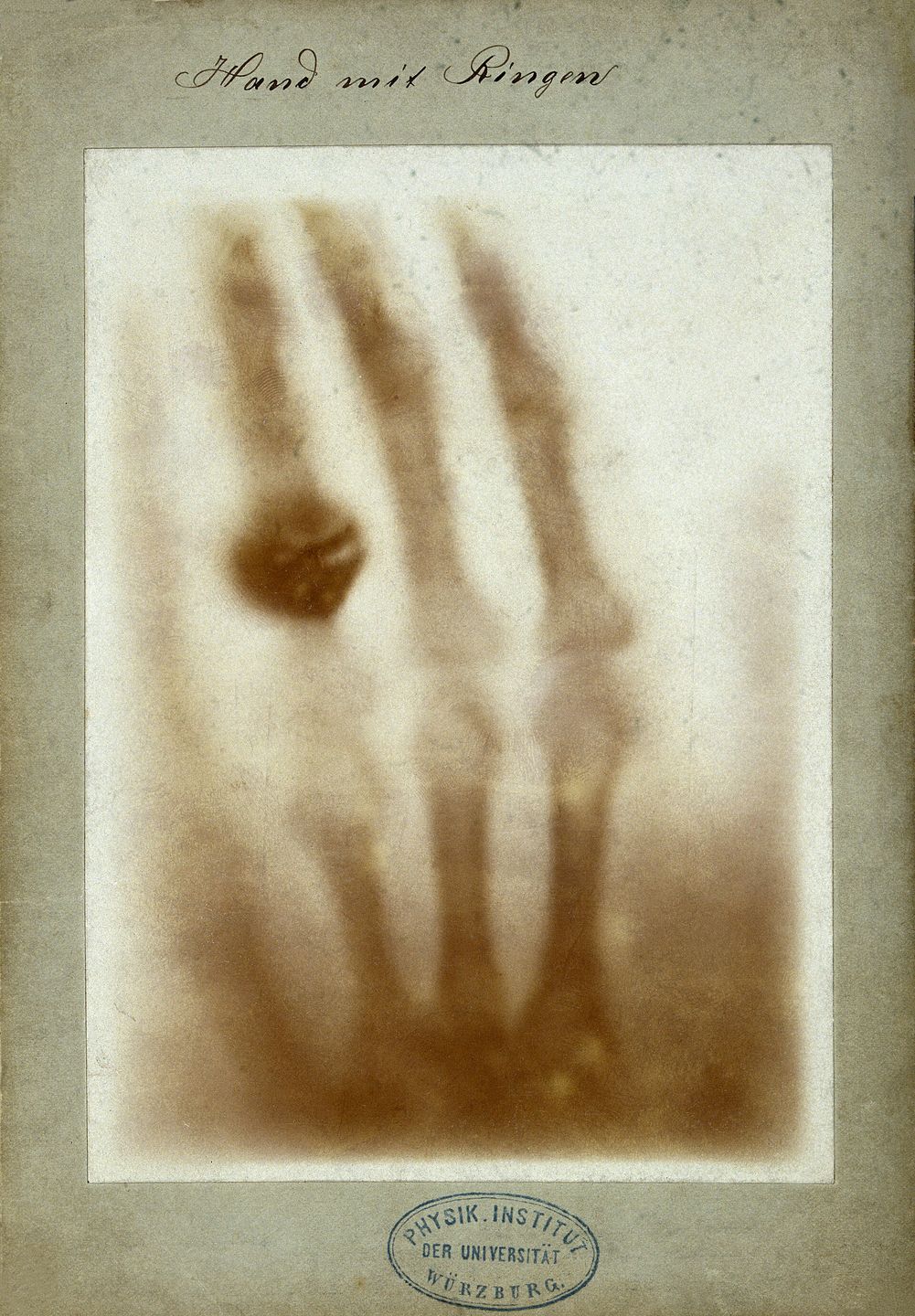
The first medical x-ray — röntgen's image of his wife anna bertha's hand and wedding ring, December 22, 1895. Wilhelm Röntgen, Public domain, via Wikimedia Commons
X-rays turned the body into a legible structure. Before Röntgen, diagnosis relied on external symptoms, palpation, and educated guessing. Doctors could infer what was happening inside, but they could not see it. X-rays made the interior visible, turning bones, organs, and foreign objects into shadows on a screen. Surgery became more precise. Tuberculosis could be detected early. Dentistry could diagnose cavities without drilling. The technology was crude by modern standards, but the principle was sound: if you can see inside without cutting, you can diagnose without invasive procedures.
Röntgen refused to patent his discovery. He believed x-rays should belong to humanity, not to any individual or corporation. This decision cost him a fortune but ensured rapid dissemination of the technology. Within a year, x-ray machines were being manufactured and sold. Within a decade, nearly every hospital had one. Röntgen received the first Nobel Prize in Physics in 1901, but he donated the prize money to his university. He was not interested in fame or wealth. He wanted to return to his research.
The broader impact of x-rays extends beyond medicine. They revealed that the visible spectrum is a narrow slice of a much larger electromagnetic spectrum. Radio waves, microwaves, infrared, ultraviolet, x-rays, and gamma rays all exist, differing only in wavelength and energy. This realization reshaped physics and led to technologies ranging from radio communication to cancer therapy. Röntgen's accidental discovery opened a window into the invisible, proving that reality is far richer than what our senses can detect.

Color x-ray photogram — the imaging Technology röntgen discovered in 1895 and refused to patent. NickSpiker, CC BY-SA 4.0, via Wikimedia Commons
X-rays are still foundational in medicine, materials science, and security. CT scans, airport scanners, and crystallography all rely on the same principle Röntgen discovered in 1895: high-energy radiation passes through matter, and the pattern of absorption reveals structure. The technology has improved, but the core insight remains. You can see through solid objects if you use the right wavelength of light. Röntgen proved it by accident. The world built an industry around it.
studio / on-this-day / Mar 27