studio / on-this-day / Feb 7
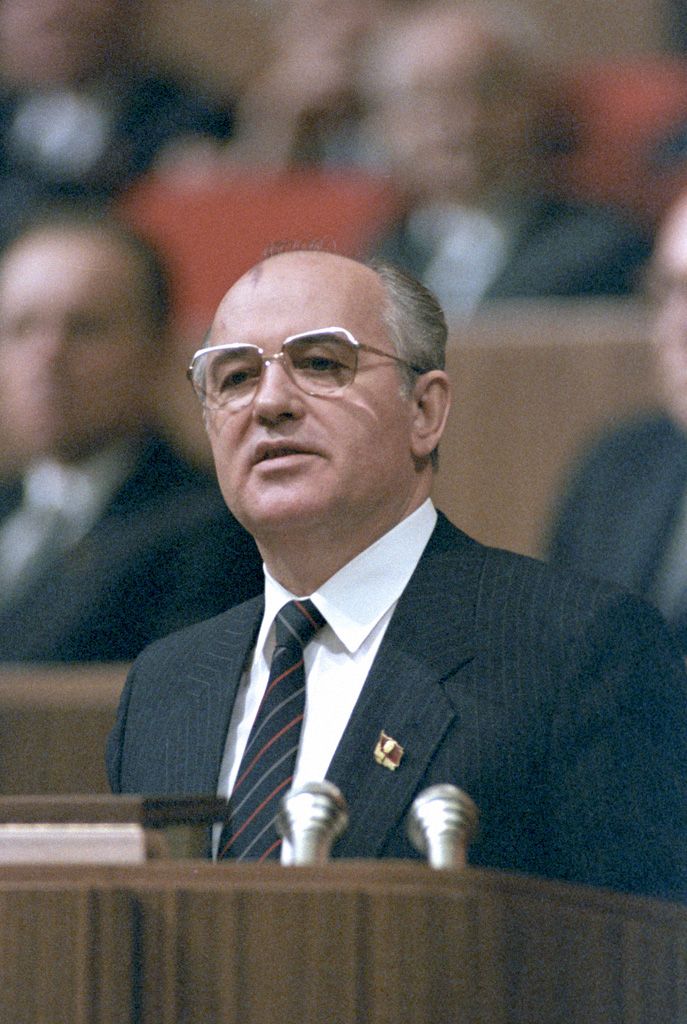
Mikhail Gorbachev delivering a speech as General Secretary of the CPSU Central Committee, whose authority he would later reform. Yuryi Abramochkin / Юрий Абрамочкин, CC BY-SA 3.0, via Wikimedia Commons
When the System Let Go
On this day in 1990 — the Soviet Communist Party agreed to surrender its monopoly on power, proof that even entrenched systems can be rewritten.
3 min read
The Central Committee of the Communist Party of the Soviet Union voted on February 7, 1990, to end its constitutionally guaranteed monopoly on political power. Article 6 of the Soviet Constitution, which enshrined the Party's leading role, would be amended. Multiple parties could now legally exist. Elections could be contested. The vote was not unanimous, but it passed. A system that had controlled every aspect of Soviet life for seventy years agreed to dismantle the mechanism that kept it in control.
Mikhail Gorbachev had been pushing for this change since becoming General Secretary in 1985. His policies of glasnost and perestroika were attempts to reform the Soviet system from within, to make it more transparent and efficient without abandoning socialism entirely. But reform created instability. Once people were allowed to criticize the government, they criticized everything. Once markets were partially opened, shortages became more visible. Once information flowed more freely, the scale of past failures became undeniable.
The decision on February 7 was not driven by ideology or philosophy. It was driven by collapse. The economy was in freefall. Nationalist movements in the Baltic states, Ukraine, and the Caucasus were demanding independence. The Communist Party had lost legitimacy. The choice was not between reform and the status quo. It was between controlled change and violent disintegration.
Ending the one-party system did not save the Soviet Union. It accelerated its end. Within 18 months, a failed coup attempt in August 1991 by hardliners trying to reverse the reforms revealed how hollow the Party's authority had become. By December 1991, the Soviet Union ceased to exist. Fifteen independent republics emerged. The hammer and sickle flag came down from the Kremlin. Russia, suddenly smaller and poorer, became one country among many.
What makes February 7, 1990, significant is not that it solved anything. It didn't. It's significant because it demonstrates that even the most rigid systems have off switches, and sometimes those switches get flipped by the people running the system. The Communist Party could have refused. It could have cracked down, purged reformers, and reasserted control. Instead, it voted to let go. Not out of altruism, but out of pragmatism. The system was failing, and holding on would have made the failure worse.
This is rare in human history. Power structures do not usually surrender power voluntarily. Monarchies end in revolutions, not abdications. Dictatorships end in coups or invasions, not elections. The Soviet decision to open the political system was an admission that the architecture of control, built painstakingly over decades, could not adapt fast enough to survive. The central planning that directed factories and farms could not handle the complexity of a modern economy. The censorship that controlled information could not compete with photocopiers and fax machines. The ideology that promised inevitability had run out of believers.
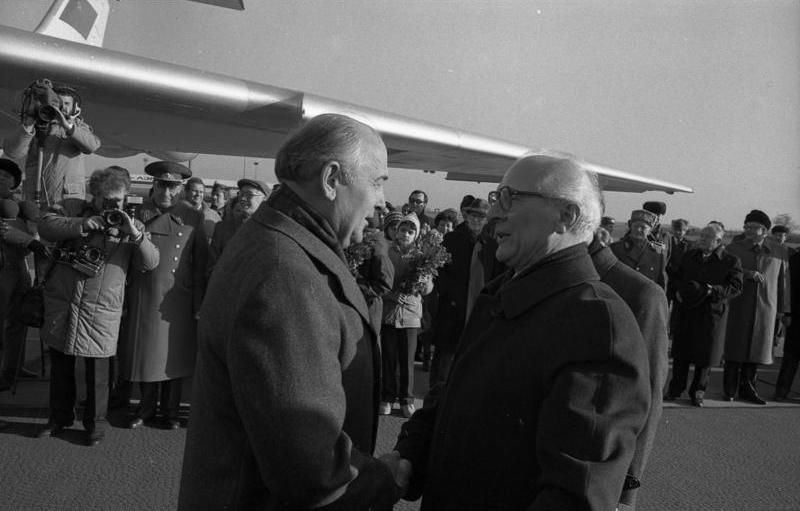
Mikhail Gorbachev and east German leader Erich Honecker during Gorbachev's visit to Berlin in December 1987, two years before the Berlin wall fell. Koard, Peter, CC BY-SA 3.0 de, via Wikimedia Commons
The comparison to modern systems is uncomfortable but unavoidable. Technology platforms, corporate structures, and political institutions all develop their own forms of lock-in. They build dependencies, eliminate alternatives, and become too complex to replace. But complexity also makes them fragile. A system optimized for control is brittle when the environment changes faster than the system can adapt. The Soviet Union lasted 74 years. Some tech companies have lasted less than a decade before becoming obsolete.
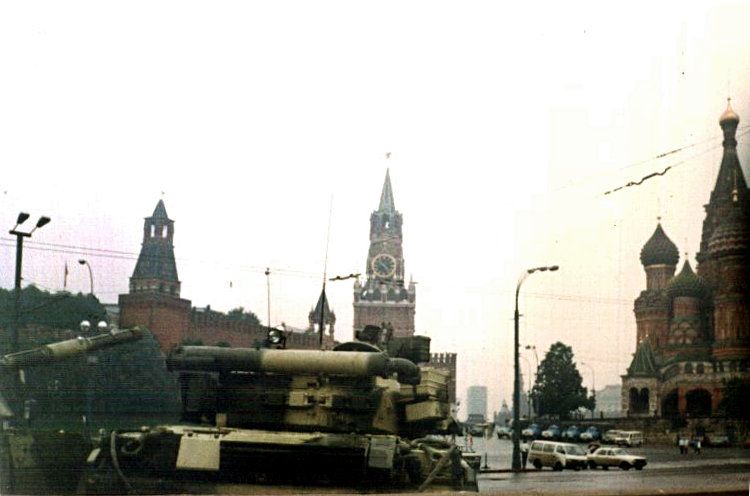
Tanks in Red Square during the failed August 1991 coup, the hardliners' last attempt to reverse the reforms before the Soviet Union dissolved. Almog, Public domain, via Wikimedia Commons
February 7, 1990, was the moment the system admitted it could not fix itself from within while maintaining its foundational structure. The reforms that were supposed to save socialism ended up dismantling it. That's the risk of redesign: once you start changing core assumptions, everything built on those assumptions becomes unstable. Sometimes the only way forward is to build something new from the pieces that remain.
studio / on-this-day / Feb 7