studio / on-this-day / Feb 6
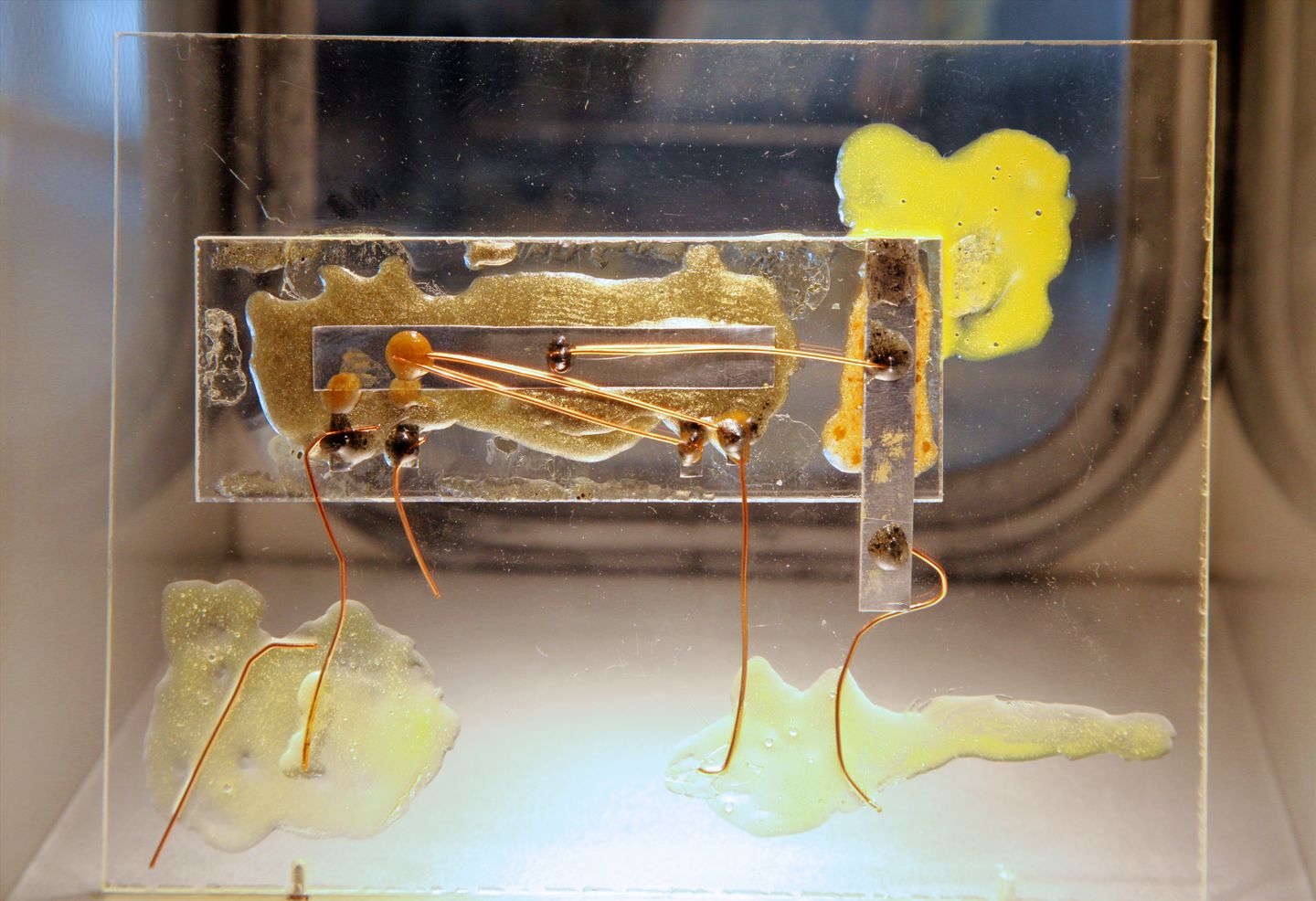
A replica of Kilby's first integrated circuit, on display at the heinz nixdorf museum. The original had just six components on a single sliver of germanium. Florian Schäffer, CC BY-SA 4.0, via Wikimedia Commons
The Seed of Everything
On this day in 1959 — Jack Kilby filed the patent for the integrated circuit, the small idea that every chip in every device grew out of.
3 min read
Jack Kilby had been at Texas Instruments for less than a year when he solved a problem that had been limiting the growth of electronics for a decade. It was the summer of 1958, and most of the company was on mandatory vacation. Kilby, being new, had no vacation time. He spent two weeks alone in the lab, sketching and thinking. By the time his colleagues returned, he had a working prototype of something no one had built before: an entire electronic circuit fabricated on a single piece of semiconductor material.
Before the integrated circuit, electronic devices were assembled by hand. Each transistor, resistor, and capacitor was a discrete component, soldered onto circuit boards by workers using tweezers and magnifying glasses. The process was slow, expensive, and error-prone. More importantly, it imposed a physical limit on complexity. You could only fit so many components in a given space, and each connection was a potential failure point. The industry called it the tyranny of numbers.
Kilby's insight was elegantly simple: instead of making each component separately and wiring them together, fabricate all of them from the same piece of germanium. A transistor is just doped silicon. So is a resistor. So is a capacitor, if you design it right. Build them all at once using photolithography, and you eliminate the wiring problem entirely. The connections are etched into the material itself.
On February 6, 1959, Kilby filed U.S. Patent 3,138,743 for a "Miniaturized Electronic Circuits." The first integrated circuit had just six components. It was crude, fragile, and required careful handling. But it worked. Six months later, Robert Noyce at Fairchild Semiconductor filed a patent for a similar device using silicon instead of germanium and a more practical fabrication method. The two patents overlapped. Both men are credited as co-inventors, though the legal battles over who invented what lasted for years.
The immediate applications were military. The Apollo Guidance Computer, which navigated astronauts to the Moon, used integrated circuits designed by Fairchild. The Minuteman missile used chips from Texas Instruments. Early ICs cost over $1,000 each, which only made sense for projects where size, weight, and reliability mattered more than cost. But manufacturing improved rapidly. By 1965, Gordon Moore observed that the number of transistors on a chip was doubling roughly every two years, a trend that held for decades and became known as Moore's Law.
Today, a modern processor contains billions of transistors, each one smaller than a virus. The smartphone in your pocket has more computing power than the entire Apollo program. None of that would exist without the integration principle Kilby demonstrated in 1958. Every chip, from the simplest sensor to the most complex GPU, descends from that first prototype built during a quiet two weeks when everyone else was on vacation.

Jack Kilby with colleagues at Texas Instruments, where he developed the first working integrated circuit in the summer of 1958. CC BY-SA 3.0, via Wikimedia Commons
Kilby won the Nobel Prize in Physics in 2000 for his work. Noyce had died in 1990, and the Nobel is not awarded posthumously. Both men understood that they had unlocked something fundamental. The integrated circuit didn't just make electronics smaller. It made them scalable. It turned manufacturing into a process that could be automated, refined, and iterated. It created an industry where improvement compounded year after year, each generation of chips enabling the next.

Jack Kilby, inventor of the integrated circuit, photographed at Texas Instruments in the 1960s. James R. Biard, CC BY-SA 4.0, via Wikimedia Commons
The patent filed on February 6, 1959, wasn't just a legal document. It was a blueprint for how the next seventy years of technology would unfold. Everything digital, everything networked, everything that runs on electricity and makes decisions, exists because Kilby figured out how to put more than one component on a single piece of material. The seed was small, but the tree it grew into is everywhere.
studio / on-this-day / Feb 6