studio / on-this-day / Feb 13
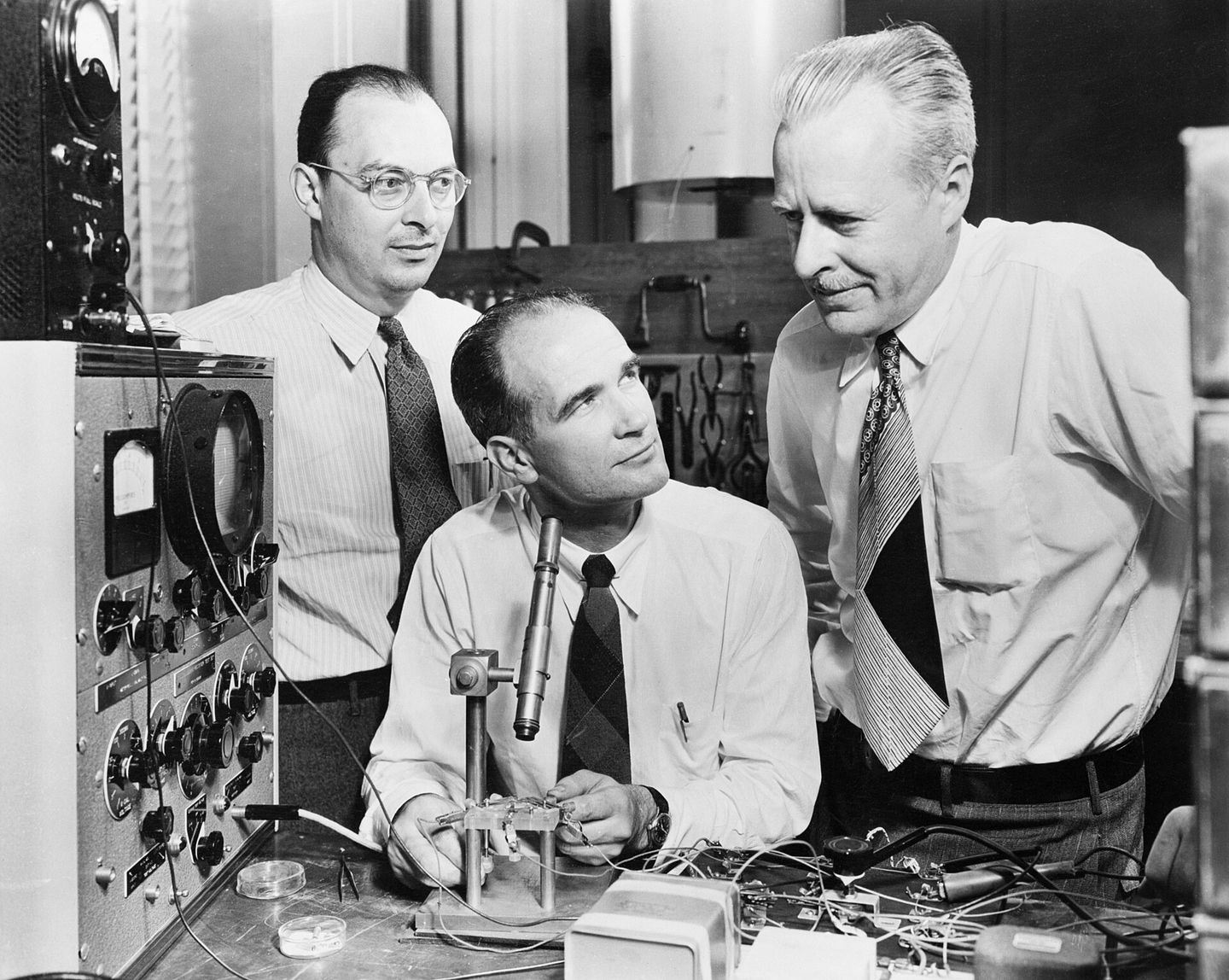
John Bardeen (left), William Shockley (center), and Walter Brattain (right) at Bell Labs in 1948, the three co-inventors of the transistor who shared the 1956 Nobel Prize in Physics. Public domain, via Wikimedia Commons
The Tiny Switch
On this day in 1910 — William Shockley was born, and would help invent the transistor, the tiny switch underneath all of modern computing.
3 min read
William Bradford Shockley was born on February 13, 1910, in London to American parents. The family moved to California when he was three. He studied physics at Caltech and MIT, earning his doctorate in 1936. He joined Bell Labs in New Jersey, where he worked on vacuum tubes and solid-state physics. During World War II, he did operations research for the Navy. After the war, he returned to Bell Labs with a single obsession: finding a solid-state replacement for the vacuum tube.
Vacuum tubes were the backbone of mid-century electronics. They amplified signals, switched currents on and off, and made radios, televisions, and early computers possible. But they were fragile, power-hungry, and generated enormous heat. The ENIAC computer, completed in 1945, used 17,000 vacuum tubes and consumed 150 kilowatts of power. Shockley believed semiconductors could do the same job faster, smaller, and more reliably.
On December 23, 1947, two researchers in Shockley's group, John Bardeen and Walter Brattain, demonstrated the first working transistor. It was a point-contact design, crude but functional. Shockley was furious. He had been excluded from the breakthrough, working on a different approach that hadn't panned out. He locked himself in a hotel room for weeks and emerged with the design for the junction transistor, a more practical and manufacturable device. Bell Labs filed patents for both. All three men shared the 1956 Nobel Prize in Physics.
The transistor was the most important invention of the 20th century. It replaced vacuum tubes in radios, then televisions, then computers. It enabled miniaturization. It made integrated circuits possible, which made microprocessors possible, which made personal computers, smartphones, and the internet possible. Every digital device you interact with contains millions or billions of transistors. The modern world runs on switches the size of viruses, turning on and off billions of times per second.
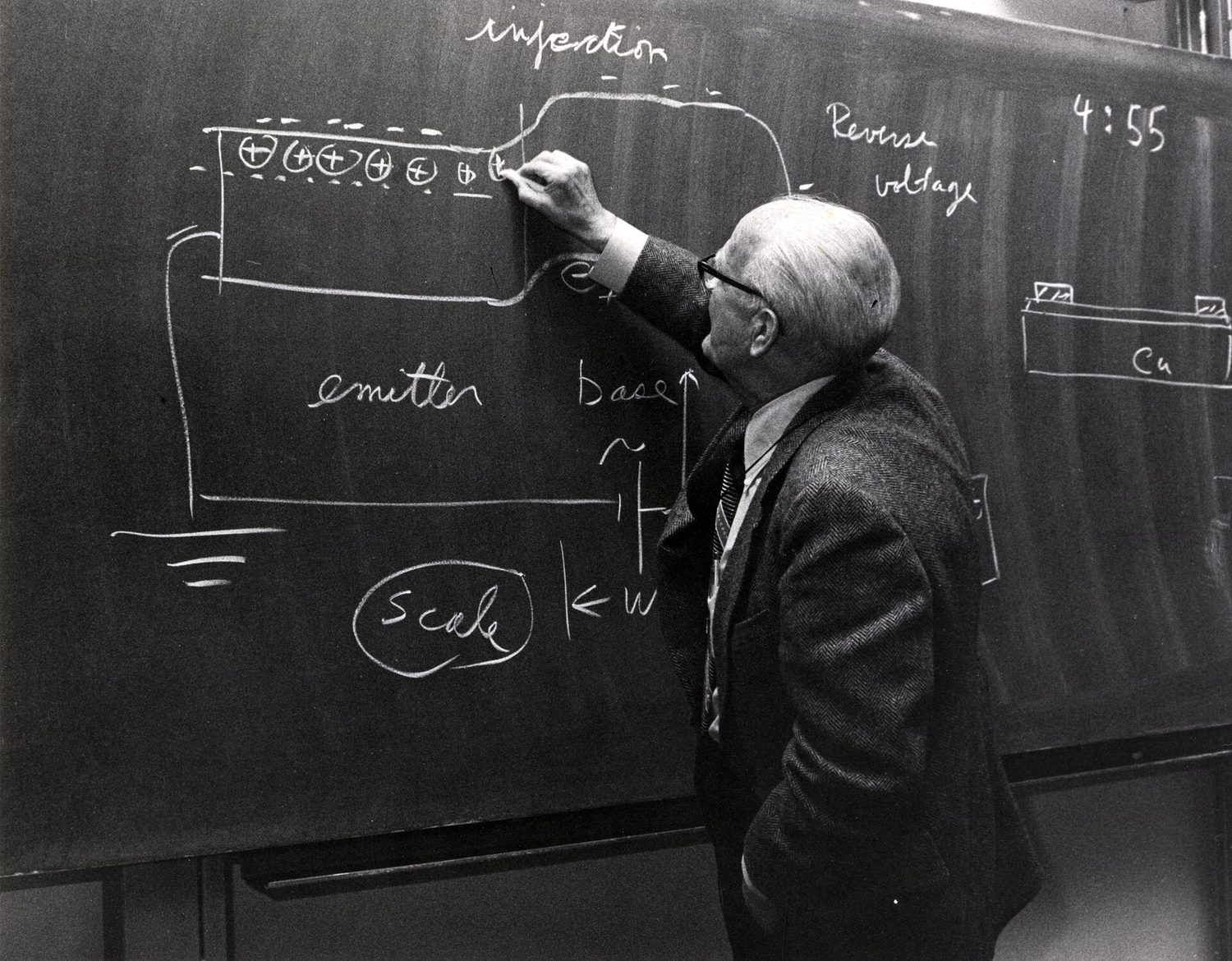
William Shockley, co-inventor of the transistor. William Shockley, CC BY 3.0, via Wikimedia Commons
Shockley left Bell Labs in 1955 to start his own company, Shockley Semiconductor Laboratory, in Mountain View, California, near where he grew up. He recruited brilliant young engineers and physicists. But he was a terrible manager: paranoid, abusive, and convinced of his own genius. In 1957, eight of his top employees quit to form Fairchild Semiconductor. That group became the foundation of Silicon Valley. Intel, AMD, and dozens of other companies trace their lineage back to the defectors from Shockley's lab.
Shockley's later life is inseparable from his advocacy of eugenics. He became convinced that intelligence was primarily genetic and that certain racial groups were intellectually inferior. He proposed voluntary sterilization programs and sperm banks for Nobel laureates. He gave interviews, wrote papers, and testified before government bodies. His views were widely condemned by scientists, but he never recanted. He died in 1989, estranged from his colleagues and widely remembered as much for his racism as for his contributions to physics.
The transistor survived its creator's failures. Every year, semiconductor manufacturers produce trillions of them. The principles Shockley, Bardeen, and Brattain discovered in the 1940s still govern how they work. A transistor is just a switch controlled by electricity instead of a mechanical lever. But that simple idea, repeated at unfathomable scale, is the engine of the information age. Processing, memory, communication: all of it depends on the ability to turn tiny currents on and off faster than thought.
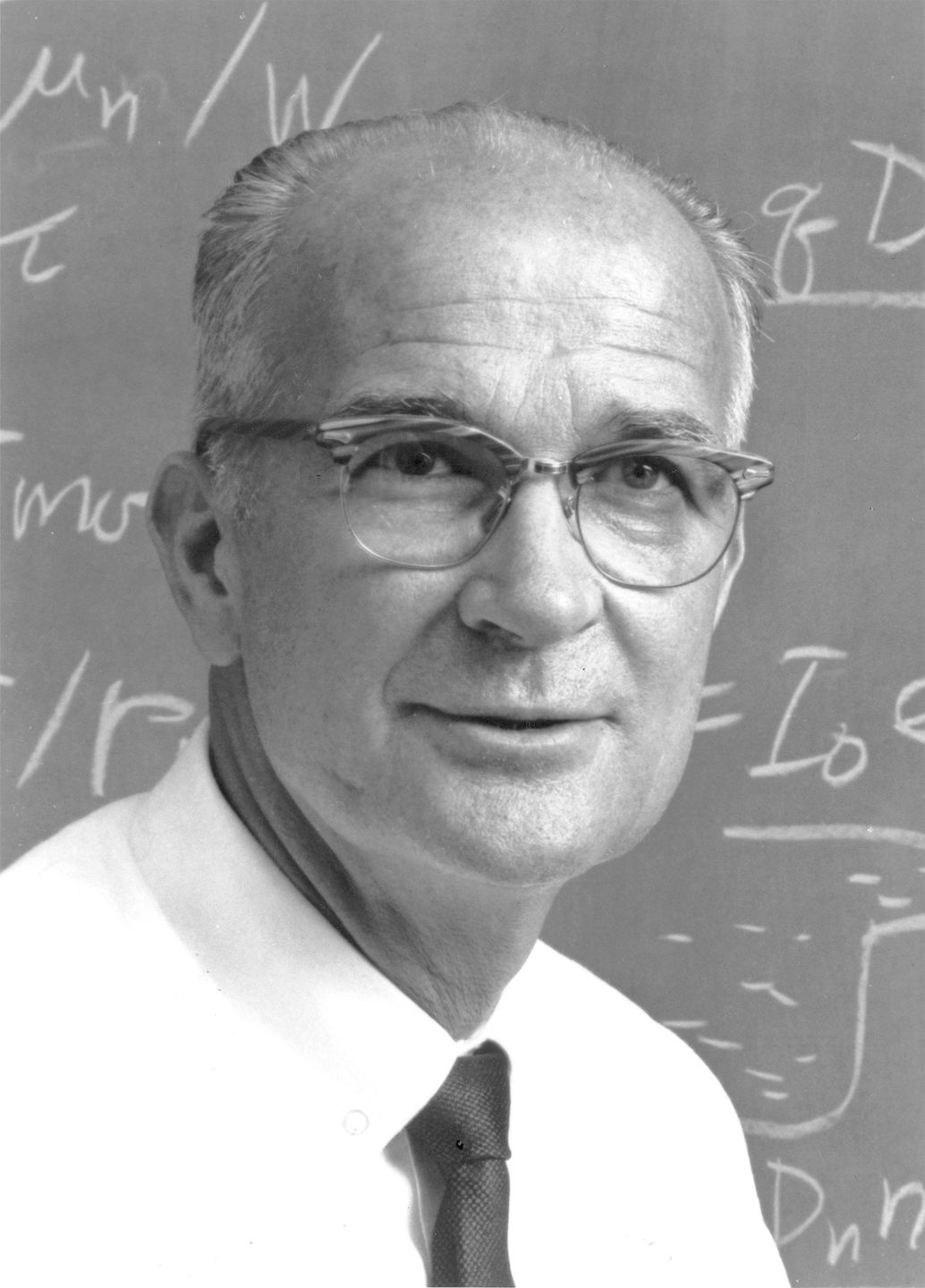
William Shockley at Stanford University, where he became a professor after his Semiconductor company's collapse, and where he later became notorious for his advocacy of eugenics. Chuck Painter / Stanford News Service, CC BY 3.0, via Wikimedia Commons
Shockley's legacy is dual. He helped invent the technology that powers modern civilization. He also demonstrated that brilliance in one domain does not confer wisdom in others. The transistor is a triumph of human ingenuity. Shockley's later beliefs were a testament to human fallibility. Both are true. Both matter. And the machine built on his work keeps running, indifferent to the intentions of its makers.
studio / on-this-day / Feb 13