studio / on-this-day / Dec 30
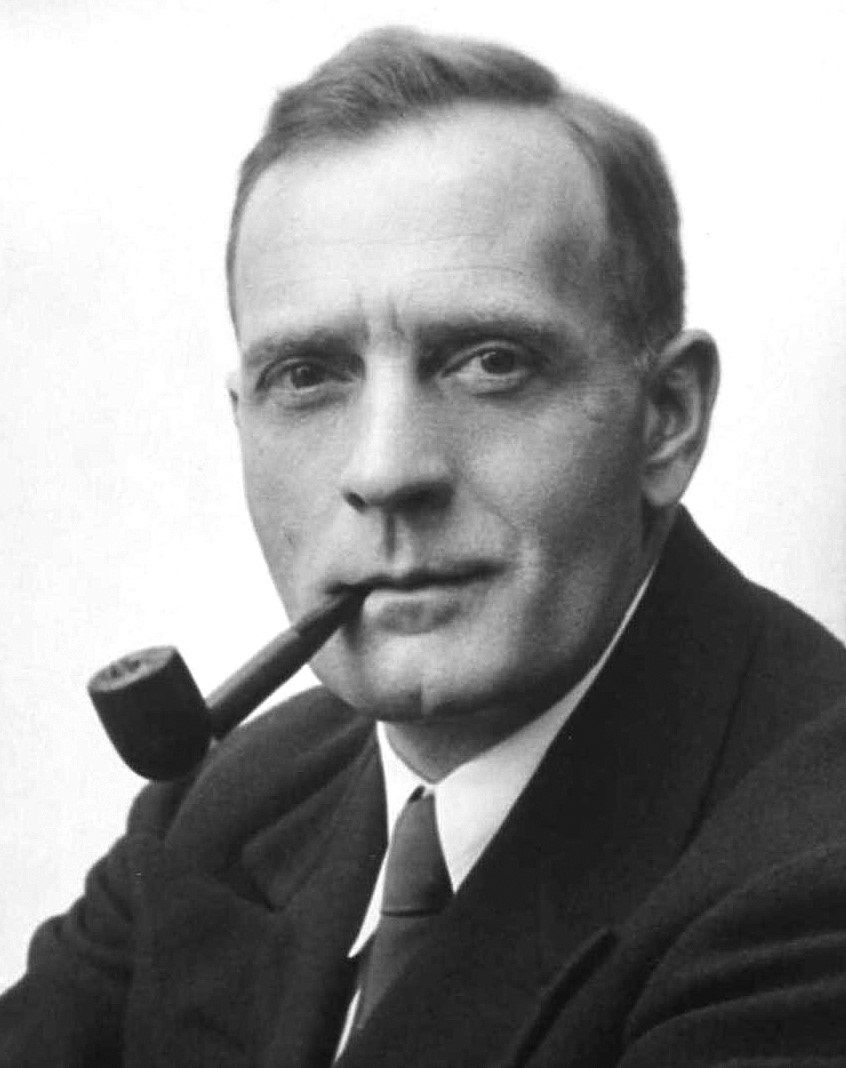
Edwin Hubble at the Mount Wilson Observatory. Johan Hagemeyer, Public domain, via Wikimedia Commons
The Universe Gets Bigger
On this day in 1924 — Edwin Hubble announced that the Milky Way is only one galaxy among countless others, and the universe abruptly grew.
3 min read
On December 30, 1924, Edwin Hubble stood before a meeting of the American Astronomical Society and presented a paper that redrew the map of the universe. He had been observing a faint patch of light in the constellation Andromeda using the 100-inch Hooker Telescope at Mount Wilson Observatory, the most powerful telescope in the world at the time. Inside that fuzzy spiral, Hubble identified a type of star called a Cepheid variable. These stars pulse at predictable intervals, and their brightness reveals their distance. The Andromeda Nebula was not a nebula. It was a galaxy, far outside the Milky Way. The universe was not one galaxy. It was millions, maybe billions.
Before Hubble, most astronomers believed the Milky Way was the entire universe. The spiral nebulae scattered across the sky were thought to be clouds of gas within our own galaxy. There was a famous debate in 1920 between Harlow Shapley and Heber Curtis about the scale of the cosmos. Shapley argued the Milky Way was enormous and contained all the nebulae. Curtis argued the nebulae were separate galaxies, far beyond the Milky Way. Both were partly right. Shapley correctly measured the size of the Milky Way. Curtis correctly identified the nebulae as distant galaxies. Hubble settled the debate with data.
Hubble measured the brightness of Cepheid variables in Andromeda and used a relationship discovered by Henrietta Leavitt to calculate their distance. Leavitt had found that the period of a Cepheid's pulsation is directly related to its intrinsic brightness. If you know how bright it really is, and you measure how bright it appears, you can calculate how far away it is. Hubble's measurements showed that Andromeda was nearly a million light-years away, far beyond the edge of the Milky Way. It was a galaxy in its own right, comparable in size to our own.
The implications were staggering. If Andromeda was a separate galaxy, then so were countless other nebulae. The universe was not a single island of stars surrounded by darkness. It was an ocean of galaxies, each containing billions of stars, stretching in every direction. Humanity's place in the cosmos shrank again. First, Earth was not the center of the solar system. Then, the sun was not the center of the galaxy. Now, the galaxy was not the center of anything. It was one galaxy among multitudes.
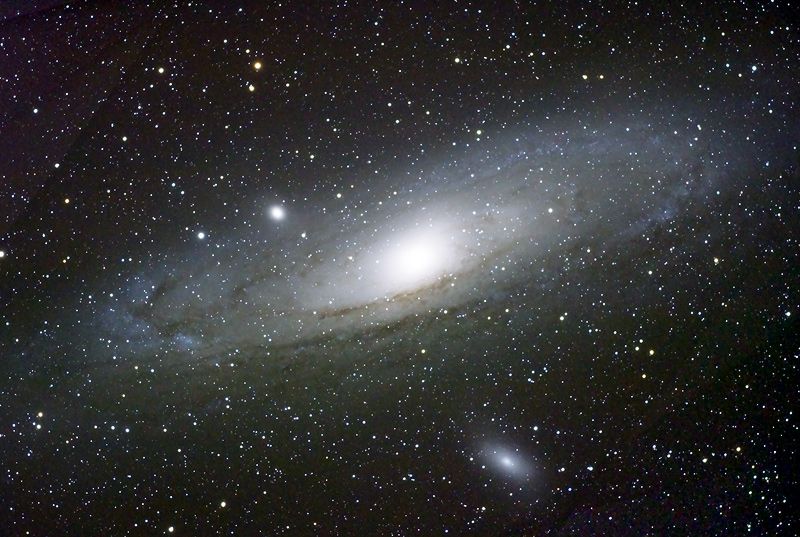
The Andromeda Galaxy, approximately 2.5 million light-years away. CC BY 3.0, via Wikimedia Commons
Hubble did not stop there. In 1929, he published another landmark paper showing that galaxies are moving away from us, and the farther away they are, the faster they are receding. This was evidence that the universe is expanding. Space itself is stretching, carrying galaxies apart. This observation became the foundation for the Big Bang theory, the idea that the universe began as a single point and has been expanding ever since. Hubble had not only discovered the scale of the universe. He had discovered its history.
The Hubble Space Telescope, launched in 1990, was named in his honor. It has extended his work, imaging galaxies billions of light-years away, showing the universe as it was when it was young. The telescope revealed that there are more galaxies than there are stars in the Milky Way. The universe contains at least 100 billion galaxies, maybe more. Each one is a system of hundreds of billions of stars. The numbers are incomprehensible. Hubble made them real. As Carl Sagan would later remind us, understanding the scale of the cosmos changes how we see ourselves.
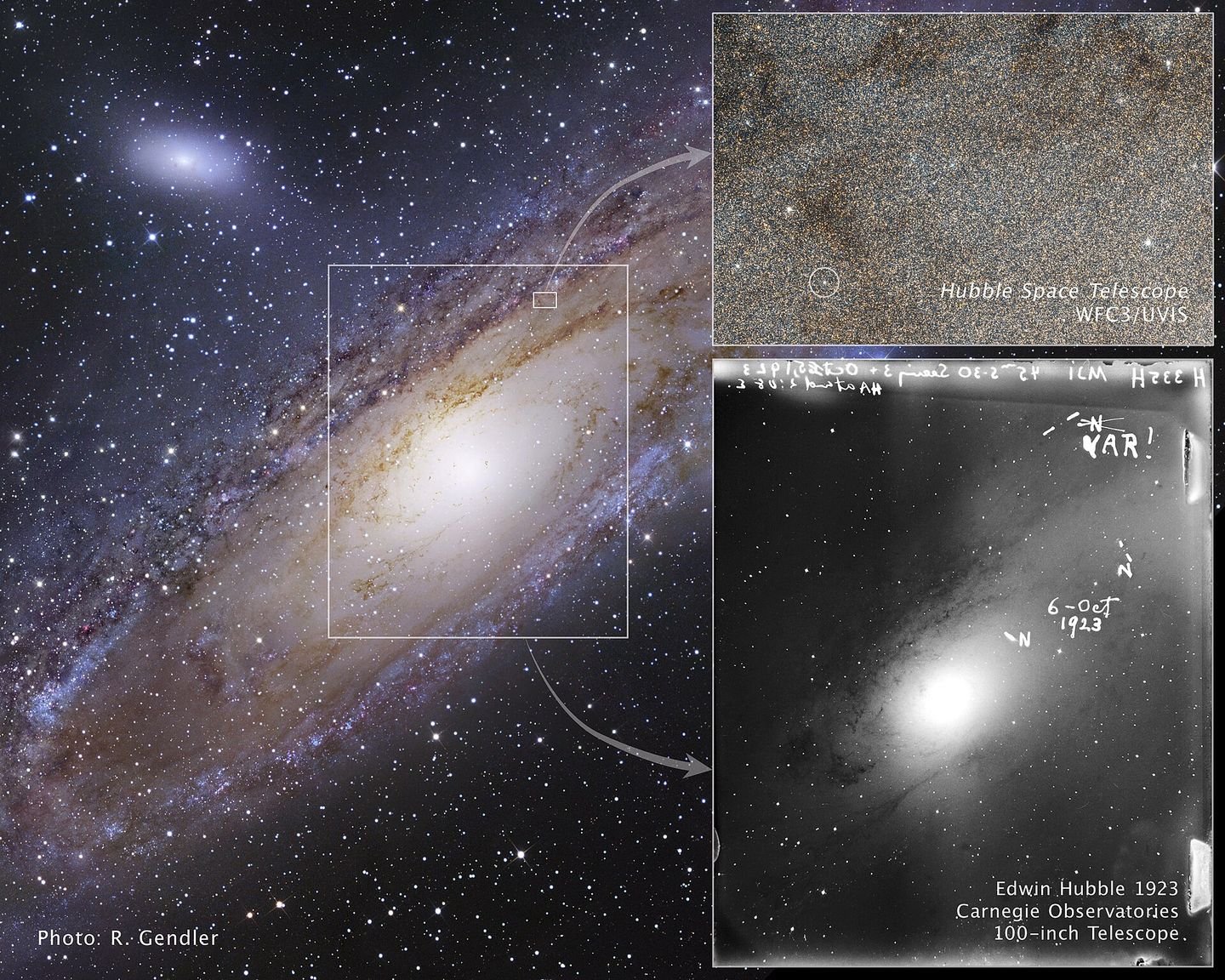
Hubble's 1923 photographic plate of Andromeda, with the Cepheid variable he marked "var!" That proved it was a separate Galaxy. CC BY 4.0, via Wikimedia Commons
Hubble died in 1953, before the space age, before anyone had left Earth's atmosphere. He spent his career looking outward, measuring distances that seemed impossible. He was meticulous, careful, and patient. He turned the universe from speculation into data. The announcement on December 30, 1924, was not dramatic. It was a paper delivered at a conference. But it changed everything. The universe was no longer small and finite. It was vast, expanding, and full of galaxies we had not yet seen. Hubble gave us the map. We are still exploring the territory.
studio / on-this-day / Dec 30