studio / on-this-day / Dec 22
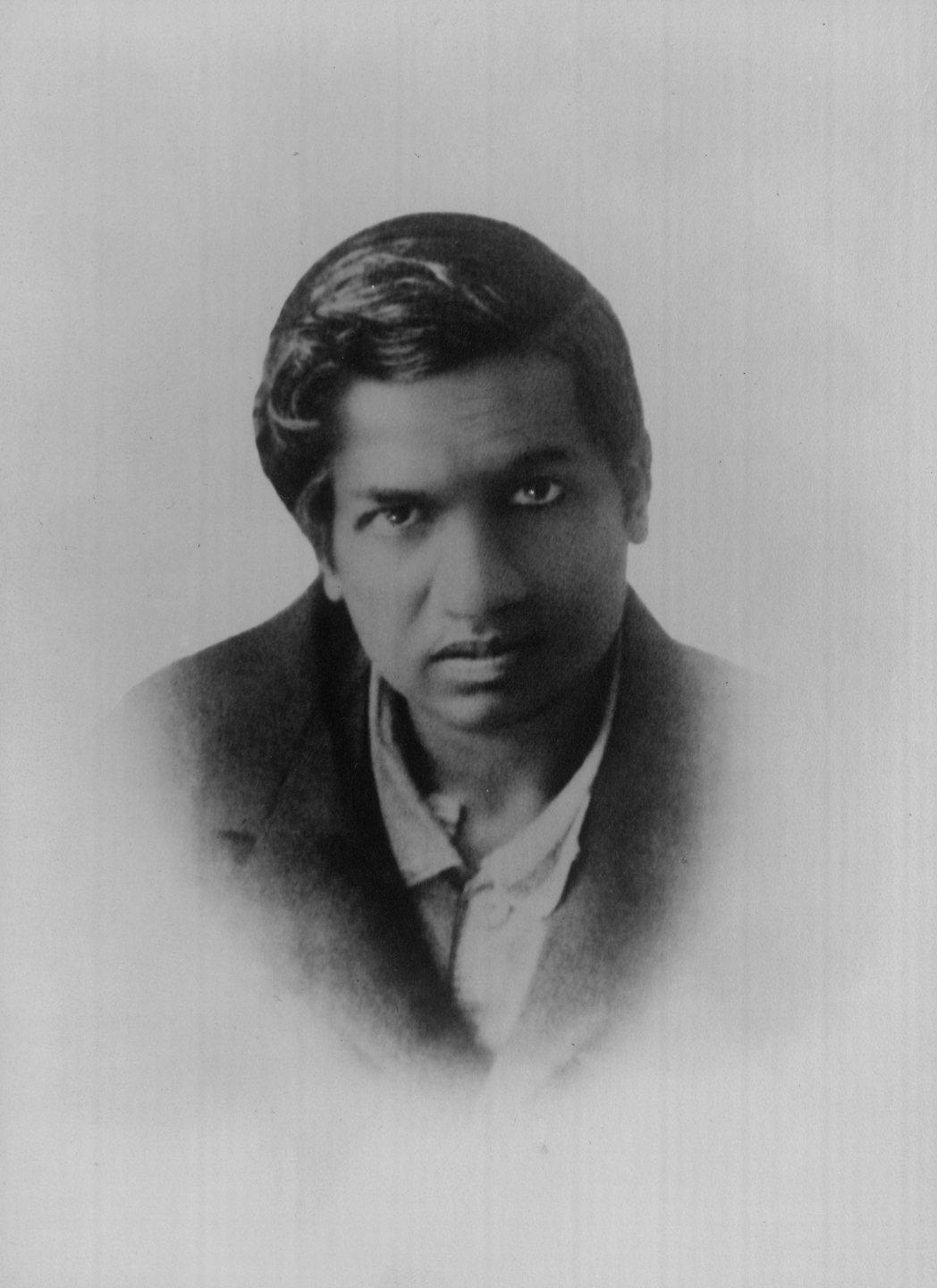
Srinivasa Ramanujan — the passport photograph, 1913. Public domain, via Wikimedia Commons
The Proofs Came Later
On this day in 1887 — Srinivasa Ramanujan was born in Tamil Nadu. Almost entirely self-taught, he generated thousands of mathematical results so original that the world is still, a century later, catching up to them.
3 min read
Srinivasa Ramanujan was born on December 22, 1887, in Tamil Nadu, in the south of India, into a poor Brahmin family. He was almost entirely self-taught, and the book that shaped him was a dry old compendium of thousands of mathematical results listed with barely any proofs. That format became his own: for the rest of his life he would simply write down astonishing formulas, seeing them whole, as if they had been handed to him. He failed out of college — he could not be bothered with any subject but mathematics — and took a job as a shipping clerk in Madras, filling notebook after notebook with original discoveries in his spare time.
In January 1913 he did something audacious: he wrote a letter to G. H. Hardy, one of the finest mathematicians at Cambridge, enclosing pages of strange, unproven formulas. Hardy’s first thought was that it must be a hoax. Then he looked harder and realized that no crank could possibly have invented these — they had to be real, Hardy decided, because no one would have had the imagination to make them up. He arranged to bring the unknown clerk to England.
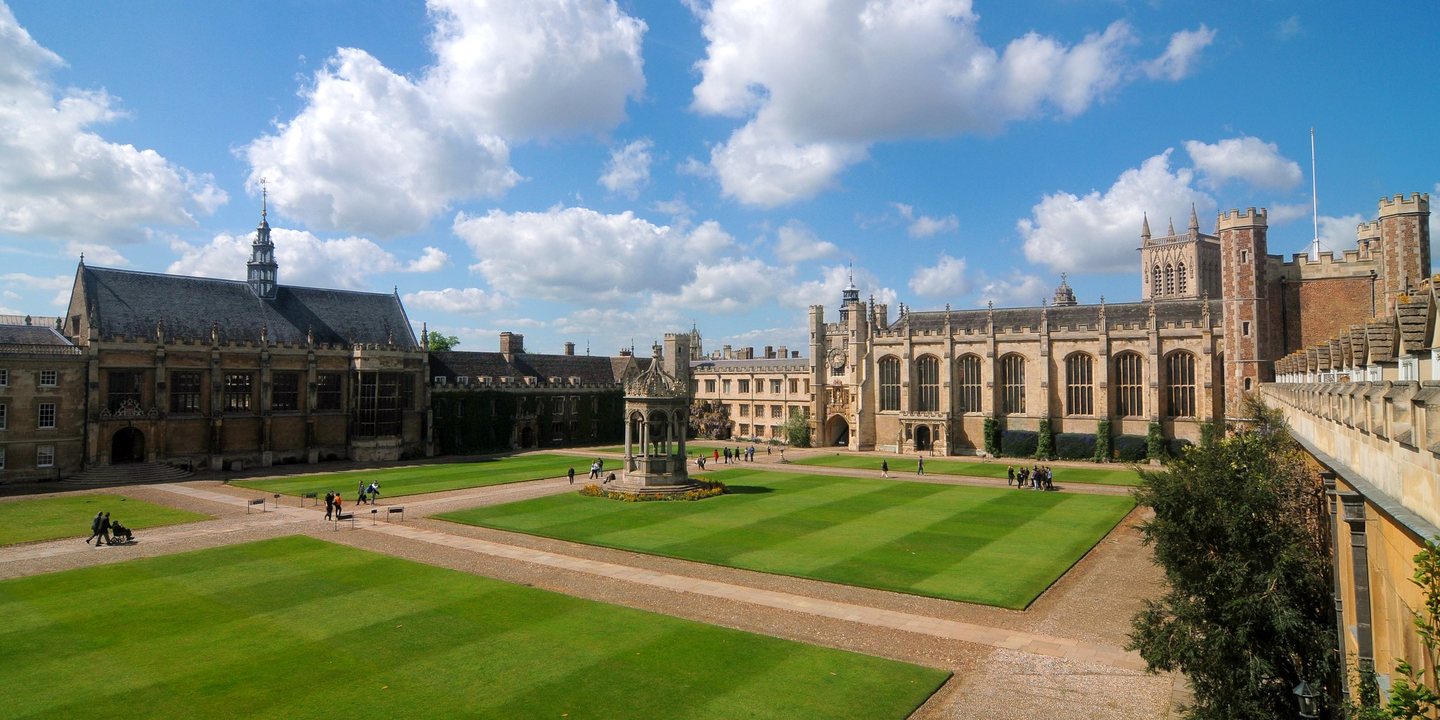
Trinity College, Cambridge, where Hardy brought Ramanujan to work. Cmglee, CC BY-SA 3.0, via Wikimedia Commons
At Cambridge, the two of them made an odd and brilliant pair — Hardy the rigorous formalist, Ramanujan the pure intuitive who cheerfully credited a family goddess with his insights. Together they produced landmark work on the partition of numbers, on infinite series, on continued fractions. Ramanujan’s mind generated results faster than anyone could prove them, and in 1918 he became one of the youngest ever elected a Fellow of the Royal Society.
A famous story catches him exactly. Hardy, visiting him in the hospital, mentioned that his taxi had borne the dull number 1729. Not dull at all, Ramanujan replied at once: it is the smallest number that can be written as the sum of two cubes in two different ways. Numbers were not tools to him. They were intimates, and he simply knew things about them that no one had noticed before.
England’s cold, its unfamiliar food — he was a strict vegetarian — and relentless overwork wrecked his health. He returned to India and died on April 26, 1920, only thirty-two years old. But his notebooks, including a "lost notebook" not rediscovered until 1976, held thousands of results, and mathematicians are still working through them — and still finding that his formulas connect to physics that did not exist in his lifetime, from black holes to string theory. Like Bernhard Riemann, he left a mind’s worth of problems for later centuries. His answers keep turning out to be true in ways he could not have known. He ran ahead of his century, and the proofs are still catching up.
studio / on-this-day / Dec 22